
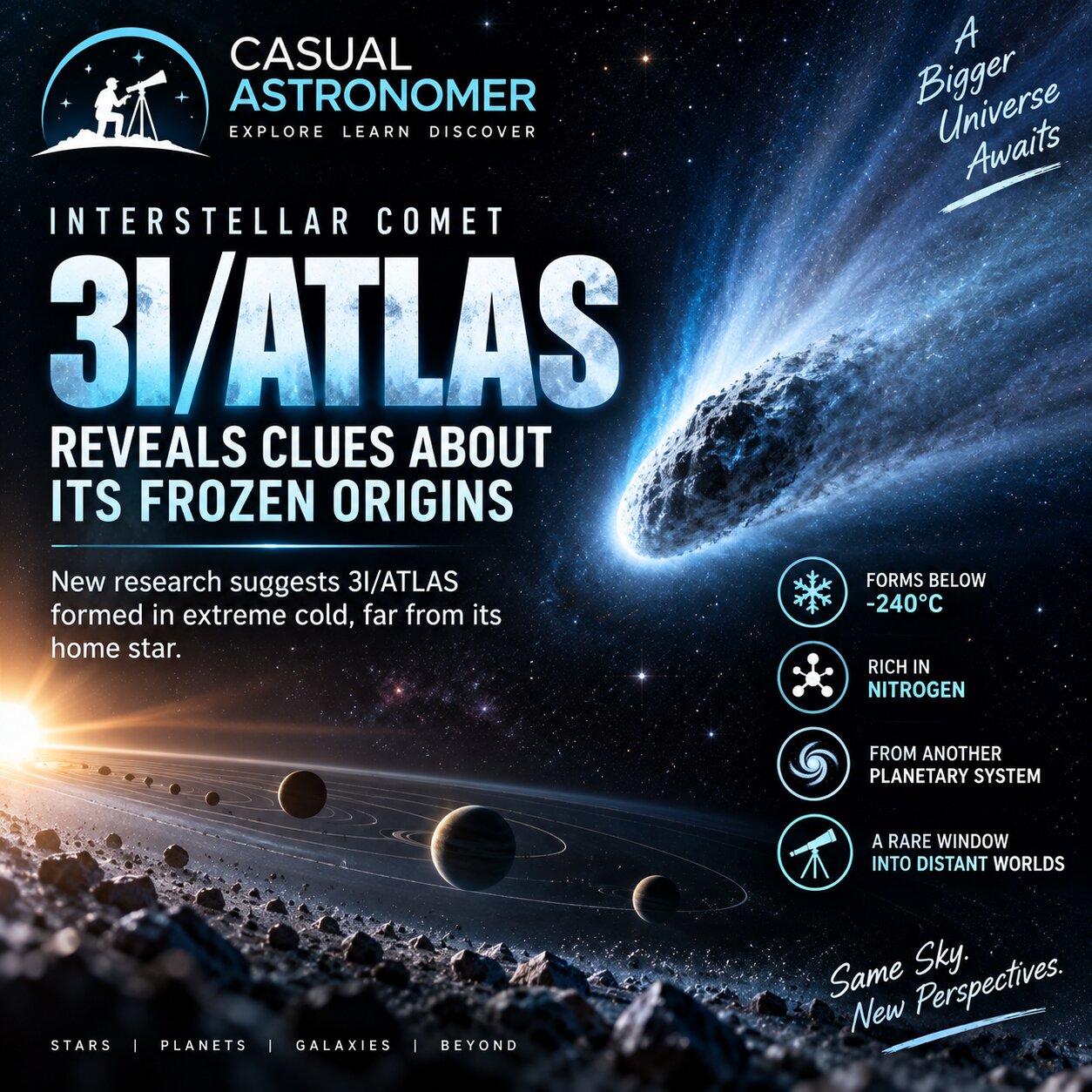

Interstellar comet 3I/ATLAS has already given astronomers an extraordinary opportunity to examine material formed beyond our Solar System. Now, new observations of gases released by the comet have provided researchers with important clues about where this mysterious visitor may have formed.
Scientists studying material expelled by 3I/ATLAS have concluded that the comet probably originated in an exceptionally cold region of its home planetary system. Temperatures during its formation may have been below -240°C, suggesting it developed far from its parent star among some of the coldest material in that distant system.
The findings are particularly significant because 3I/ATLAS is only the third confirmed interstellar object detected passing through our Solar System.
Unlike ordinary comets that formed alongside the Sun and planets, 3I/ATLAS carries material created around another star. Studying its chemistry therefore gives astronomers a rare opportunity to investigate another planetary system without travelling there.
What Is Interstellar Comet 3I/ATLAS?

Interstellar objects are asteroids, comets or other bodies that originated beyond our Solar System before eventually wandering into interstellar space.
The first confirmed example was 1I/’Oumuamua, discovered in 2017. It was followed by the clearly cometary 2I/Borisov in 2019.
The designation of 3I/ATLAS identifies it as the third recognised interstellar object.
As the comet travelled through the Solar System and approached the Sun, increasing temperatures caused volatile material within it to turn into gas. This process, known as outgassing, provided astronomers with material that could be examined using spectroscopy.
Its activity after passing close to the Sun proved particularly valuable because scientists could analyse substances released from deeper within the comet.
WEAVE Examines the Chemistry of 3I/ATLAS
Researchers used the WHT Enhanced Area Velocity Explorer (WEAVE) to examine 3I/ATLAS after it emerged from behind the Sun and continued its journey out of the Solar System.
WEAVE is installed on the 4.2-metre William Herschel Telescope and allows astronomers to examine the spectral signatures of astronomical objects.
Using its Large Integral Field Unit spectroscopy, researchers studied ionised gases escaping from the comet.
The observations revealed five different ions associated with:
- Dinitrogen
- Carbon monoxide
- Carbon dioxide
- Water
- Hydrocarbons
These chemical signatures provided scientists with a way to reconstruct some of the environmental conditions under which 3I/ATLAS originally formed.
3I/ATLAS Formed in Extreme Cold

One of the most revealing measurements involved the relationship between nitrogen and carbon monoxide.
The observed ratio indicates that 3I/ATLAS probably formed at temperatures colder than approximately -240°C (-400°F).
Conditions that cold would typically exist extremely far from a star.
This suggests that the interstellar comet developed somewhere in the frozen outer reaches of its original planetary system, potentially in an environment comparable to the distant reservoirs of icy objects surrounding our own Solar System.
For comparison, the Kuiper Belt beyond Neptune contains numerous icy bodies left over from the Solar System’s formation. Even farther away, astronomers believe the enormous Oort Cloud surrounds the Solar System and provides the source for many long-period comets.
3I/ATLAS may therefore represent material created in the equivalent outer frontier of another star system.
Why Nitrogen Is an Important Clue
The comet’s nitrogen content is particularly useful because highly volatile substances can reveal information about temperature during formation.
Dr Léa Ferellec, lead author of the research, explained that the nitrogen-rich composition suggests the object formed extremely far from its home star.
That makes 3I/ATLAS something of a preserved chemical record.
Asteroids and comets contain material remaining from the era when planetary systems formed. Their compositions can therefore retain information about temperatures, chemical environments and processes occurring billions of years ago.
Usually, astronomers investigate these remnants within our own Solar System.
An interstellar comet changes that equation completely.
Scientists Also Examined the Comet’s Tail
The research went beyond simply identifying which substances were present.
Scientists examined how different ions were distributed through the tail of 3I/ATLAS.
A comet’s ion tail forms through interaction with the solar wind. Charged particles released by the comet are swept away from the Sun, producing the distinctive elongated structure visible behind an active comet.
Researchers measured how the chemical ratios changed at different positions along the tail. They found only a marginal decline in hydrocarbon ions with increasing distance.
This represented an unusually detailed chemical examination of an interstellar object and demonstrated what modern astronomical instruments can accomplish when unexpected visitors enter our Solar System.
An Alien Time Capsule From Another Planetary System
Perhaps the most fascinating aspect of 3I/ATLAS is what the comet represents.
It is physical material from somewhere else in the Milky Way.
The atoms and molecules contained within it were assembled in an environment completely independent from the cloud of material that eventually produced Earth, the Sun and everything else within our Solar System.
At some point, gravitational interactions probably expelled the object from its original planetary system. It then travelled through interstellar space until its trajectory happened to carry it through ours.
Astronomers can consequently use 3I/ATLAS to compare the chemistry of distant planetary systems with our own.
From ‘Oumuamua to the Next Interstellar Visitor
Only three confirmed interstellar objects have been detected so far, but astronomers are becoming considerably better at finding and studying them.
When ‘Oumuamua appeared in 2017, scientists had relatively little warning and limited time to investigate it before the object rapidly disappeared from reach.
2I/Borisov subsequently provided researchers with a much clearer example of an interstellar comet.
Now, observations of 3I/ATLAS demonstrate how rapidly the science has progressed. Astronomers have been able to examine multiple ion species and even investigate how their distribution changes through an interstellar comet’s tail.
The next visitor could provide even greater scientific returns.
What 3I/ATLAS Tells Us About Other Solar Systems
Astronomers normally investigate planetary systems around other stars through light.
Telescopes can detect exoplanets, examine stellar environments and increasingly analyse the atmospheres of distant worlds. Yet the distances involved make physically sampling another planetary system extraordinarily difficult.
Interstellar objects offer an unexpected alternative.
Nature occasionally delivers pieces of other planetary systems directly into our astronomical neighbourhood.
The extremely cold formation conditions indicated by 3I/ATLAS suggest that distant planetary systems can produce reservoirs of frozen material resembling those found around our own Sun.
Every new interstellar visitor therefore provides another point of comparison.
3I/ATLAS may soon disappear back into interstellar space, but the material it released while passing through our Solar System has left astronomers with something remarkable: a chemical glimpse into the frozen outskirts of a planetary system that formed around another star.


