
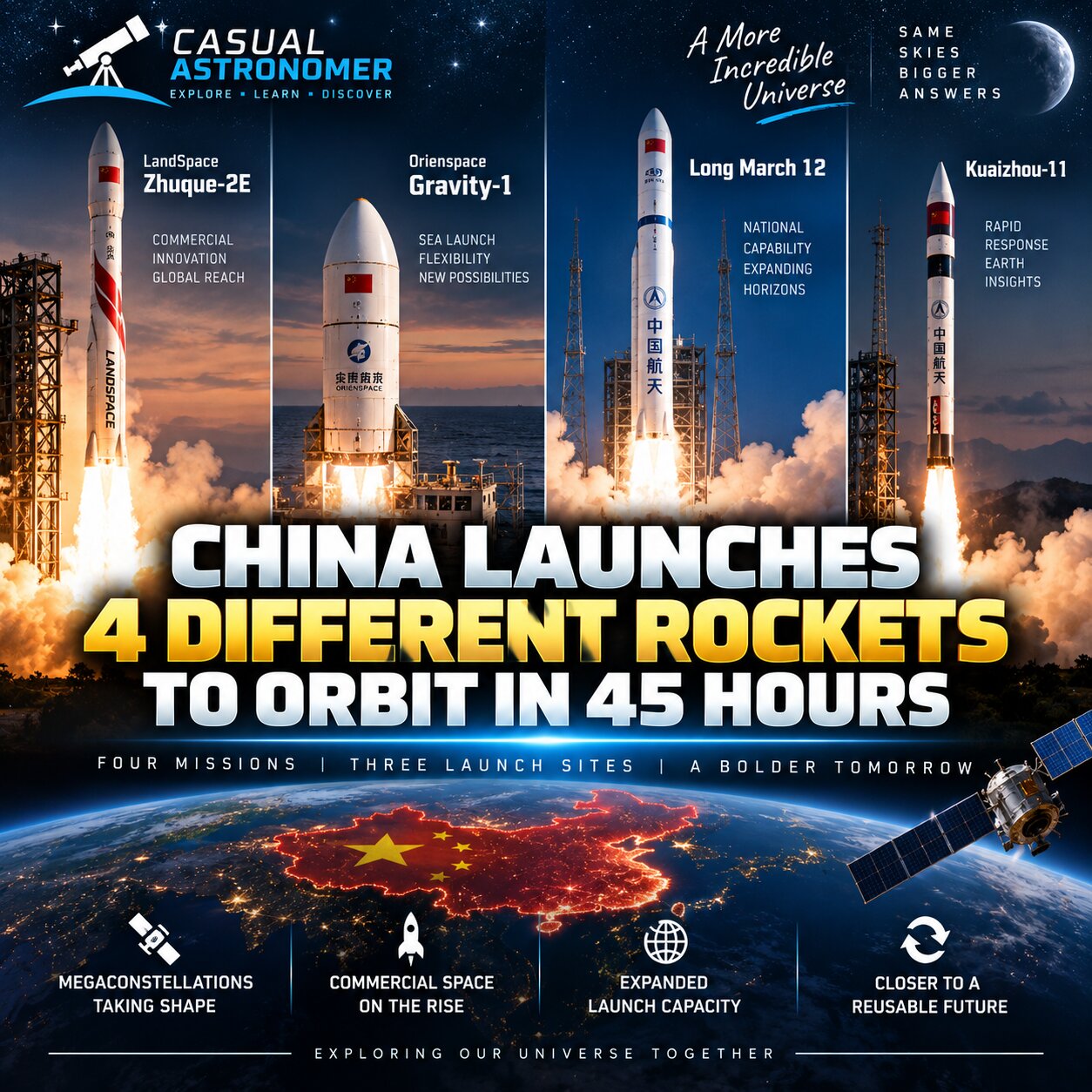

China has demonstrated the growing pace and diversity of its space programme by successfully launching four different rockets within a remarkable 45-hour period.
The launches took place between 15 and 17 September 2026 and involved rockets operating from three different launch locations. Perhaps most significantly, the missions included vehicles operated by both private companies and state-linked organisations, highlighting how China’s commercial launch industry is developing alongside its established national space programme.
All four missions successfully reached orbit.
Four Rockets, Four Successful Missions

The rapid sequence began with LandSpace’s Zhuque-2E, which lifted off from the Jiuquan area in northwestern China at 14:26 Beijing time on 15 September.
The methane-fuelled rocket successfully deployed 10 satellites destined for China’s Qianfan broadband constellation. Chinese authorities subsequently confirmed that the satellites entered their planned orbits successfully.
Next came the unusual-looking Gravity-1.
Operated by commercial company Orienspace, the solid-fuel rocket launched from a sea-based platform off China’s coast at 06:00 Beijing time on 16 September. Its payload consisted of another batch of satellites for the Qianfan network.
The action then shifted to Wenchang for the third launch.
A Long March 12 lifted off at 08:32 Beijing time on 17 September carrying nine satellites associated with China’s SatNet low-Earth-orbit communications constellation.
Only a little more than two hours later, the fourth rocket joined the orbital rush.
A Kuaizhou-11 launched from Jiuquan at 10:40 Beijing time carrying two radar Earth-observation satellites for Chinese company Spacety.
That completed four successful orbital launches in roughly 45 hours.
China’s Massive Satellite Constellations Are Taking Shape
Two of the launches were directly connected with China’s increasingly ambitious plans for large satellite networks.
Qianfan, sometimes translated as “Thousand Sails”, is being developed as a broadband communications megaconstellation in low Earth orbit. Long-term plans envision a network eventually containing around 15,000 operational satellites.
China is simultaneously developing another major communications constellation known as SatNet.
The Long March 12 mission contributed another nine spacecraft towards that system, which is eventually expected to contain approximately 13,000 satellites.
These projects could ultimately place tens of thousands of additional Chinese satellites into orbit.
That scale helps explain why increasing launch frequency is becoming so important.
Building enormous satellite networks requires rockets capable of delivering spacecraft regularly rather than relying on occasional launches separated by weeks or months.
Commercial Rockets Are Becoming Increasingly Important
Another notable element of the four-launch sequence was the participation of China’s commercial space industry.
LandSpace and Orienspace operated the first two rockets.
The Zhuque-2E is particularly interesting because it uses liquid methane and liquid oxygen as propellants. Methane propulsion has attracted considerable attention across the global space industry as companies investigate engines suitable for reusable launch vehicles.
Gravity-1 takes a very different approach.
The Orienspace vehicle uses solid propulsion and launches from a platform at sea. It is currently described as the world’s most powerful solid-fuel rocket.
Having different launch providers and vehicle designs could give China greater flexibility as demand for access to orbit increases.
Reusable Rockets Are the Next Challenge
None of these four missions attempted to recover their rocket stages.
That does not mean China is ignoring reusable launch technology.
Reusable rockets are becoming increasingly important because recovering and flying major components again could eventually reduce costs while allowing companies to launch more frequently.
China has recently made significant progress in this area. LandSpace’s Zhuque-3 and the state-developed Long March 10B have both successfully landed first stages during orbital missions within the past few months.
The next major milestone will be actually flying a recovered Chinese orbital booster again.
Successfully landing a rocket is only part of the reusable-launch equation. Demonstrating that the same stage can be inspected, prepared and launched on another mission is what begins proving the operational benefits of reusability.
China’s Launch Pace Is Accelerating
Four successful missions within approximately 45 hours do not mean China will necessarily maintain that launch frequency every week.
They do, however, provide an interesting glimpse at the country’s growing launch capacity.
Different rockets departed from different facilities carrying payloads for different customers, while commercial and state-backed operators participated in the same concentrated period of activity.
For casual astronomy and spaceflight enthusiasts, the development is worth watching because it reflects a broader transformation occurring in access to space.
The number of organisations capable of launching satellites is growing, enormous constellations require increasingly frequent missions, and reusable launch technology continues advancing.
China’s four-launch sprint in September 2026 therefore represents more than an unusually busy couple of days.
It demonstrates just how quickly the country’s orbital launch capabilities are expanding — and with thousands of satellites planned for the years ahead, considerably busier periods may still be coming.


