
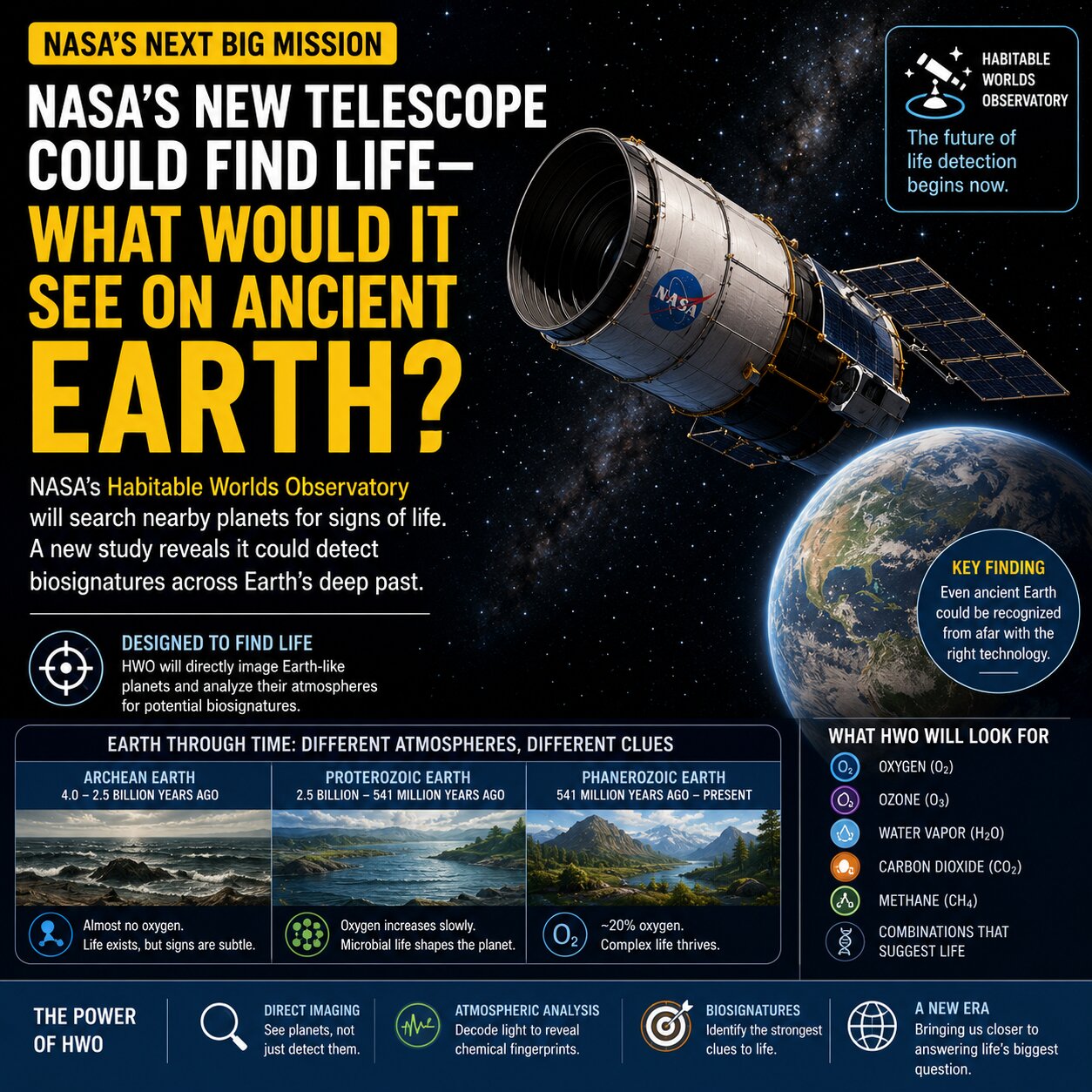

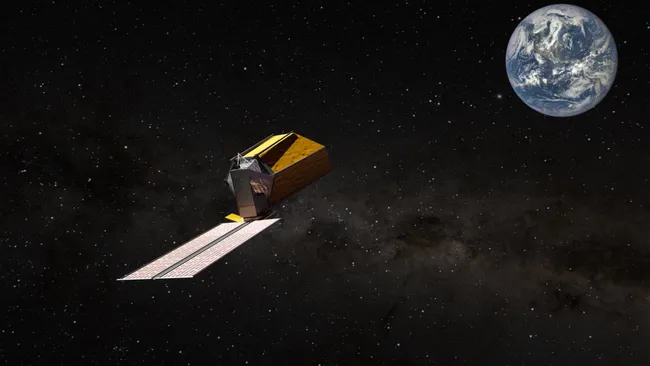
NASA‘s search for life beyond our Solar System is taking another significant step forward with plans for the Habitable Worlds Observatory (HWO), a next-generation space telescope designed to directly study Earth-like planets orbiting nearby stars. Unlike previous missions that focused primarily on discovering exoplanets, HWO aims to analyse their atmospheres in unprecedented detail.
One of the biggest challenges facing scientists is determining what signs of life might actually look like from across the vast distances of space. While modern Earth presents obvious atmospheric indicators, our planet has not always looked the same throughout its 4.5-billion-year history.
A recent study explored how the Habitable Worlds Observatory could detect signs of life by observing ancient versions of Earth. The findings may help shape the telescope’s final design and improve humanity’s chances of identifying potentially habitable worlds.
Earth’s Atmosphere Has Changed Dramatically
When many people think about life on Earth, they imagine the oxygen-rich atmosphere we breathe today. However, for much of our planet’s history, oxygen was either extremely scarce or completely absent.
During the Archean Eon, which lasted from roughly 4 billion to 2.5 billion years ago, Earth’s atmosphere contained very little oxygen despite life already existing in the oceans. Later, during the Proterozoic Eon, oxygen levels slowly began to rise as microorganisms transformed the planet.
Only during more recent geological periods did oxygen become abundant enough to support complex life forms, including plants, animals, and eventually humans.
This means that alien astronomers observing Earth at different points in history would have detected very different atmospheric signatures depending on when they looked.
What the Habitable Worlds Observatory Will Search For
Scientists hope the Habitable Worlds Observatory will identify gases that may indicate biological activity on distant planets. These atmospheric fingerprints can reveal valuable information about a world’s potential habitability.
Some of the key biosignatures researchers will search for include:
- Oxygen
- Ozone
- Water vapour
- Carbon dioxide
- Methane
- Carbon monoxide levels
- Atmospheric combinations that suggest biological processes
The presence of a single gas is not necessarily proof of life. Instead, scientists examine how different gases interact and whether they can be explained through natural geological processes alone.
Why Spectral Resolution Matters
The study focused on a concept known as spectral resolution. This refers to how precisely a telescope can separate different wavelengths of light when analysing a planet’s atmosphere.
Higher spectral resolution provides more detailed information, allowing scientists to distinguish between gases that might otherwise appear similar. However, increased resolution also requires more sophisticated instruments and longer observation times.
Researchers found that relatively modest levels of spectral resolution could allow the Habitable Worlds Observatory to detect important biosignatures across various stages of Earth’s history.
This is encouraging news because it suggests the telescope may not need extreme engineering solutions to perform many of its most important scientific tasks.
A Telescope Designed to Answer One of Humanity’s Biggest Questions
The possibility of finding life elsewhere in the universe remains one of the most exciting goals in modern astronomy. The Habitable Worlds Observatory represents a major step towards answering that question by giving scientists the ability to directly analyse potentially Earth-like planets.
Even if the telescope identifies promising biosignatures, confirming the existence of life will remain a complex process. Nature can sometimes produce similar atmospheric signatures without biological activity.
Nevertheless, the observatory could dramatically narrow the search and identify worlds worthy of further investigation. By studying how ancient Earth would appear from afar, researchers are ensuring that future discoveries are not limited to planets that look exactly like our modern world.
The search for life beyond Earth may still take decades, but every improvement in telescope technology brings us closer to understanding whether our planet is unique or simply one example among countless inhabited worlds throughout the cosmos.
Leave a Reply