
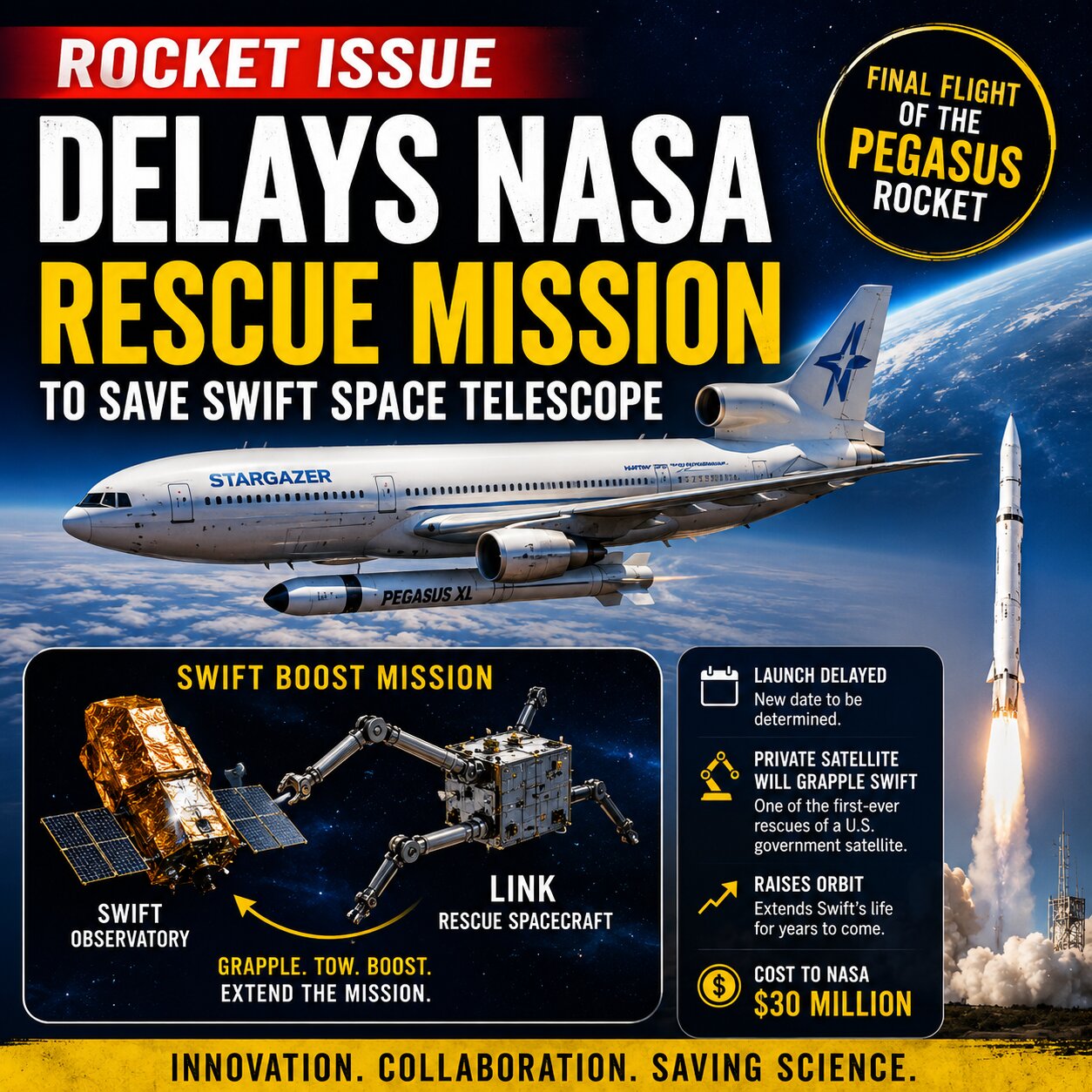

A technical issue has delayed one of the most unusual and historic space missions of 2026. NASA has confirmed that the launch of the Swift Boost mission has been postponed after a problem with the Northrop Grumman Pegasus XL launch vehicle prevented deployment during its latest launch attempt.
The mission is significant for two major reasons. It represents the final flight of the Pegasus rocket, and it aims to save NASA’s ageing Neil Gehrels Swift Observatory by boosting it into a higher orbit instead of allowing it to eventually fall back to Earth.
While teams investigate the issue, a new launch date has yet to be announced.
A Mission to Save an Observatory

The Swift Observatory has been studying gamma-ray bursts and other energetic cosmic events since its launch in 2004. More than two decades later, the spacecraft continues to deliver valuable scientific observations.
Unfortunately, increasing atmospheric drag has slowly lowered Swift’s orbit. Unlike many modern satellites, Swift was never designed to perform orbital boosts, leaving it unable to raise itself to a safer altitude.
Rather than retiring the observatory, NASA has chosen an innovative solution by commissioning a private spacecraft to rescue it, extending its operational life while demonstrating new satellite servicing capabilities.
LINK Takes Centre Stage
The rescue mission relies on a spacecraft called LINK, developed by Katalyst Space Technologies. After reaching orbit, LINK will carefully approach Swift before using three robotic arms to securely capture the observatory.
Before attempting the rendezvous, LINK will spend several weeks studying the spacecraft to determine the safest and most effective grapple points. Once attached, gentle ion thrusters will gradually raise both spacecraft into a more stable orbit over several months.
Highlights of the mission include:
- The final launch of the historic Pegasus rocket
- LINK becoming one of the first private spacecraft to capture a U.S. government satellite
- Extending Swift’s scientific mission by several years
- Demonstrating future satellite servicing technologies
- Completing the entire rescue mission at a relatively modest cost
A Historic Rocket Nears Retirement
Pegasus first flew in 1990 and became famous as the world’s premier operational air-launched orbital rocket. Carried beneath the wings of the L-1011 Stargazer aircraft, Pegasus could launch from locations that conventional rockets could not easily reach.
Over its decades of service, Pegasus completed dozens of successful missions, placing scientific satellites and research payloads into orbit. Its unique launch method made it an important part of spaceflight history.
The Swift Boost mission was chosen as Pegasus’ final flight because the rocket’s capabilities perfectly matched Swift’s orbital requirements.
Waiting for the Next Opportunity
Although the delay is disappointing, launch postponements are a normal part of spaceflight whenever engineers identify potential issues. Taking additional time to resolve technical problems greatly improves the chances of a successful mission.
If LINK successfully reaches the Swift Observatory, it will demonstrate that ageing satellites can be serviced rather than abandoned. This could reshape how future spacecraft are designed and maintained, reducing costs while extending the scientific value of missions already in orbit.
For now, all eyes remain on NASA, Northrop Grumman and Katalyst Space Technologies as teams work towards setting a new launch date for what promises to be one of the most fascinating orbital rescue missions ever attempted.

