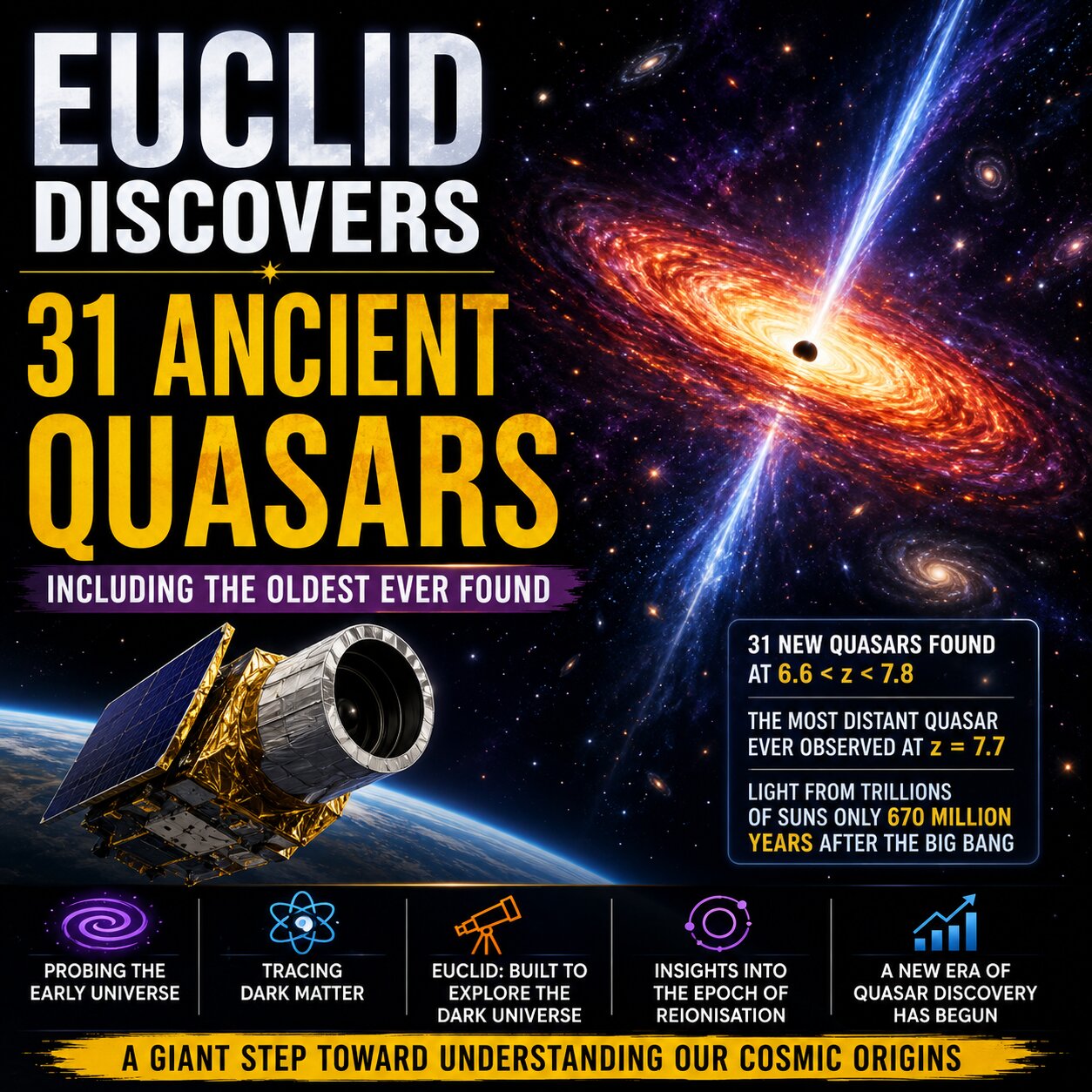

The Euclid Space Telescope has achieved another remarkable milestone by discovering 31 previously unknown ancient quasars, including the most distant quasar ever identified. These extraordinary objects were shining when the Universe was only around 670 million years old, offering astronomers an unprecedented opportunity to study the earliest chapters of cosmic history.
The discovery strengthens Euclid’s growing reputation as one of the most important observatories for exploring the mysterious dark Universe, helping scientists investigate dark matter, dark energy and the formation of the first galaxies.
What Are Quasars?
Quasars are among the brightest objects in the Universe. They are powered by supermassive black holes that actively consume enormous amounts of surrounding material, producing immense quantities of light that can outshine entire galaxies.
Because their host galaxies formed within massive concentrations of dark matter, quasars also serve as valuable markers for studying how cosmic structures developed shortly after the Big Bang.
The newly discovered quasars have redshifts between 6.6 and 7.8, placing them firmly within one of the most fascinating periods in cosmic history.
Looking Back to the Universe’s Dawn
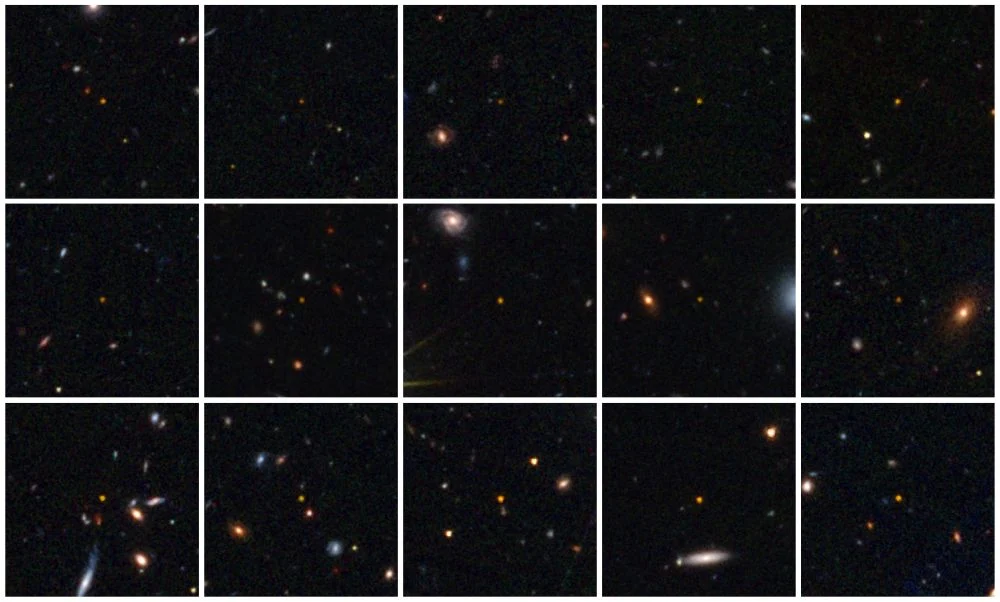
For many years, astronomers struggled to locate these incredibly distant objects. Finding even a handful required more than a decade of observations using some of the world’s largest telescopes.
Euclid has now transformed that search.
During only the first 1.5 years of its planned six-year mission, the telescope has identified 31 new high-redshift quasars, more than doubling the known population from this era. Two of them have even surpassed the previous distance record, becoming the oldest quasars ever observed.
These ancient beacons allow astronomers to look back to a time when the Universe was only about 5% of its current age.
Why This Discovery Matters
The newly discovered quasars provide astronomers with far more than impressive distance records.
Their discovery could help researchers:
- Better understand how supermassive black holes grew so rapidly
- Study the earliest galaxies in the Universe
- Investigate the role of dark matter in galaxy formation
- Explore the Epoch of Reionisation, when the first stars illuminated the cosmos
- Test existing models describing the evolution of the Universe
- Map large-scale cosmic structures more accurately
Having a much larger sample of ancient quasars allows scientists to compare many different objects instead of relying on only a few exceptional discoveries.
Euclid’s Mission Is Only Beginning
One of Euclid’s greatest strengths is its ability to survey enormous areas of the sky using a powerful 600-megapixel camera combined with advanced near-infrared instruments. Rather than focusing on small regions, it systematically scans vast portions of the cosmos, making discoveries that would have been extremely difficult using previous observatories.
As its survey continues over the coming years, astronomers expect Euclid to uncover many more ancient quasars, revealing new clues about how the first galaxies, supermassive black holes and the cosmic web evolved after the Big Bang.
Every new discovery brings us closer to understanding one of astronomy’s greatest mysteries: how the Universe transformed from a dark, featureless expanse into the rich and complex cosmos we observe today.