
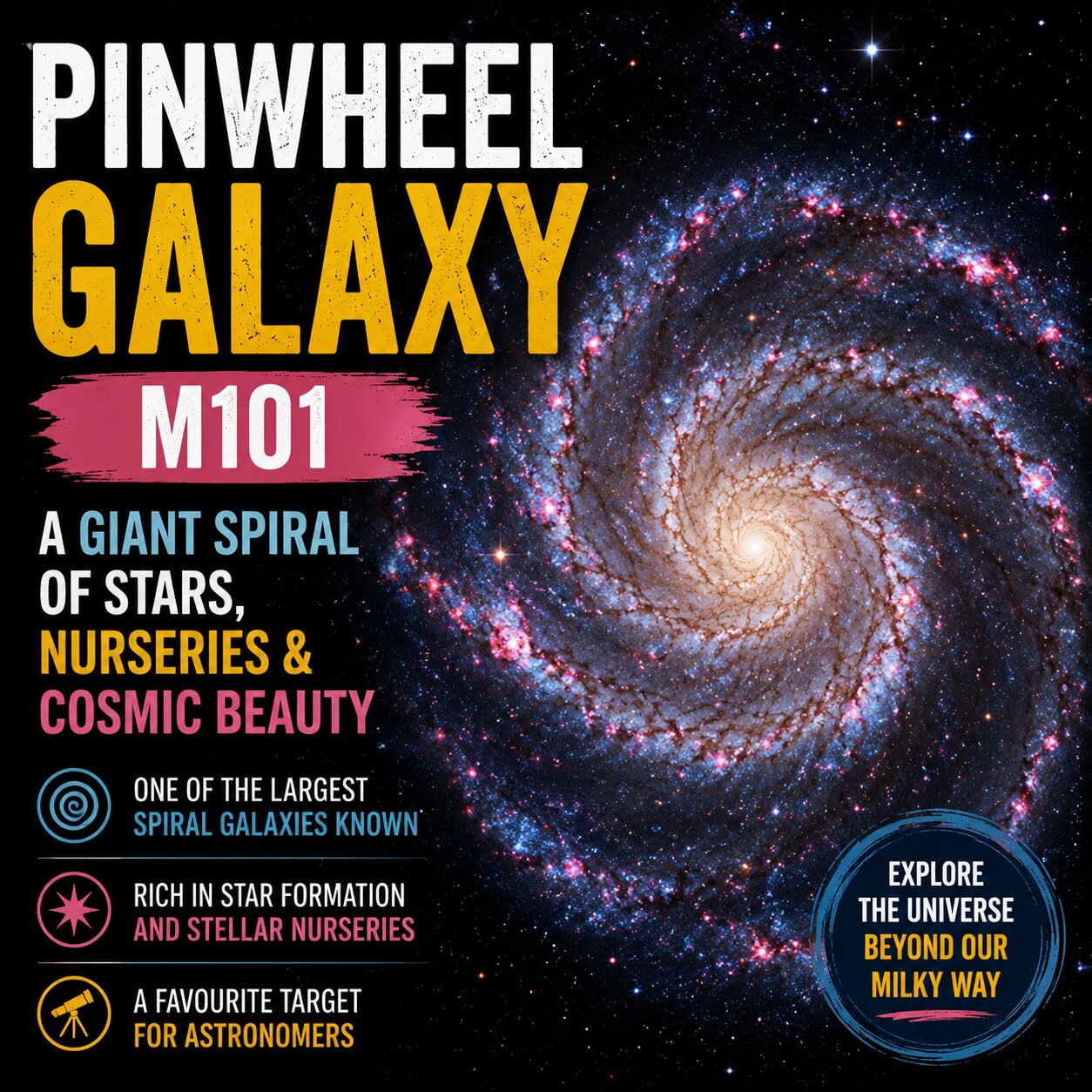

When people imagine a classic spiral galaxy, the Pinwheel Galaxy (Messier 101 or M101) is often the perfect example. With its elegant spiral arms stretching across space and countless regions of active star formation, M101 is one of the largest and most beautiful spiral galaxies visible from Earth.
Located approximately 21 million light-years away in the constellation Ursa Major, the Pinwheel Galaxy has fascinated both professional astronomers and amateur stargazers for generations. Its enormous size, colourful star-forming regions and unusual asymmetrical appearance continue to provide valuable insights into how galaxies grow and evolve.
For casual astronomers, the Pinwheel Galaxy represents one of the finest examples of a grand design spiral galaxy beyond our own Milky Way.
A giant among spiral galaxies
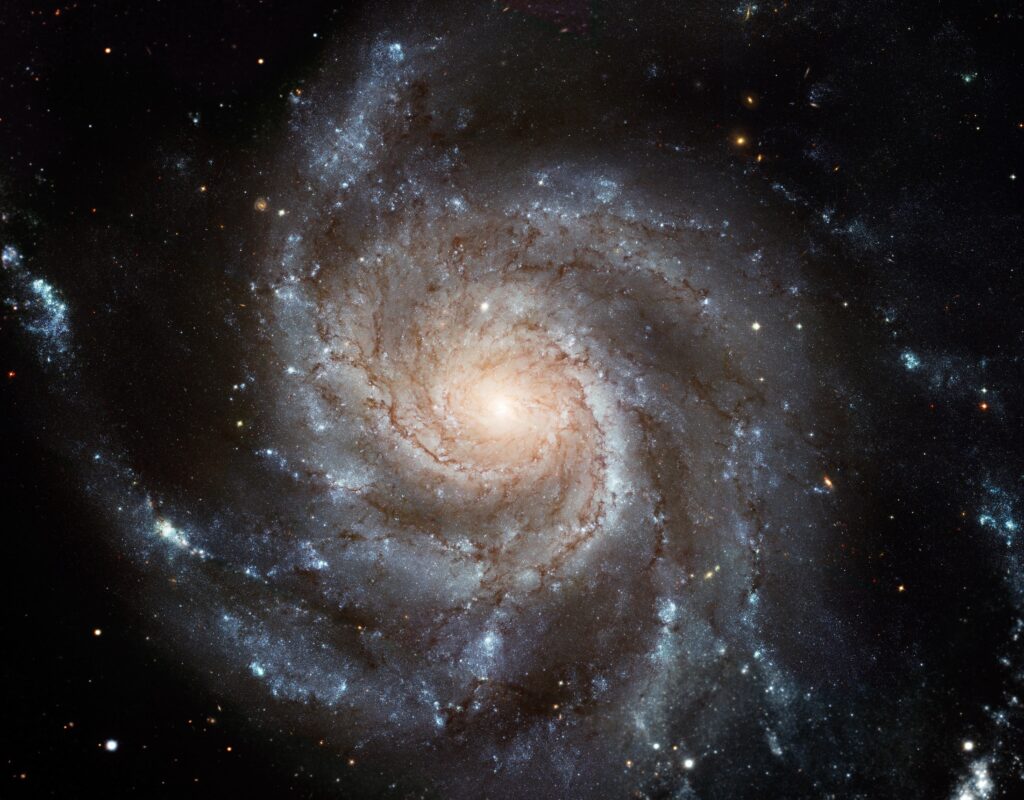
Although many people assume the Andromeda Galaxy is the largest nearby spiral, the Pinwheel Galaxy is actually one of the biggest known spiral galaxies in our local cosmic neighbourhood.
Measuring around 170,000 light-years across, it is significantly larger than the Milky Way, which spans roughly 100,000 light-years.
Its immense spiral arms are packed with billions of stars, vast clouds of gas and dust, and enormous stellar nurseries where new stars continue to form.
These active regions give the galaxy its distinctive appearance, with bright blue young stars contrasting beautifully against darker dust lanes and older yellow stars nearer the centre.
Why does it look uneven?
One of the first things astronomers notice about the Pinwheel Galaxy is that it isn’t perfectly symmetrical.
Unlike the Whirlpool Galaxy‘s balanced spiral structure, M101 has one side that appears much more extended and irregular than the other.
Scientists believe this unusual appearance is the result of gravitational interactions with several smaller companion galaxies over millions of years.
As these neighbouring galaxies passed nearby, their gravity distorted M101’s spiral arms, triggering waves of star formation while stretching parts of the galaxy outward.
These cosmic encounters remind us that galaxies are not isolated islands in space but constantly influence one another over vast timescales.
A factory for new stars
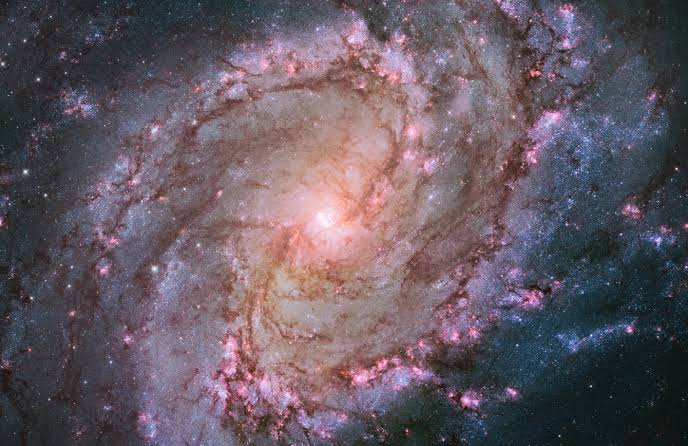
The Pinwheel Galaxy is one of the most active star-forming galaxies visible to amateur astronomers.
Its spiral arms contain enormous clouds of hydrogen gas that collapse under gravity to form new stars.
Many of these regions glow with a reddish hue because energetic young stars excite surrounding hydrogen gas, creating vast emission nebulae.
Some of these stellar nurseries are among the largest ever observed, producing clusters of massive blue stars that shine brilliantly across intergalactic distances.
Studying these regions helps astronomers better understand how stars like our Sun were born billions of years ago.
Home to spectacular supernovae
Few galaxies have produced as many observed supernovae as the Pinwheel Galaxy.
Over the past century, astronomers have detected numerous stellar explosions within M101, making it an important target for studying how massive stars end their lives.
Each supernova briefly becomes one of the brightest objects in the galaxy before gradually fading over weeks or months.
These powerful explosions scatter heavy elements such as carbon, oxygen and iron throughout the galaxy, enriching future generations of stars and planets.
In many ways, supernovae are responsible for recycling the building blocks that eventually form worlds capable of supporting life.
Can you see the Pinwheel Galaxy?
Despite its enormous size, the Pinwheel Galaxy can be surprisingly difficult to observe.
Its light is spread across a very large area of sky, giving it relatively low surface brightness.
Under exceptionally dark skies, experienced observers using medium to large telescopes may detect its faint glow.
Larger amateur telescopes reveal hints of its spiral structure, while long-exposure astrophotography uncovers the breathtaking detail that has made M101 famous.
For observers in South Africa, the Pinwheel Galaxy sits low in the northern sky during the appropriate season, making excellent viewing conditions and minimal light pollution especially important.
Fascinating facts about the Pinwheel Galaxy
The Pinwheel Galaxy continues to surprise astronomers with its size and activity.
Some remarkable facts include:
- Also known as Messier 101 (M101).
- Located approximately 21 million light-years from Earth.
- Found in the constellation Ursa Major.
- Measures around 170,000 light-years across.
- Contains hundreds of billions of stars.
- One of the largest nearby spiral galaxies.
- Rich in active star-forming regions.
- Has hosted numerous observed supernovae.
- Its asymmetrical shape was likely caused by interactions with neighbouring galaxies.
- A favourite target for astrophotographers around the world.
A masterpiece of galactic evolution
The Pinwheel Galaxy demonstrates that galaxies are dynamic, ever-changing systems shaped by gravity, star formation and cosmic interactions.
Rather than remaining static over billions of years, galaxies collide, distort, grow and continually create new generations of stars that illuminate the universe.
For casual astronomers, M101 offers far more than a beautiful photograph. It serves as a reminder that even on the largest cosmic scales, change is constant. Every glowing spiral arm, every newborn star and every ancient supernova tells part of a story that has unfolded over billions of years.
The Pinwheel Galaxy remains one of the finest examples of the beauty, complexity and ongoing evolution of our remarkable universe.

Leave a Reply