
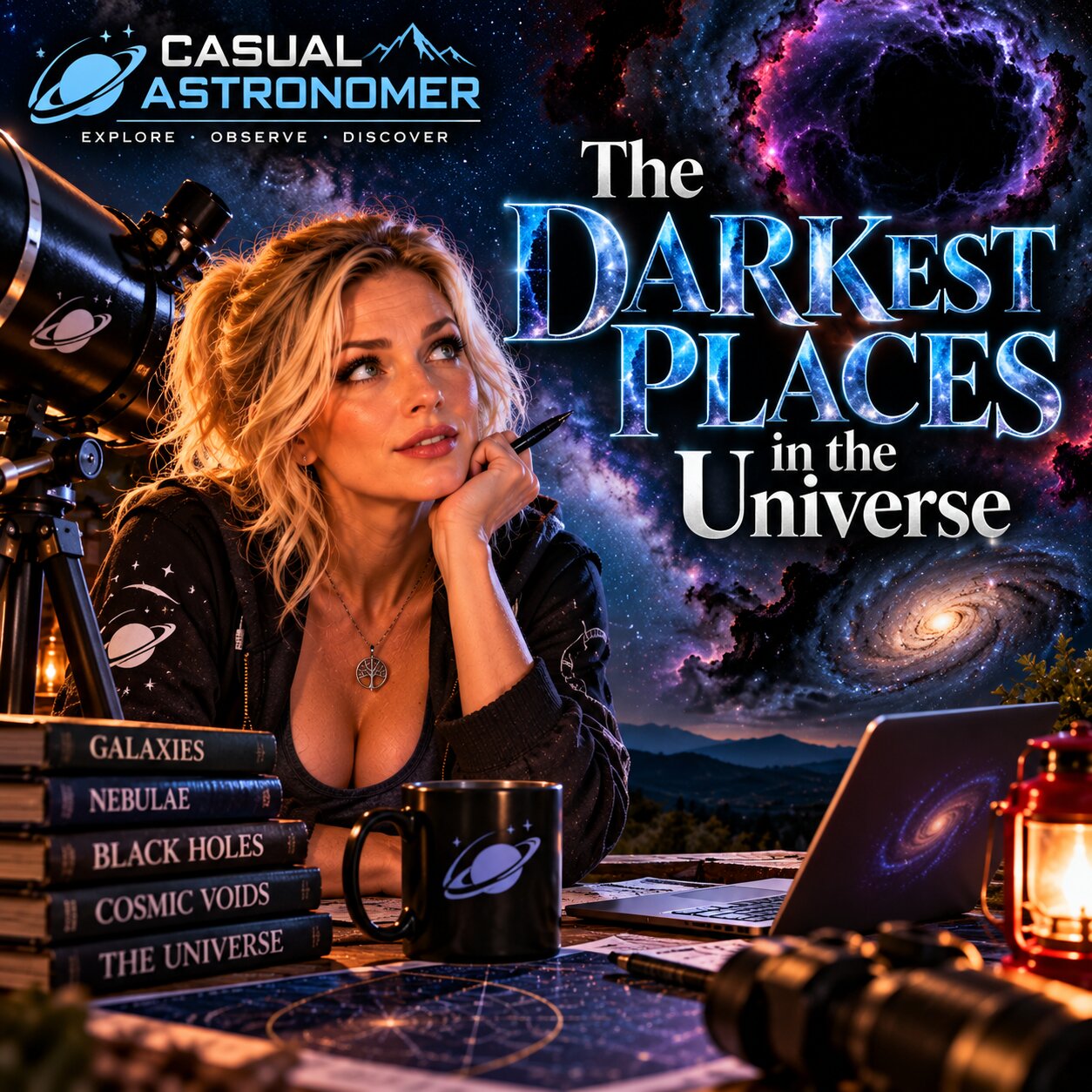

Space contains breathtaking stars, colourful nebulae, and brilliant galaxies. Yet some of its most fascinating regions are defined by an apparent absence of light.
These cosmic shadows offer astronomers valuable opportunities to investigate the structure and evolution of our universe.
Clouds That Hide the Stars
Dark nebulae are dense concentrations of interstellar dust and gas that block visible light from objects behind them.
Some appear as enormous black shapes against glowing star fields, creating the illusion of holes in space.
Despite their intimidating appearance, these clouds can become stellar nurseries where gravity eventually helps form new stars.

The Mystery of Cosmic Voids
On much larger scales, cosmic voids are enormous regions containing relatively few galaxies compared with the surrounding universe.
They form part of the cosmic web, the vast arrangement of galaxies, clusters, and filaments shaped by gravitational evolution.
These voids are not completely empty, but their sparse distribution of luminous matter makes them fascinating subjects for cosmological research.
Darkness Is Not Always Emptiness
Astronomers study these regions using observations across different wavelengths, including infrared and radio astronomy.
What appears invisible to human eyes may reveal hidden gas, dust, developing stars, or the distribution of matter.
The universe’s darkest places remind us that absence of visible light does not mean an absence of scientific discovery.
Leave a Reply