A dramatic explosion involving Blue Origin‘s New Glenn rocket lit up the Florida night sky on 28 May 2026, creating a flash so bright that it was reportedly visible from more than 100 miles away. The incident occurred during a pre-launch test at Launch Complex 36 (LC-36) at Cape Canaveral Space Force Station.
While no injuries were reported, the explosion resulted in the complete loss of the rocket and appears to have caused significant damage to launch infrastructure at the site. Videos captured by witnesses across Florida quickly spread online, showcasing the immense power of modern spaceflight systems.
The event serves as a reminder that despite incredible technological advances, rocket development remains one of the most challenging engineering pursuits on Earth.
What happened during the test?
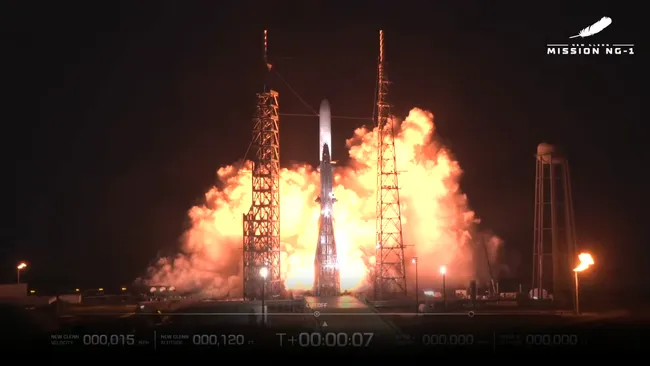
The New Glenn rocket was undergoing testing ahead of a planned mission that would have carried Amazon’s Project Kuiper internet satellites into low Earth orbit.
During the test, an anomaly occurred that led to a catastrophic explosion. Blue Origin founder Jeff Bezos later confirmed that all personnel were safe and that an investigation into the root cause had already begun.
Rocket testing is designed to identify problems before flight, and while failures are never desirable, they remain an important part of the development process. Aerospace companies routinely use test campaigns to push systems to their limits and uncover weaknesses that might otherwise go unnoticed.
Blue Origin has not yet released a detailed explanation of what caused the explosion, but engineers will likely spend months analysing telemetry, hardware damage, and operational procedures.
Visible across much of Florida
One of the most remarkable aspects of the explosion was its visibility.
Witnesses near Cape Canaveral described an enormous fireball erupting from the launch site. Cameras at beaches, marinas, residential neighbourhoods, and even aircraft captured the bright flash illuminating the night sky.
Reports indicate the explosion was visible from locations including:
- Cocoa Beach
- Port Canaveral
- Orlando
- Offshore vessels near the coast
- Tampa and Florida’s west coast
Observers more than 100 miles away reported seeing the sky briefly light up from the blast. This demonstrates the tremendous amount of energy involved in large rocket systems, particularly those designed to carry heavy payloads into orbit.
The widespread visibility quickly made the event one of the most discussed spaceflight incidents of the year.
Why New Glenn is important
New Glenn is Blue Origin’s heavy-lift launch vehicle designed to compete with some of the world’s most capable rockets.
Named after astronaut John Glenn, the rocket stands over 98 metres tall and is intended to carry large payloads into Earth orbit and beyond. The vehicle plays a key role in Blue Origin’s long-term ambitions for commercial spaceflight, satellite deployment, lunar exploration, and future deep-space missions.
The rocket also supports Amazon’s Project Kuiper constellation, which aims to provide broadband internet access from space through thousands of satellites orbiting Earth.
Despite this setback, industry experts expect Blue Origin to continue development and return the vehicle to flight after completing its investigation and rebuilding any damaged infrastructure.
The risks and rewards of space exploration
Rocket failures often generate headlines because of their dramatic nature, but they are also part of the history of space exploration. Many of today’s most successful launch systems experienced setbacks during their development.
Every launch vehicle operates under extreme conditions involving massive amounts of fuel, high pressures, intense heat, and complex engineering systems. Even minor faults can lead to major failures.
The New Glenn explosion will undoubtedly lead to design reviews, safety assessments, and technical improvements. These lessons help advance not only one rocket programme but often the wider aerospace industry.
As investigations continue, Blue Origin faces the challenge of rebuilding and moving forward. The company has already stated its intention to return to flight, reinforcing a reality that has defined space exploration since its earliest days: progress often comes through persistence, learning, and the willingness to try again.