
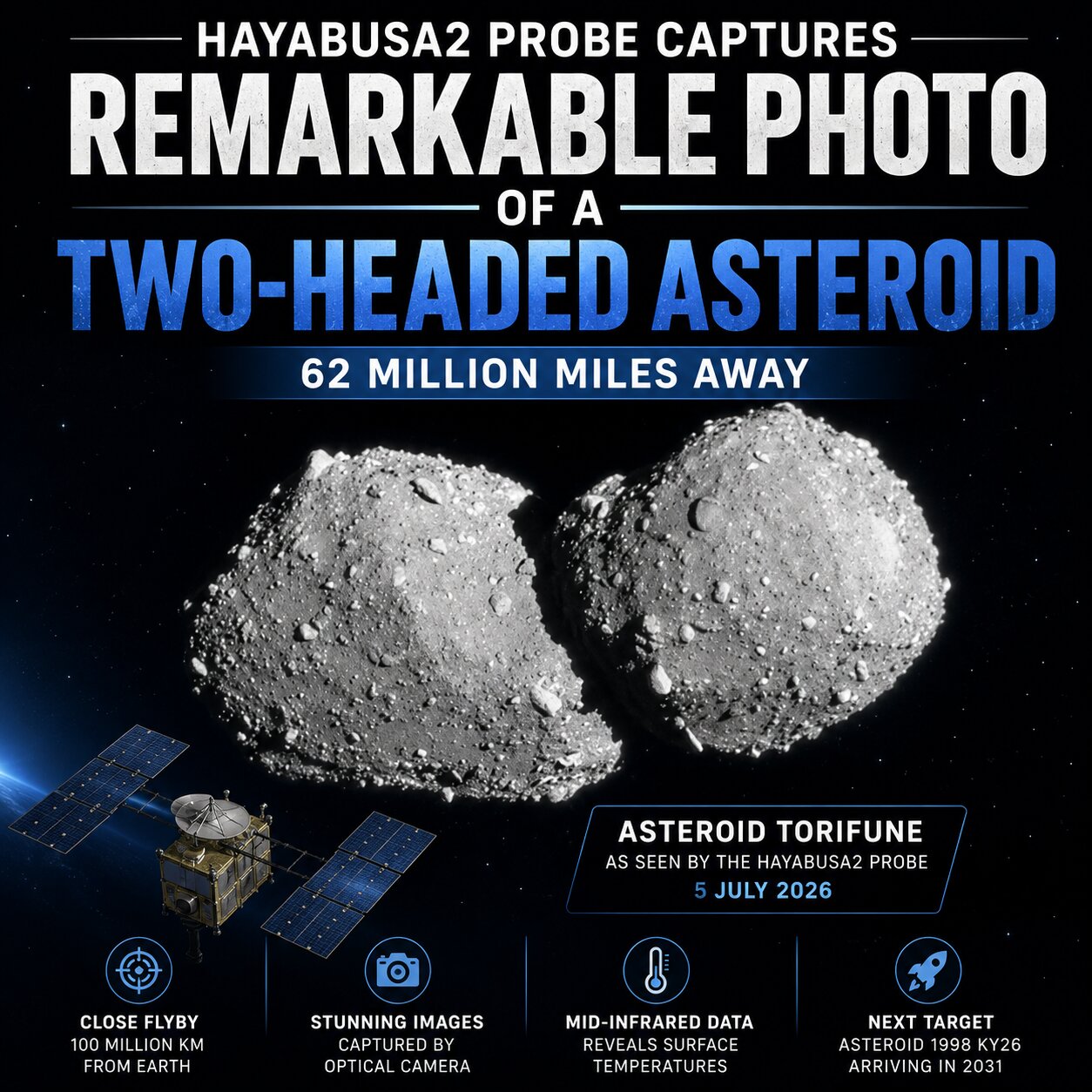

Japan’s remarkable Hayabusa2 spacecraft has added another milestone to its already extraordinary mission by capturing detailed new images of asteroid Torifune during a close flyby on 5 July 2026. The encounter provided scientists with a rare opportunity to study a previously unseen world while demonstrating that Hayabusa2 continues to deliver valuable science years after completing its primary mission.
The flyby also highlights how extended space missions can continue making important discoveries long after their original objectives have been achieved.
A Close Encounter with Torifune
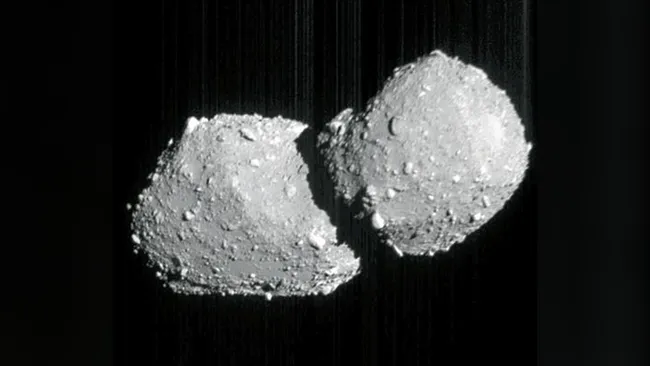
Asteroid Torifune measures approximately 450 metres across and currently travels around the Sun roughly 100 million kilometres from Earth. Images returned by Hayabusa2 reveal an unusual double-lobed shape, giving the asteroid the appearance of two rocky bodies joined together.
These “contact binary” asteroids form when two separate objects gently collide and remain attached, offering astronomers valuable clues about how small bodies evolve within our Solar System.
More Than Just Beautiful Pictures
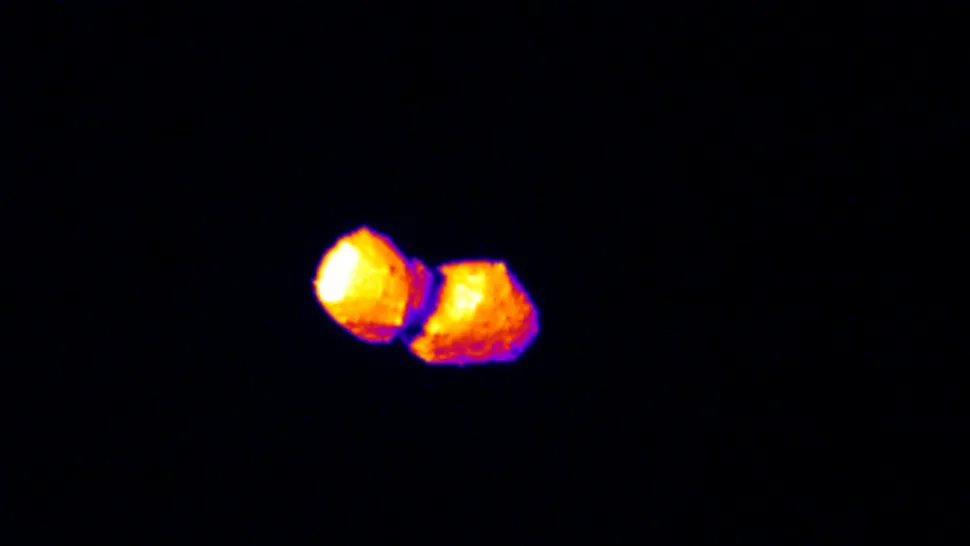
Hayabusa2 did far more than capture impressive photographs. During the flyby, the spacecraft also observed Torifune using its mid-infrared camera, allowing scientists to study temperature differences across the asteroid’s surface.
These measurements help researchers understand:
- Surface composition.
- Rock and dust distribution.
- Thermal properties.
- Surface roughness.
- How the asteroid responds to sunlight.
Together with the optical images, these observations will help researchers better understand Torifune’s physical characteristics once additional scientific data is downloaded and analysed.
A Mission That Keeps Delivering
Hayabusa2 originally launched in 2014 to visit asteroid Ryugu, collect surface samples, and safely return them to Earth. That ambitious mission was completed successfully in 2020, providing scientists with pristine asteroid material that continues to reveal new insights into the early Solar System and the building blocks of life.
Rather than retiring the spacecraft after this historic achievement, the Japan Aerospace Exploration Agency (JAXA) extended the mission to explore additional asteroids, turning Hayabusa2 into one of the most productive deep-space probes ever launched.
Looking Ahead to 2031
The Torifune encounter is only one stop on Hayabusa2’s extended journey. Its next destination is asteroid 1998 KY26, an incredibly small near-Earth asteroid measuring only around 11 metres across.
If successful, Hayabusa2 could become the first spacecraft to closely investigate one of the smallest asteroids ever visited. Scientists hope the mission will improve our understanding of how these tiny space rocks formed, evolved, and respond to the harsh environment of space.
With every flyby, Hayabusa2 continues to demonstrate that well-designed spacecraft can achieve far more than originally planned. Its latest images of Torifune not only provide another fascinating glimpse into our Solar System but also reinforce the value of extending successful space missions well beyond their primary objectives.

