
Gravity is one of the most fundamental forces in the universe. It governs the motion of planets, stars, galaxies, and even light itself. For centuries, scientists have sought to understand why objects fall, why planets orbit stars, and how massive structures shape the cosmos.
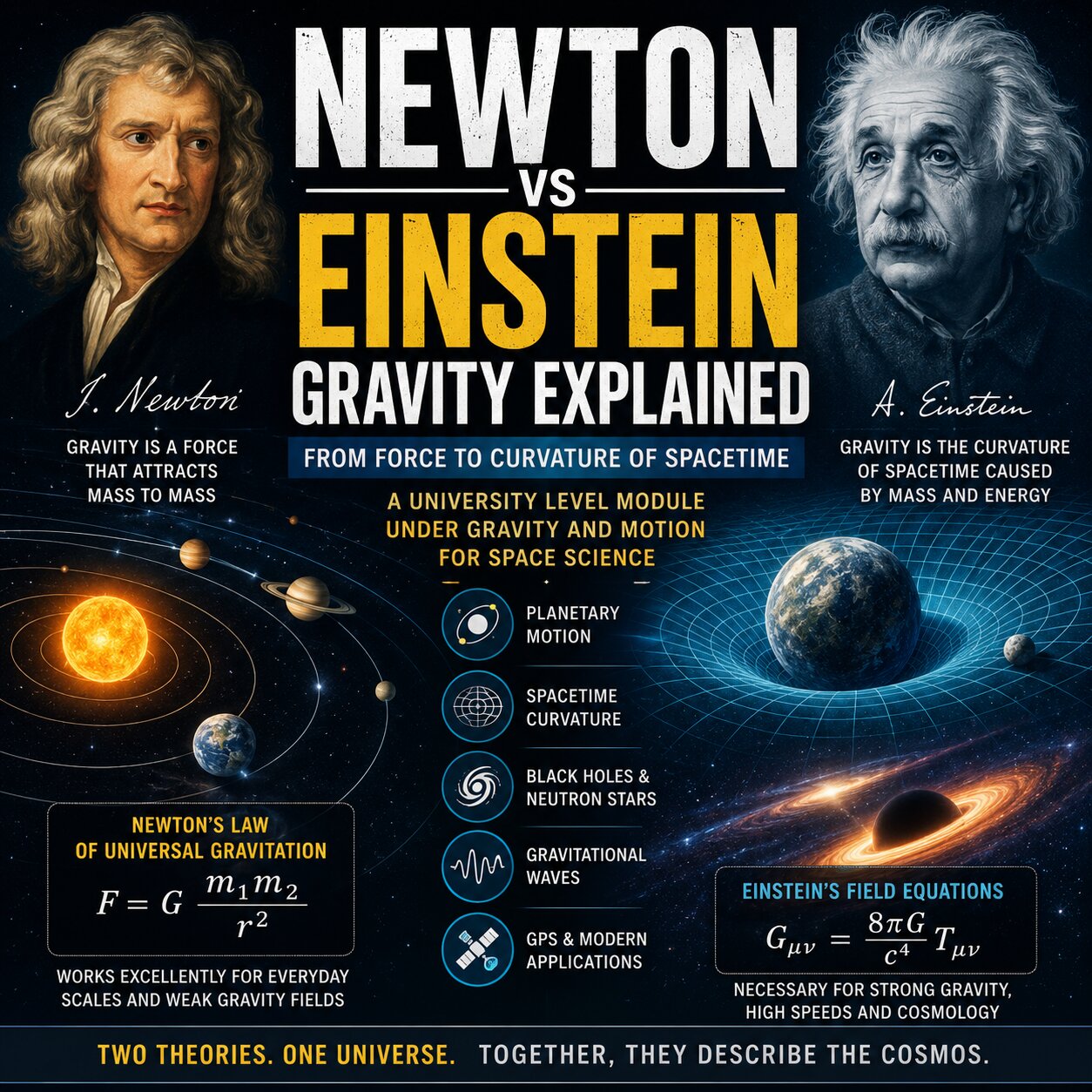
Two of the most influential theories of gravity were developed by Sir Isaac Newton and Albert Einstein. Newton’s theory dominated scientific thinking for over 200 years and remains extremely useful today. Einstein’s theory of General Relativity later revolutionised our understanding of gravity, revealing that it is not a force in the traditional sense but rather a consequence of the curvature of space and time.
Understanding the differences between Newtonian gravity and Einsteinian gravity is essential for students studying space science, astrophysics, cosmology, and orbital mechanics. Both theories remain important, but each applies differently depending on the scale and precision required.
Newton’s theory of gravity
In 1687, Sir Isaac Newton published his groundbreaking work Philosophiæ Naturalis Principia Mathematica, introducing the Universal Law of Gravitation.
Newton proposed that every object with mass attracts every other object with mass. The strength of this attraction depends on the masses involved and the distance separating them.
F = G\frac{m_1m_2}{r^2}
In this equation:
- F is the gravitational force
- G is the gravitational constant
- m₁ and m₂ are the masses of the objects
- r is the distance between their centres
According to Newton, gravity acts instantaneously across space. If the Sun were to move suddenly, Earth would theoretically feel the change immediately.
Newton’s model successfully explains:
- Falling objects on Earth
- Planetary orbits
- Moon-Earth interactions
- Satellite motion
- Tides
Even today, Newtonian gravity remains sufficiently accurate for many engineering applications, including bridge design, construction calculations, and basic spacecraft trajectory planning.
The limitations of Newtonian gravity

Although Newton’s theory was remarkably successful, astronomers eventually discovered situations where it failed to provide perfectly accurate predictions.
One notable example involved the orbit of Mercury. Observations showed slight deviations in Mercury’s orbit that could not be fully explained by Newtonian mechanics.
Another challenge concerned the speed of gravity itself. Newton’s equations imply that gravitational effects travel instantaneously, which conflicts with modern physics and the finite speed of light established by James Clerk Maxwell’s electromagnetic theory.
As observational astronomy became more precise, scientists realised a more comprehensive explanation of gravity was needed.
Einstein’s revolution: General Relativity
In 1915, Albert Einstein introduced the General Theory of Relativity, fundamentally changing our understanding of gravity.
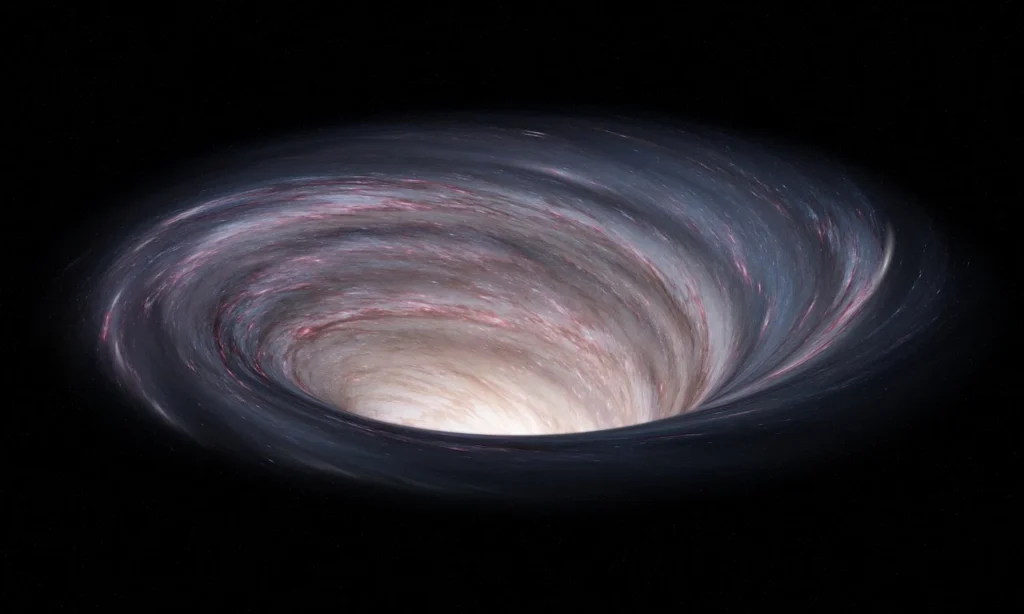
Einstein proposed that gravity is not a force pulling objects together. Instead, massive objects distort the fabric of spacetime around them.
A useful analogy is to imagine placing a heavy bowling ball on a stretched rubber sheet. The ball creates a depression in the sheet, causing smaller objects to move towards it. While spacetime is far more complex than a rubber sheet, the analogy helps visualise how mass curves the geometry of the universe.
Under General Relativity, planets orbit stars not because they are being pulled by an invisible force, but because they are following the curved paths created by spacetime distortion.
Gravity becomes a geometric property of the universe itself.
Spacetime and curved geometry
Einstein combined the three dimensions of space with the dimension of time into a single four-dimensional framework known as spacetime.
Mass and energy tell spacetime how to curve, while spacetime tells matter how to move.
This relationship is described by Einstein’s famous field equations.
G_{\mu\nu}=\frac{8\pi G}{c^4}T_{\mu\nu}
While the mathematics becomes highly complex, the key concept is relatively simple: gravity arises because objects move through curved spacetime.
This idea successfully explains phenomena that Newton’s theory could not fully describe.
Evidence supporting Einstein’s theory
One of the first major successes of General Relativity was its accurate explanation of Mercury’s unusual orbit.
Einstein’s theory also predicted that gravity could bend light passing near massive objects.
This effect was confirmed during a solar eclipse in 1919, when astronomers observed starlight bending around the Sun exactly as Einstein predicted.
Since then, numerous observations have validated General Relativity, including:
- Gravitational lensing
- Time dilation near massive objects
- Black holes
- Gravitational waves
- The expansion of the universe
- Precise GPS satellite corrections
These discoveries have transformed modern astronomy and cosmology.
Newton versus Einstein in practical applications
Although Einstein’s theory is more accurate, Newtonian gravity remains extremely useful because it is much simpler to calculate.
For many situations, the difference between the two theories is negligible.
Examples where Newtonian gravity works well include:
- Everyday engineering
- Most Earth-based calculations
- Basic satellite orbits
- Planetary motion within the Solar System
Einstein’s theory becomes necessary when dealing with:
- Black holes
- Neutron stars
- Strong gravitational fields
- High-speed objects approaching light speed
- Cosmology
- Precision satellite navigation
Modern GPS systems, for example, must account for both Special and General Relativity to maintain accurate positioning. Without these corrections, navigation errors would accumulate rapidly.
Comparing the two theories
The chart illustrates a simplified comparison of the strengths of each model. Newton’s theory excels in simplicity and remains highly practical, while Einstein’s theory provides a deeper and more complete description of reality.
Why both theories still matter
One of the most fascinating aspects of science is that new theories do not always replace old ones entirely. Instead, they often extend them.
Newton’s theory remains extraordinarily useful and continues to be taught because it accurately describes many real-world situations. Einstein’s theory builds upon Newton’s work by providing a more complete explanation of gravity under extreme conditions.
In many ways, Newtonian gravity can be viewed as an approximation of General Relativity that works exceptionally well when gravitational fields are weak and speeds are relatively low.
Understanding both perspectives allows students to appreciate how scientific knowledge evolves and how increasingly precise observations lead to deeper insights about the universe.
Gravity as our window into the cosmos
From falling apples to black holes consuming stars, gravity influences nearly every process in the universe. Newton provided humanity with the first comprehensive mathematical description of gravitational attraction, while Einstein revealed the deeper structure of spacetime itself.
Together, their discoveries form the foundation of modern space science, astrophysics, and cosmology. As researchers continue exploring dark matter, dark energy, gravitational waves, and the origins of the universe, both Newton’s and Einstein’s contributions remain central to our quest to understand the cosmos.