


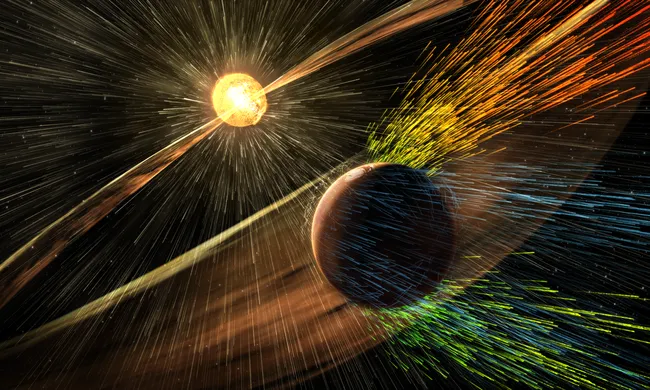
A powerful solar superstorm that struck Earth in May 2024 also slammed into Mars, giving scientists a rare opportunity to observe how extreme space weather affects the Red Planet. Data gathered by the European Space Agency’s Mars orbiters revealed dramatic changes in the Martian atmosphere, including a massive surge in charged particles.
Two spacecraft — Mars Express and the ExoMars Trace Gas Orbiter — recorded the event as it unfolded. The observations showed that Mars experienced an intense bombardment of radiation and energetic particles, creating one of the strongest atmospheric responses ever measured around the planet.
Solar superstorm hits both Earth and Mars
The solar storm reached Earth on 11 May 2024, producing spectacular auroras and becoming the strongest solar radiation event recorded in more than two decades. Bright northern lights were visible much farther south than usual, even appearing as far toward the equator as Mexico.
While Earth was experiencing its own dramatic space weather display, Mars was also directly in the storm’s path. Because the Red Planet lacks a global magnetic field like Earth’s, it is far more exposed to charged particles from the sun.
As the solar storm reached Mars, the orbiting spacecraft detected a massive increase in radiation levels. Instruments on board the probes recorded roughly 200 days’ worth of radiation exposure within just 64 hours, highlighting the extreme intensity of the event.
Scientists reported that the upper atmosphere of Mars became flooded with energetic electrons during the storm, marking the most powerful response to solar activity ever recorded at the planet.
Mars orbiters capture rare atmospheric changes
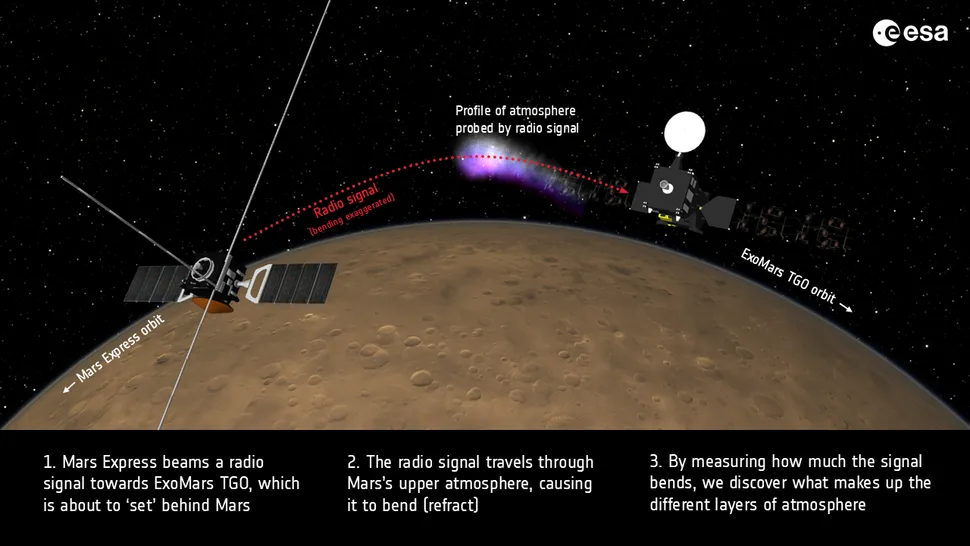
The two orbiters were able to monitor the storm using a technique known as radio occultation, which allowed researchers to analyse how the Martian atmosphere reacted to the incoming solar energy.
During the event, Mars Express transmitted radio signals toward the Trace Gas Orbiter as one spacecraft moved behind Mars relative to the other. As the signals passed through the atmosphere, scientists measured how they were refracted and distorted by different atmospheric layers.
This method revealed dramatic increases in electron density within the upper atmosphere. Measurements showed:
- A 45% increase in electrons at around 110 kilometres above the Martian surface
- A 278% increase in electrons at approximately 130 kilometres altitude
- The highest concentration of atmospheric electrons ever recorded at Mars
These spikes occurred when solar radiation and energetic particles stripped electrons from neutral atoms in the Martian atmosphere. The result was an unusually dense layer of charged particles surrounding the planet.
The timing of the observations proved extremely fortunate, as the orbiters happened to be in the right positions to capture the storm’s effects shortly after a major solar flare.
Spacecraft systems affected by intense radiation
The solar superstorm also demonstrated how space weather can affect spacecraft operating around other planets. Both Mars orbiters experienced temporary computer glitches during the storm as high-energy particles interfered with onboard electronics.
Radiation events like this are a known risk for spacecraft beyond Earth’s protective magnetic field. However, modern space probes are designed to cope with these conditions using radiation-hardened electronics and automated error-recovery systems.
Despite the intense radiation exposure, both Mars Express and the Trace Gas Orbiter recovered quickly and continued normal operations after the storm passed.
Understanding how solar storms interact with planetary atmospheres is also essential for future exploration missions. Space weather events could potentially disrupt communication systems or interfere with radar instruments used to study planetary surfaces.
Why Mars responds differently to solar storms
One of the key reasons this solar superstorm had such a dramatic effect on Mars is the absence of a global magnetosphere around the planet.
Earth’s magnetic field acts as a protective shield that deflects most charged solar particles away from the atmosphere. Some particles are guided toward the poles, where they create auroras such as the northern and southern lights.
Mars, however, lost its global magnetic field billions of years ago. Without this protective barrier, solar radiation and energetic particles can interact much more directly with the atmosphere.
This vulnerability allows solar storms to strip particles from the upper atmosphere more easily, gradually eroding the planet’s atmosphere over long periods of time.
Scientists believe this process played a major role in transforming Mars from a once wetter world into the cold, dry planet we see today.
New insights into Mars’ atmospheric history
The data gathered during this solar superstorm could help researchers better understand how Mars lost much of its atmosphere and surface water over billions of years.
Continuous exposure to solar wind and energetic solar storms likely contributed to the gradual escape of atmospheric gases into space. Over time, this atmospheric loss would have dramatically altered the planet’s climate and surface conditions.
Studying how modern solar storms interact with the Martian atmosphere helps scientists reconstruct how similar events may have shaped the planet’s evolution in the past.
The observations also highlight the importance of monitoring space weather when planning future robotic and human missions to Mars. Solar radiation events remain one of the major hazards for long-duration space exploration.
As more missions continue to study the Red Planet, events like this solar superstorm provide valuable real-world data about the powerful forces shaping planetary environments across our solar system.

