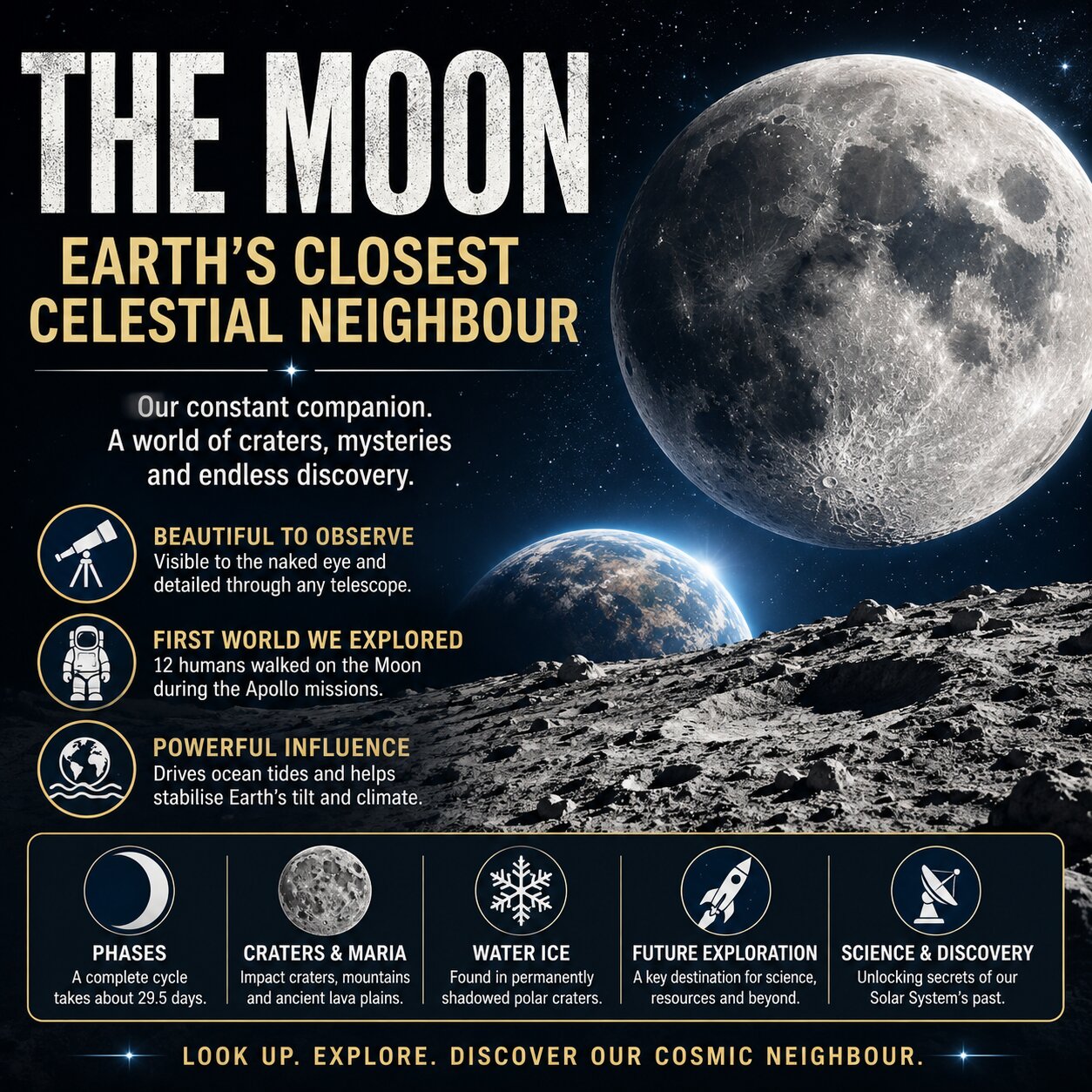

The Moon has watched over Earth for billions of years. It is the brightest object in our night sky, our planet’s only natural satellite, and the first world beyond Earth that humans have physically explored. Yet despite appearing familiar, the Moon is an extraordinary place filled with enormous impact basins, towering mountains, ancient lava plains and clues to the earliest history of our Solar System.
Orbiting Earth at an average distance of approximately 384,400 kilometres, the Moon is close enough for us to observe remarkable surface detail even with relatively modest telescopes. Its gravitational relationship with Earth also has profound effects on our planet, most noticeably through ocean tides.
For astronomers, however, the Moon is much more than a beautiful object to observe. Its heavily cratered surface preserves evidence of events stretching billions of years into the past. Because the Moon lacks Earth’s active weather systems and extensive geological recycling, many ancient features remain remarkably well preserved.
From its mysterious formation to the Apollo landings and today’s renewed race to explore its surface, the Moon remains one of humanity’s most important gateways to the cosmos.
Quick Stats: The Moon

| Category | Value |
|---|---|
| Type | Natural satellite |
| Age | Approximately 4.5 billion years |
| Diameter | Approximately 3,475 km |
| Radius | Approximately 1,737 km |
| Mass | 7.342 × 10²² kg |
| Surface Gravity | About 1.62 m/s² |
| Average Distance from Earth | Approximately 384,400 km |
| Orbital Period | About 27.3 Earth days |
| Phase Cycle | About 29.5 Earth days |
| Surface Temperature | Roughly −173°C to 127°C |
| Atmosphere | Extremely thin exosphere |
| Number of Moons | 0 |
| Escape Velocity | Approximately 2.38 km/s |
| First Human Landing | Apollo 11, 20 July 1969 |
| Humans to Walk on Moon | 12 |
How did the Moon form?
Scientists cannot travel back 4.5 billion years to watch the Moon being created, but evidence collected from lunar rocks, computer modelling and observations of the Solar System has produced a compelling explanation.
The leading theory is known as the giant-impact hypothesis.
According to this model, the young Earth collided with a planetary body commonly called Theia during the chaotic early history of the Solar System. The impact blasted enormous quantities of material into orbit around Earth.
That debris eventually accumulated under gravity and formed the young Moon.
The early Moon was dramatically different from the world we see today. Large portions of its surface were probably molten, creating what scientists describe as a lunar magma ocean. As this material cooled and differentiated, lighter minerals rose while denser materials sank deeper into the interior.
Billions of years of asteroid and comet impacts subsequently reshaped the surface, creating many of the craters and enormous basins we can still observe.
Inside the Moon: What lies beneath the surface?

The Moon isn’t simply a solid ball of rock. Like Earth, it has several internal layers.
At its centre is a relatively small metallic core containing primarily iron, with other elements also present. Surrounding the core is a mantle extending through much of the lunar interior, while the outermost rocky layer forms the crust.
The Moon was once considerably more geologically active than it is today.
Ancient volcanic eruptions allowed molten material to reach the surface and fill enormous impact basins. Once cooled, these lava flows produced the broad, dark regions easily visible from Earth.
These areas became known as maria, the Latin word for “seas”, because early astronomers once believed they might contain water.
They don’t.
Instead, the lunar maria consist largely of ancient basaltic lava plains, providing visible evidence of the Moon’s volcanic past.
Understanding the phases of the Moon
One of the most recognisable characteristics of the Moon is its constantly changing appearance.
The Moon doesn’t produce visible light of its own. What we see is sunlight reflected from its surface. As the Moon orbits Earth, our viewing angle relative to the illuminated half changes, producing the familiar lunar phases.
The primary phases include:
- New Moon
- Waxing Crescent
- First Quarter
- Waxing Gibbous
- Full Moon
- Waning Gibbous
- Third or Last Quarter
- Waning Crescent
A complete cycle from one New Moon to the next takes approximately 29.5 days.
Importantly, Earth’s shadow does not normally cause the phases of the Moon. That misconception is surprisingly common. Earth’s shadow only becomes involved during a lunar eclipse, when the Sun, Earth and Moon align sufficiently for the Moon to pass through Earth’s shadow.
Why do we always see the same side of the Moon?

Look at the Moon throughout the year and the same familiar features continue facing Earth.
This happens because the Moon is tidally locked to our planet.
It takes approximately 27.3 days for the Moon to rotate once on its axis and approximately the same amount of time to complete one orbit around Earth. Because these periods match, roughly the same lunar hemisphere continually faces us.
This doesn’t mean the opposite hemisphere is permanently dark.
The so-called far side of the Moon receives sunlight just like the near side. Depending on the Moon’s position in its orbit, both hemispheres experience periods of daylight and darkness.
The far side remained unseen by humans until spacecraft photography finally revealed it during the space age.
Craters, mountains and seas: Exploring the lunar surface
Even without expensive equipment, the Moon provides amateur astronomers with an extraordinary amount to observe.
Its surface contains hundreds of thousands of impact craters ranging from tiny depressions to enormous structures hundreds of kilometres across. Some younger craters are surrounded by bright rays of material thrown outward during the original impacts.
One of the most prominent is Tycho, whose brilliant ray system becomes particularly noticeable around the Full Moon.
Other famous lunar features include Copernicus crater, Plato crater, Mare Imbrium, Mare Serenitatis and Mare Tranquillitatis.
The last of these holds a particularly important place in human history.
Mare Tranquillitatis — the Sea of Tranquillity — was where Apollo 11 landed in July 1969.
Interestingly, the Full Moon isn’t necessarily the best time to observe lunar surface features through a telescope. Around the boundary between lunar day and night, known as the terminator, sunlight strikes the surface at a shallow angle.
Long shadows then reveal dramatic details around crater walls, mountain ranges and other terrain.
How the Moon affects Earth

The relationship between Earth and the Moon goes far beyond providing something beautiful to observe at night.
The Moon’s gravity contributes significantly to Earth’s ocean tides. As Earth rotates, gravitational interactions involving the Moon and Sun produce the regular rising and falling of sea levels experienced around our planet.
The Moon also helps stabilise Earth’s axial tilt over long periods. This contributes to a relatively stable climate compared with what Earth might experience if its orientation changed much more dramatically.
Our relationship is slowly changing, however.
The Moon is gradually moving away from Earth at roughly 3.8 centimetres per year. Measurements using lasers reflected from equipment left on the lunar surface have allowed scientists to track this tiny but persistent change with remarkable precision.
At the same time, tidal interactions are gradually affecting Earth’s rotation.
These changes are extraordinarily slow on human timescales, but over hundreds of millions and billions of years they become significant.
Humanity reaches the Moon
For most of human history, reaching the Moon belonged entirely to imagination.
That changed during the 20th century.
After increasingly ambitious robotic missions from the United States and Soviet Union, NASA’s Apollo 11 successfully landed astronauts Neil Armstrong and Buzz Aldrin on the Moon on 20 July 1969 while Michael Collins remained in lunar orbit.
Five further Apollo missions successfully landed astronauts on the lunar surface.
By the end of the Apollo programme, 12 people had walked on another world.
Astronauts conducted experiments, photographed the landscape, deployed scientific instruments and returned hundreds of kilograms of lunar material to Earth. Those samples transformed scientific understanding of both the Moon and the early Solar System.
Apollo wasn’t the end of lunar exploration, either.
Numerous nations have subsequently sent robotic orbiters, landers and other spacecraft towards the Moon, transforming it into an increasingly international destination for space exploration.
Water on a seemingly dry world
For decades, the Moon was commonly described as completely dry.
Modern observations have complicated that picture considerably.
Scientists have detected evidence of water ice in permanently shadowed regions near the lunar poles. Some craters in these areas receive little or no direct sunlight, allowing temperatures to remain extremely low for immense periods.
These potential resources have enormous implications for future exploration.
Water could support astronauts directly, while its hydrogen and oxygen components could potentially contribute to producing breathable oxygen or rocket propellant.
This is one reason why the Moon’s south polar region has become such an important target for modern lunar exploration.
Rather than merely visiting the Moon again, future missions increasingly aim to understand whether humans can establish a sustainable presence there.
The Moon as humanity’s gateway to deeper space
More than half a century after Apollo 11, the Moon has returned to the centre of human spaceflight ambitions.
NASA’s Artemis programme and lunar programmes involving numerous other countries and commercial organisations are developing technologies intended to return humans to the lunar environment and expand robotic exploration.
The scientific possibilities are enormous.
Researchers want to investigate lunar geology, search for resources, study permanently shadowed regions and use the Moon to learn more about the early Solar System. The far side could also eventually provide interesting opportunities for radio astronomy because it is naturally shielded from much of Earth’s radio interference.
Perhaps most importantly, operating on the Moon provides experience that could eventually support missions much farther from Earth.
Mars may be the great destination frequently discussed when imagining humanity’s future in space, but the Moon is considerably closer.
It provides somewhere to learn how humans, habitats, vehicles and equipment perform beyond Earth before committing crews to journeys lasting months rather than days.
Our companion in the night sky
The Moon is simultaneously one of the easiest astronomical objects to observe and one of the most scientifically fascinating worlds in our Solar System.
You don’t need a giant telescope to begin exploring it. Even binoculars can reveal major maria and craters, while a small telescope transforms the lunar surface into a landscape filled with mountains, valleys, shadows and impact scars.
Yet our closest celestial neighbour still has much to teach us.
Its rocks preserve evidence from the earliest history of the Solar System. Its polar regions may contain resources capable of supporting future explorers. Its gravitational relationship with Earth continues influencing our oceans and planet billions of years after the two worlds formed.
And after thousands of years of humans looking upward and wondering what might be there, the Moon became the first world beyond Earth upon which humanity left its footprints.
The next chapter of that story is only beginning.