
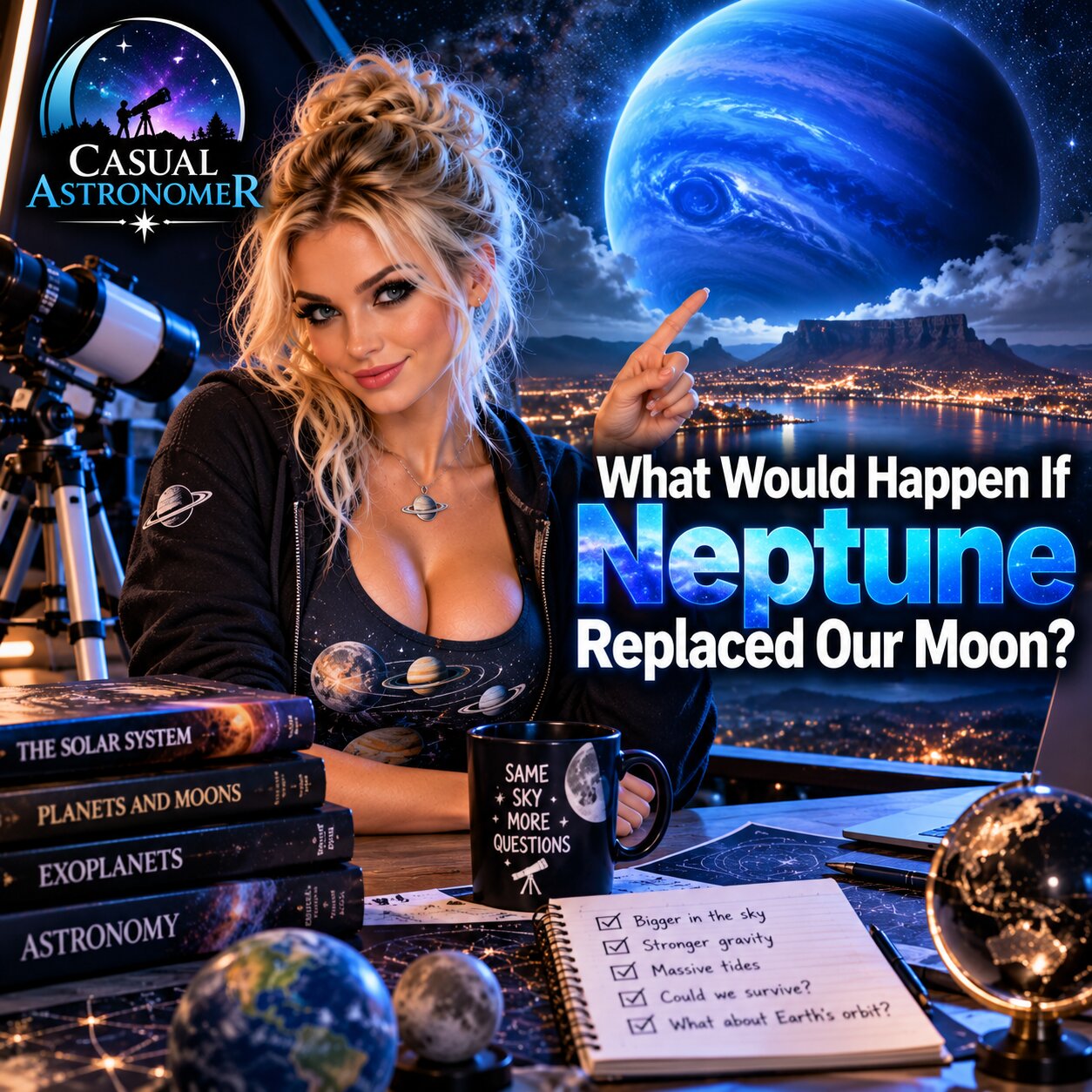

Imagine stepping outside tonight and discovering that our familiar Moon has disappeared. In its place hangs an enormous blue planet, its atmospheric bands stretching across the night sky. The sight would be extraordinary, transforming Earth’s celestial landscape into something resembling a science-fiction illustration.
But what would actually happen if Neptune replaced our Moon? Assuming the giant planet suddenly appeared at approximately the Moon’s current distance from Earth, the consequences would be far more dramatic than an impressive new view.
A Giant Blue World in Our Sky
Neptune is approximately 49,244 kilometres across, making it nearly fourteen times wider than Earth’s Moon. At the Moon’s average orbital distance of roughly 384,400 kilometres, Neptune would appear dramatically larger in our sky.
Its apparent diameter would be approximately 7.3 degrees, compared with the Moon’s familiar half-degree appearance. This means the blue planet would stretch across an enormous portion of the night sky.
Neptune’s atmosphere, dominated by hydrogen and helium with methane contributing to its blue appearance, would create a fascinating spectacle. However, the planet would not necessarily display the vivid colours and details familiar from enhanced spacecraft imagery.
Neptune’s Gravity Would Be Catastrophic
The real problem would be Neptune’s enormous mass. Although it is much smaller than Jupiter or Saturn, Neptune contains approximately 17 times Earth’s mass and more than 1,400 times the mass of our Moon.
Replacing the Moon with such a massive planet would fundamentally change the gravitational relationship between the two worlds.
Potential consequences include:
- Extreme tidal forces: Neptune would produce vastly stronger tidal effects than our Moon, potentially devastating coastal regions.
- Severe crustal deformation: Powerful gravitational forces could flex Earth’s crust and contribute to intense geological disturbances.
- Orbital disruption: Earth and Neptune would orbit a shared centre of mass, significantly changing Earth’s movement through space.
- Environmental instability: Rapid changes in ocean circulation and planetary motion would create widespread disruption.
- A transformed night sky: Neptune would dominate the heavens, producing extraordinary planetary views.
These effects would make the scenario extremely dangerous for life on Earth.
Would Earth Become Neptune’s Moon?
Under the influence of Neptune’s greater mass, Earth would effectively become the smaller partner in a two-planet system. The shared centre of mass would lie much closer to Neptune than to Earth.
However, the situation would not resemble a stable version of our present Earth-Moon arrangement. At their assumed separation, the gravitational relationship between Earth, Neptune and the Sun would be profoundly altered.
The system’s subsequent evolution would depend on the initial velocities and positions of both planets. A sudden replacement would not automatically produce a stable orbit.
Could We Survive the Change?
The immediate gravitational effects would be devastating. Neptune’s tidal influence would generate enormous stresses within Earth’s oceans and solid structure, while the altered orbital dynamics could threaten long-term stability.
Even if Earth somehow avoided a collision or complete orbital catastrophe, civilisation would face environmental challenges far beyond anything experienced in recorded history.
The spectacular blue planet overhead would offer little consolation to those dealing with the consequences below.
A Beautiful but Terrifying Cosmic Experiment
Neptune replacing our Moon is an entertaining thought experiment because it demonstrates how carefully balanced our planetary environment really is. The Moon does much more than decorate the night sky. Its gravitational influence shapes tides and contributes to the long-term behaviour of Earth’s rotation and axial orientation.
Replacing it with a giant planet would reveal just how significant those relationships are.
Fortunately, Neptune remains billions of kilometres away, safely occupying its distant orbit around the Sun.
For now, we can appreciate its mysterious blue atmosphere through telescopes and spacecraft observations without worrying about an enormous planet appearing outside our bedroom windows.


