Astronomers have observed the birth of one of the most extreme objects in the universe for the first time. A massive stellar explosion has revealed the formation of a rapidly spinning neutron star known as a magnetar, confirming a long-standing theory about how these incredibly magnetic stars are created.
The discovery links the formation of magnetars to superluminous supernovae, a rare class of stellar explosions that shine far brighter and last longer than typical supernova events. Scientists have suspected this connection for years, but direct evidence had been missing until now.
The breakthrough observation provides new insight into how some of the most powerful magnetic objects in the universe are formed.
What makes magnetars so extraordinary
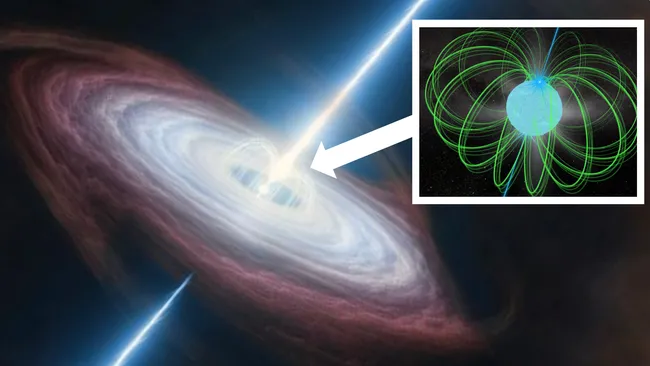
Magnetars are a rare type of neutron star with magnetic fields far stronger than any other known object in the universe. These compact remnants are created when massive stars collapse after exhausting their nuclear fuel.
Although neutron stars are already extremely dense, magnetars push the limits of physics even further. Their magnetic fields can be hundreds to thousands of times stronger than those of ordinary neutron stars.
To put this into perspective, the magnetic field of a magnetar can be trillions of times stronger than Earth’s magnetic field. These intense magnetic forces can affect nearby matter and even distort the structure of atoms.
Magnetars are also known for their rapid rotation. Newly formed neutron stars can spin hundreds of times every second, releasing enormous amounts of energy into surrounding space.
A supernova brighter than most
The observation began with a supernova event detected in late 2024, designated SN 2024afav. This explosion occurred around one billion light-years from Earth and was initially detected by the global telescope network operated by the Las Cumbres Observatory.
Unlike typical supernovae, which gradually fade after reaching peak brightness, this event behaved differently. After reaching its brightest point around 50 days after the explosion, the light from the supernova showed unusual fluctuations.
Astronomers observed several repeating increases in brightness, which researchers described as “chirps” in the supernova’s light curve.
These signals hinted that something unusual was happening inside the expanding debris of the exploded star.
The hidden engine inside the explosion
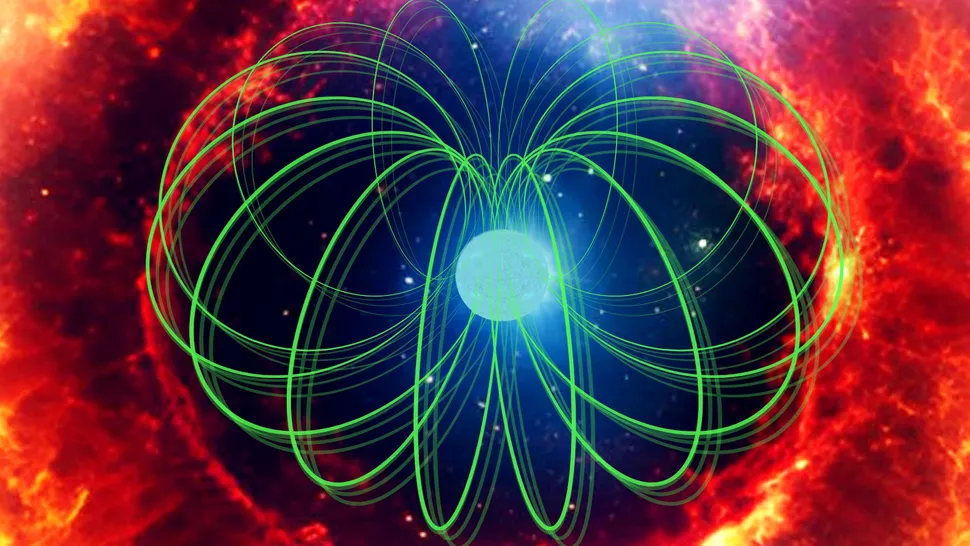
Scientists believe these brightness fluctuations are caused by the newly formed magnetar at the heart of the explosion.
When the massive star collapsed, its core compressed into a neutron star only about 20 kilometres across. As the star shrank dramatically, its rotation speed increased — similar to how an ice skater spins faster when pulling in their arms.
This rapid rotation, combined with an extremely powerful magnetic field, created a magnetar spinning around 238 times per second.
The magnetar continued injecting energy into the expanding supernova debris. This additional energy source explains why superluminous supernovae shine much brighter than ordinary stellar explosions.
Einstein’s theory appears in a supernova
The strange “chirp” signals observed in the supernova’s brightness appear to be linked to an effect predicted by Einstein’s theory of general relativity.
After the explosion, some material fell back toward the magnetar and formed a swirling disk of gas known as an accretion disk. Because the disk and the magnetar’s rotation were not perfectly aligned, the disk began to wobble.
This wobble is caused by a phenomenon called frame dragging, where a massive spinning object drags spacetime along with it. The effect, known as the Lense–Thirring effect, can cause nearby material to precess or wobble.
As the disk wobbled around the magnetar, it occasionally blocked or reflected light from the central engine. This created the repeating brightness signals seen in the supernova’s light curve.
This marks the first time general relativity has been required to explain the internal mechanics of a supernova event.
Confirming a long-standing cosmic theory
For decades, astronomers suspected that magnetars were responsible for the incredible brightness of superluminous supernovae. The idea was that the spinning magnetar would act like a powerful energy engine inside the explosion.
However, proving that a magnetar actually formed during such an event had remained difficult.
The unusual light patterns observed in SN 2024afav provided the missing evidence. The timing and structure of the signals match predictions from magnetar-powered supernova models.
The data also revealed the strength of the object’s magnetic field, estimated to be around 300 trillion times stronger than Earth’s magnetic field, confirming the object as a magnetar.
A new window into extreme cosmic physics
The observation of this magnetar’s birth gives astronomers an unprecedented look into one of the most powerful processes in the universe.
By studying events like SN 2024afav, scientists can better understand how massive stars die, how neutron stars form and how magnetars generate such extraordinary magnetic fields.
These discoveries also highlight the role of general relativity in extreme cosmic environments, where gravity, magnetism and stellar explosions interact in complex ways.
As telescopes continue to improve, astronomers hope to detect more events like this one, revealing even more about the violent processes that shape the universe.