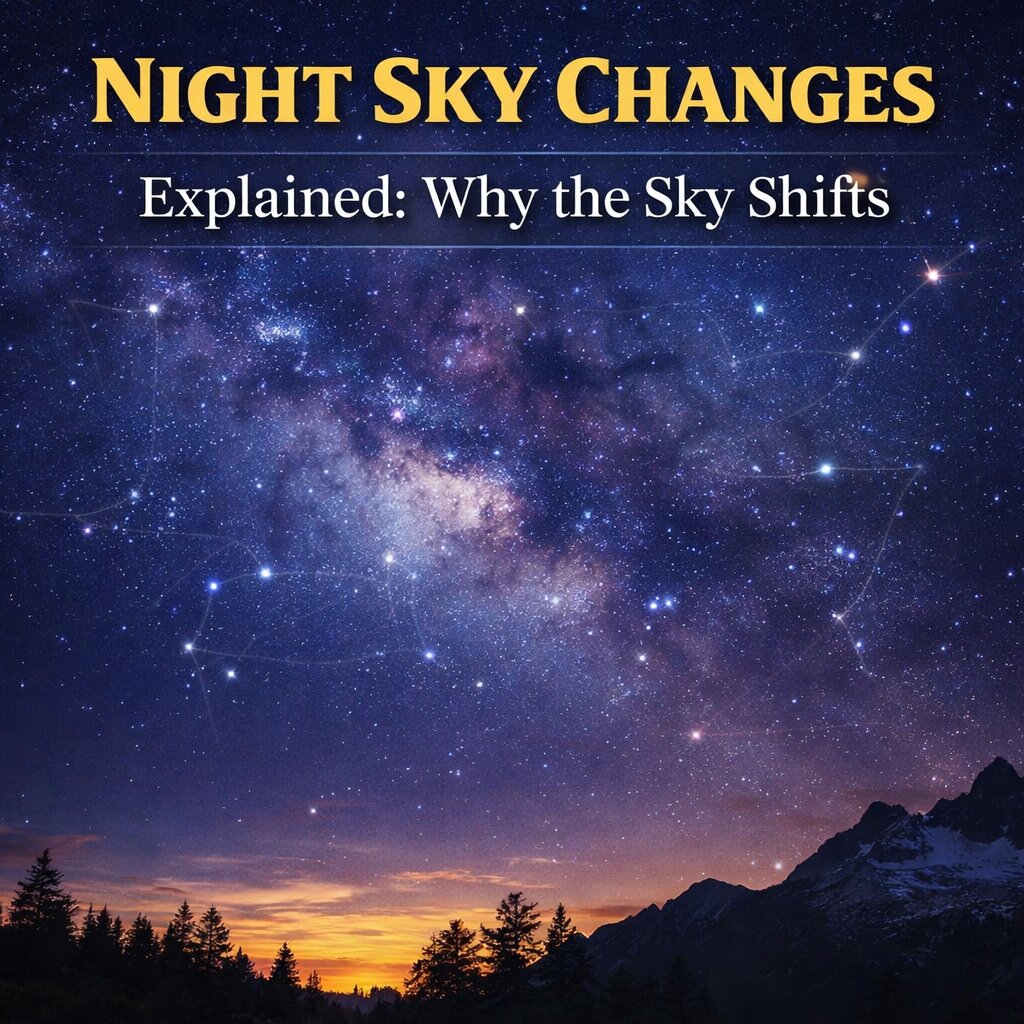

If you spend enough time looking up, you will begin to notice something fascinating. The night sky is not fixed. The stars, constellations and planets slowly shift, changing their positions over hours, days and seasons.
These night sky changes can feel subtle at first, but once you understand what is happening, you begin to see patterns everywhere. The sky becomes something alive, constantly moving and evolving rather than a static backdrop.
In this guide, we explore why night sky changes occur and how long it takes for familiar objects to return to the same place in the sky.
The Earth’s rotation and nightly movement

The most immediate cause of night sky changes is the rotation of the Earth. As our planet spins on its axis, the sky appears to move from east to west.
This is why stars rise in the east and set in the west, much like the Sun during the day. Over the course of a single night, constellations will slowly drift across the sky, changing their position hour by hour.
If you observe the same group of stars at different times during the night, you will notice this movement clearly. What starts low on the horizon may end up high overhead or disappearing completely by morning.
This daily motion is predictable and consistent, forming the foundation of how we track objects in the night sky.
Why the sky changes from season to season

Beyond the nightly movement, there are longer-term night sky changes that occur over weeks and months. These are caused by the Earth’s orbit around the Sun.
As the Earth travels along its orbit, the direction we face at night changes. This means we are looking at different parts of space at different times of the year.
For example, constellations visible in summer may not be visible in winter. They have not disappeared. They are simply positioned in the daytime sky, hidden by the Sun’s brightness.
This is why the night sky feels different depending on the season. Each time of year offers its own set of constellations and celestial objects to observe.
How long it takes for stars to return to the same position
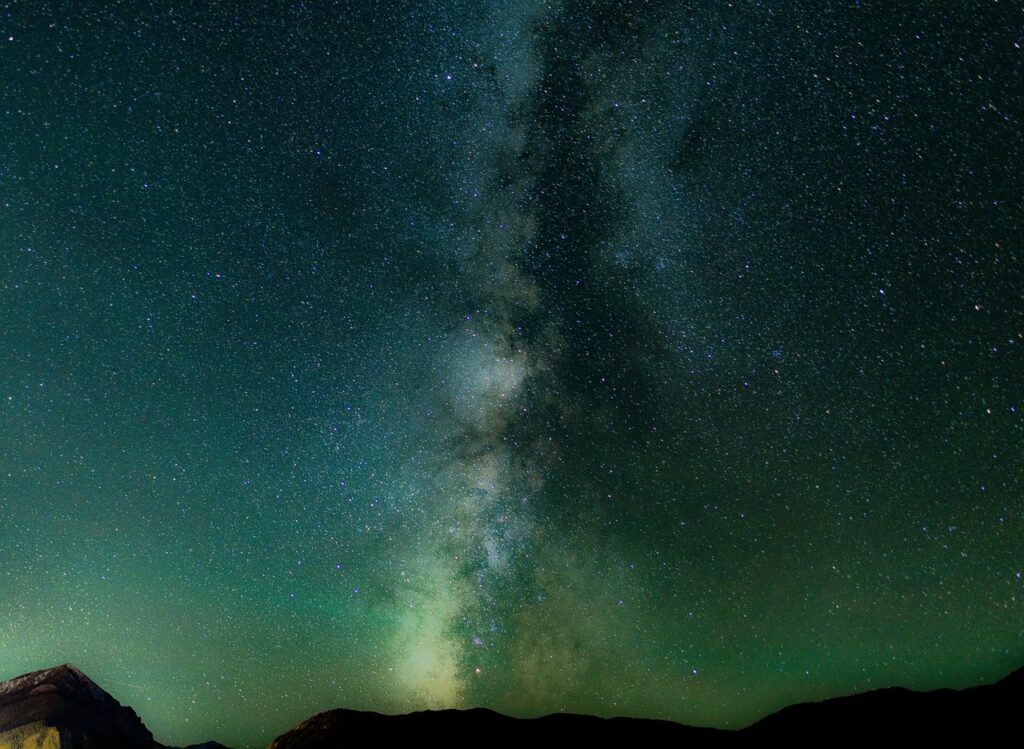
One of the most interesting aspects of night sky changes is how long it takes for stars to return to the same place in the sky.
You might expect this to happen every 24 hours, but the reality is slightly different. The Earth completes one full rotation relative to the stars in about 23 hours and 56 minutes. This is known as a sidereal day.
Because of these night sky changes, the stars appear about four minutes earlier each night. Over the course of a month, this adds up significantly, causing constellations to shift noticeably in the evening sky.
After a full year, the cycle completes, and the same constellations return to roughly the same position at the same time of night.
Why planets move differently from stars

While stars follow predictable patterns, planets behave differently, adding another layer to night sky changes.
Planets orbit the Sun just like Earth, but at different speeds and distances. This causes them to move against the background of stars over time.
You may notice a bright object that appears to “wander” from one constellation to another over days or weeks. This is a planet, not a star.
Sometimes, planets even appear to move backwards for a short period. This effect, known as retrograde motion, is caused by the relative motion between Earth and the other planet.
Because of this, planets do not return to the same position in the sky on a simple daily or yearly cycle like stars do.
Long-term changes in the night sky
There are also very slow night sky changes that occur over thousands of years. These are caused by the gradual wobble of the Earth’s axis, a process known as precession.
This movement changes the orientation of the Earth over time, slowly altering which stars are visible and how constellations appear.
For example, the current North Star will not always hold that position. Over long periods, different stars take its place as the Earth’s axis shifts.
While these changes are not noticeable within a human lifetime, they are an important part of understanding how dynamic the universe truly is.
Final thoughts
Night sky changes remind us that the universe is always in motion. What may seem fixed at first glance is actually part of a complex and beautifully coordinated system.
From the daily rotation of the Earth to its yearly orbit around the Sun, and even the slow shifts over thousands of years, every movement contributes to how we see the sky.
Once you begin to recognise these patterns, stargazing becomes more than observation. It becomes understanding.
And with that understanding, the night sky becomes far more than just something to look at.
It becomes something to follow. 🌌🔥