

The Sun is the heart of our Solar System and the driving force behind life on Earth. Every planet, asteroid, comet, and moon within our cosmic neighbourhood is bound to it by gravity. Without the Sun’s energy, Earth would become a frozen and lifeless world drifting through darkness. Yet despite being so familiar in our daily lives, the Sun remains one of the most extraordinary and powerful objects humans have ever studied.
As a massive sphere of superheated plasma, the Sun constantly generates energy through nuclear fusion deep within its core. This process releases incredible amounts of heat and light that travel across space to warm our planet and sustain ecosystems. From weather systems and ocean currents to plant growth and climate cycles, nearly every natural process on Earth depends on solar energy in some way.
For astronomers, the Sun is also an important scientific laboratory. By studying it closely, scientists gain valuable insight into how stars form, evolve, and eventually die. The Sun may appear calm from Earth, but it is actually an active and dynamic star capable of violent eruptions and magnetic storms that can affect entire planets.
Quick Stats: The Sun
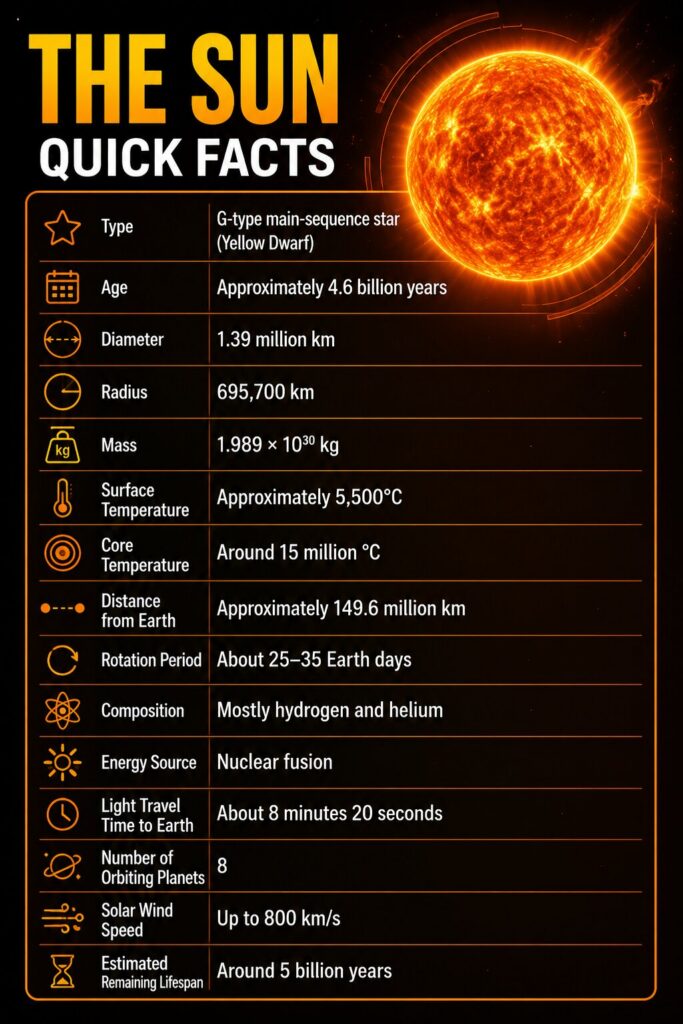
| Category | Value |
|---|---|
| Type | G-type main-sequence star (Yellow Dwarf) |
| Age | Approximately 4.6 billion years |
| Diameter | 1.39 million km |
| Radius | 695,700 km |
| Mass | 1.989 × 10³⁰ kg |
| Surface Temperature | Approximately 5,500°C |
| Core Temperature | Around 15 million °C |
| Distance from Earth | Approximately 149.6 million km |
| Rotation Period | About 25–35 Earth days |
| Composition | Mostly hydrogen and helium |
| Energy Source | Nuclear fusion |
| Light Travel Time to Earth | About 8 minutes 20 seconds |
| Number of Orbiting Planets | 8 |
| Solar Wind Speed | Up to 800 km/s |
| Estimated Remaining Lifespan | Around 5 billion years |
The Sun’s role in the Solar System
The Sun contains approximately 99.8% of all the mass in the Solar System. Its immense gravity controls the motion of every major object orbiting it, from giant planets like Jupiter to distant icy bodies in the Kuiper Belt.
Earth orbits the Sun at an average distance of about 149.6 million kilometres, a distance known as one astronomical unit. This positioning places our planet within the habitable zone where temperatures allow liquid water to exist. If Earth were significantly closer or farther away, life as we know it would likely be impossible.
The Sun also drives the seasons through Earth’s axial tilt. As our planet orbits the Sun throughout the year, different hemispheres receive varying amounts of sunlight, creating seasonal climate changes across the globe.
Even beyond visible light, the Sun constantly emits radiation and charged particles into space. This stream of particles, known as the solar wind, shapes planetary magnetospheres and influences space weather throughout the Solar System.
Inside the Sun: Layers of a giant star

The Sun may appear like a glowing ball from Earth, but internally it consists of several complex layers working together to produce and transfer energy outward into space.
At the centre lies the core, where temperatures reach around 15 million degrees Celsius. Here, immense pressure forces hydrogen atoms to fuse into helium through nuclear fusion. This process releases enormous amounts of energy in the form of gamma rays.
Surrounding the core is the radiative zone, where energy slowly travels outward through radiation. Photons generated in the core may take thousands or even millions of years to pass through this dense region due to constant collisions with particles.
Above this lies the convective zone. In this layer, hot plasma rises toward the surface while cooler plasma sinks downward, creating convection currents similar to boiling water. These movements help transfer energy toward the visible surface.
The visible outer layer is called the photosphere, which is what we see from Earth. Above it are the chromosphere and corona, the Sun’s outer atmosphere. Surprisingly, the corona becomes far hotter than the surface itself, reaching temperatures of several million degrees.
Solar activity and powerful eruptions
Although the Sun appears steady from Earth, it is an incredibly active and turbulent star. Magnetic activity constantly shapes its surface and atmosphere, producing dramatic events that can affect planets across the Solar System.
Some of the most important solar phenomena include:
- Sunspots caused by intense magnetic fields
- Solar flares that release massive bursts of radiation
- Coronal mass ejections that eject billions of tons of plasma
- Solar wind streams flowing throughout the Solar System
- Auroras triggered when solar particles interact with planetary atmospheres
Solar storms can sometimes interfere with satellites, GPS systems, radio communication, and power grids on Earth. Strong coronal mass ejections may trigger geomagnetic storms capable of affecting global technology infrastructure.
Fortunately, Earth’s magnetic field helps shield the planet from much of the Sun’s harmful radiation. Without this protective magnetosphere, life on Earth would face far greater exposure to dangerous solar particles.
The Sun also operates on an approximately 11-year solar cycle during which magnetic activity rises and falls. During solar maximum, sunspots and solar storms become more frequent and intense.
The future life of the Sun

Like all stars, the Sun will not last forever. It is currently about halfway through its main-sequence lifespan, steadily converting hydrogen into helium through nuclear fusion.
In roughly 5 billion years, the Sun will begin exhausting the hydrogen fuel within its core. As this happens, the core will contract while outer layers expand dramatically. The Sun will transform into a red giant, potentially engulfing Mercury and Venus and possibly reaching Earth itself.
During this phase, temperatures on Earth would become far too extreme for life to survive. Oceans would evaporate, and the planet would eventually become a scorched and barren world.
After the red giant phase, the Sun will shed its outer layers into space, forming a planetary nebula. The remaining core will collapse into a white dwarf, a dense stellar remnant roughly the size of Earth that will slowly cool over billions of years.
While this future lies unimaginably far away, studying the Sun helps astronomers understand the life cycles of stars throughout the universe.
Our closest star and the source of life
The Sun is far more than a bright object in the sky. It is the engine of our Solar System, the source of Earth’s energy, and one of the most important astronomical objects humanity has ever studied. From sustaining life to shaping planetary systems and influencing space weather, the Sun affects nearly every aspect of existence on our planet.
Despite centuries of scientific observation, the Sun still holds many mysteries. Questions surrounding solar magnetism, coronal heating, and stellar evolution continue driving research and space missions today. As humanity develops more advanced telescopes and solar probes, our understanding of this remarkable star will continue growing.
For now, the Sun remains both familiar and extraordinary, a reminder that even the most common sights in our daily lives can hold unimaginable power and complexity.

