Asteroid 16 Psyche has long fascinated scientists due to its unusual composition and structure. Unlike most asteroids, which are primarily rocky, Psyche appears to be rich in metal, leading to the theory that it could be the exposed core of a failed planet.
Now, new research suggests that giant craters on its surface may hold the key to confirming this theory. By studying how these craters formed, scientists are gaining valuable insight into what lies beneath the asteroid’s surface.
This breakthrough comes as part of ongoing efforts to understand planetary formation during the early days of the solar system. Psyche offers a rare opportunity to study what might be the internal structure of a planetary body without needing to dig deep into a planet like Earth.
With NASA’s Psyche spacecraft already on its way, these findings arrive at a crucial time, setting the stage for what could become one of the most important space discoveries of the decade.
Simulating massive impacts to understand Psyche’s interior
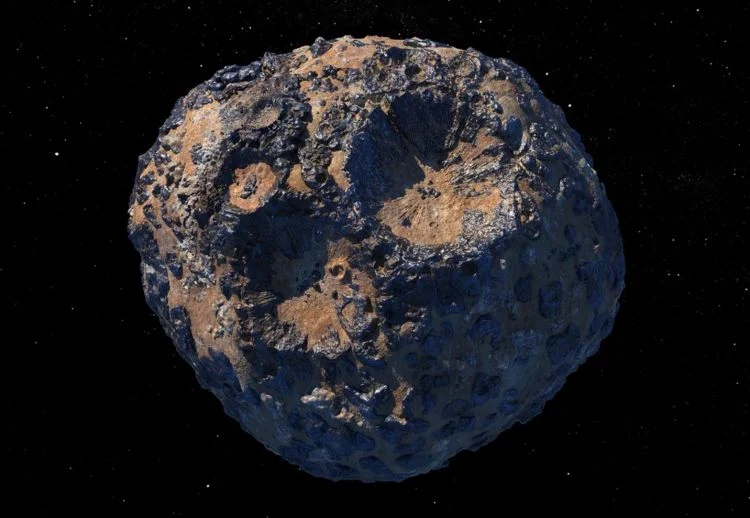
To better understand Psyche, researchers used advanced 3D computer simulations to model how large impacts shaped the asteroid’s surface. These simulations focused particularly on a massive crater near Psyche’s north polar region.
Because direct observations are still limited, scientists relied on these models to test different theories about Psyche’s internal structure. The asteroid’s irregular, potato-like shape and its large impact basin were key factors in the simulations.
The team explored multiple scenarios, including whether Psyche is made of a single uniform material or has a layered structure with a metallic core and rocky exterior. Each possibility produces different crater shapes and behaviours during impacts.
One of the most important factors studied was porosity, or the amount of empty space within the asteroid. This property significantly affects how impacts occur and how craters form, offering critical clues about Psyche’s composition.
What giant craters reveal about planetary formation
The study found that crater characteristics, particularly their depth and width, are closely linked to the asteroid’s internal structure. Stronger, denser interiors tend to preserve more material from impacts, while weaker, more porous structures behave very differently.
This means that by analysing crater shapes, scientists can infer what lies beneath the surface. On Psyche, these craters may act as natural probes, exposing information about its internal makeup.
If Psyche is indeed the remnant of a planetary core, it would provide direct evidence of how early planets formed and evolved. Most planetary cores are hidden deep beneath layers of rock, making them impossible to study directly.
Psyche, however, could offer a unique window into this hidden world. Understanding its structure could reshape current models of planetary formation, not just in our solar system but across the universe.
Key discoveries from the Psyche crater study
The research has already revealed several important insights that could guide future exploration and analysis:
- Porosity plays a major role in how impact craters form and evolve
- Crater depth-to-diameter ratios can indicate internal composition
- Psyche may have either a layered structure or a mixed composition
- Large impacts could expose deeper materials from within the asteroid
- Crater preservation varies depending on the strength of the interior
These findings provide a framework for interpreting future data from NASA’s Psyche mission. Once the spacecraft arrives, scientists will be able to compare real observations with these models.
This combination of simulation and direct exploration will help refine our understanding of Psyche and similar objects.
NASA’s Psyche mission and what comes next
NASA’s Psyche spacecraft, launched in 2023, is expected to arrive at the asteroid in 2029. Its mission is to study Psyche in detail and determine whether it truly is the exposed core of a protoplanet.
This mission is particularly significant because it represents the first opportunity to directly explore what could be the interior of a planetary body. On Earth, reaching the core is impossible with current technology, making Psyche an invaluable scientific target.
The spacecraft will analyse the asteroid’s composition, magnetic field, and surface features, providing data that could confirm or challenge current theories.
As new information becomes available, scientists will be able to test their models and refine their understanding of how planets form and evolve.
A glimpse into the hidden hearts of planets
The study of Psyche’s giant craters is more than just an investigation into a single asteroid. It represents a broader quest to understand the building blocks of planets and the processes that shaped our solar system.
If Psyche is confirmed as a planetary core, it would mark a historic milestone in space exploration. It would allow scientists to study something that has never been directly observed before.
Beyond our solar system, these insights could also help researchers identify similar bodies around other stars, potentially revealing new clues about planetary systems and the conditions needed for life.
For now, all eyes remain on Psyche as it continues its journey through space. With each new discovery, we move closer to unlocking the secrets hidden within the cores of worlds.
As always, keep doing science and keep looking up. 🚀✨