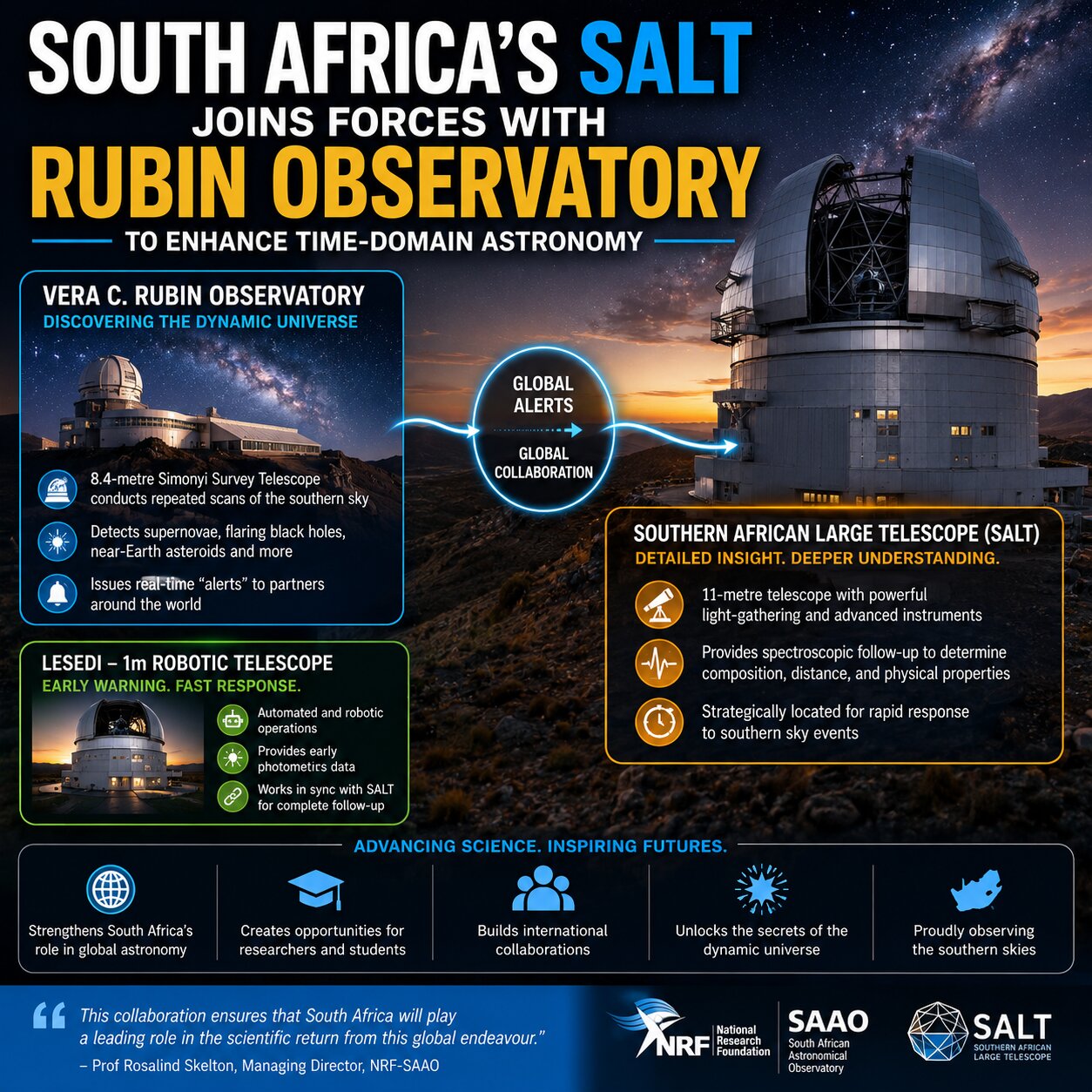

South Africa’s role in global astronomy continues to grow as the Southern African Large Telescope (SALT) begins an exciting collaboration with the Vera C. Rubin Observatory. This partnership strengthens South Africa’s position in time-domain astronomy, a rapidly evolving field focused on observing celestial events that change over time.
The collaboration will see SALT responding to selected astronomical alerts issued by the Rubin Observatory in Chile. These alerts identify newly detected cosmic events such as supernovae, flaring black holes, and potentially hazardous near-Earth asteroids. By combining Rubin Observatory’s wide-field sky monitoring with SALT’s powerful spectroscopic capabilities, astronomers hope to gain deeper insight into some of the universe’s most dynamic and short-lived phenomena.
What makes the Rubin Observatory so important?
The Vera C. Rubin Observatory is currently one of the most ambitious astronomical survey projects ever developed. Located in Chile, the observatory uses the massive 8.4-metre Simonyi Survey Telescope to repeatedly scan the southern sky for changes and transient events.
Unlike traditional observatories that may focus on specific targets, Rubin Observatory continuously monitors huge sections of the sky. This allows it to quickly detect sudden cosmic events that may only remain visible for hours, days, or weeks.
Once unusual activity is detected, alerts are distributed globally to partner observatories for follow-up observations. These alerts create opportunities for other telescopes to study the physical nature, movement, composition, and behaviour of newly discovered objects in far greater detail.
This real-time observation system is transforming how astronomers study the dynamic universe.
Why SALT plays a critical role
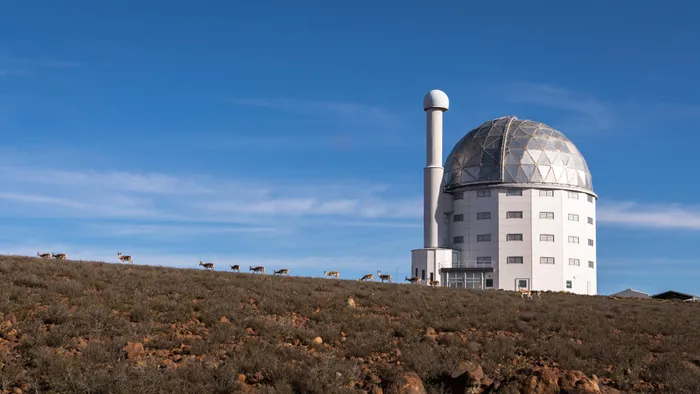
South Africa’s SALT telescope, located at the National Research Foundation’s South African Astronomical Observatory in Sutherland, offers several unique advantages within this collaboration.
As the largest single optical telescope in the southern hemisphere, SALT features an impressive 11-metre segmented primary mirror designed for exceptional light-gathering performance. Its advanced spectroscopic instruments allow scientists to analyse the light emitted by distant celestial objects in extraordinary detail.
While Rubin Observatory specialises in discovering new events rapidly across the sky, SALT excels at investigating what those objects actually are. Spectroscopy allows astronomers to determine important characteristics including:
- Chemical composition
- Distance from Earth
- Temperature and motion
- Physical behaviour and evolution
- Energy signatures and object classification
This makes SALT an ideal follow-up telescope for transient astronomical events detected by Rubin Observatory.
South Africa’s geographic location also provides a major advantage. Since SALT observes the same southern skies monitored by Rubin Observatory, it can respond quickly to time-sensitive alerts before objects fade or evolve further.
Lesedi and South Africa’s intelligent observatory systems
The collaboration also highlights the growing importance of South Africa’s Intelligent Observatory programme. Part of this initiative includes the robotic 1-metre telescope called Lesedi, which works alongside SALT in monitoring transient astronomical objects.
Lesedi can automatically respond to alerts and rapidly gather early photometric data on newly discovered events. This helps astronomers understand how an object changes in brightness over time before SALT performs more detailed spectroscopic analysis.
Together, Rubin Observatory, Lesedi, and SALT form a highly coordinated astronomical observation network capable of detecting, monitoring, and analysing cosmic events with remarkable speed and precision.
This combination of technologies strengthens South Africa’s scientific infrastructure while supporting global astronomical research efforts.
A major opportunity for South African astronomy

The SALT and Rubin Observatory collaboration represents more than just a scientific partnership. It also creates significant opportunities for South African researchers, universities, and astronomy students.
By participating directly in major international discoveries, local scientists gain access to cutting-edge astronomical data and global research networks. Students and researchers can contribute to studies involving black holes, supernovae, variable stars, asteroid monitoring, and other important cosmic phenomena.
South Africa has steadily become an important hub for international astronomy thanks to facilities such as SALT, MeerKAT, and the country’s involvement in the Square Kilometre Array project. Collaborations like this further strengthen the country’s reputation within the global scientific community.
As time-domain astronomy continues advancing, South African observatories are increasingly helping shape humanity’s understanding of how the universe changes in real time.
Watching the universe unfold in real time
The partnership between SALT and the Rubin Observatory marks an exciting new chapter for South African astronomy. By combining powerful discovery systems with detailed follow-up analysis, astronomers are gaining new tools to explore the rapidly changing universe around us.
From exploding stars and flaring black holes to asteroid tracking and cosmic mysteries yet to be discovered, this collaboration ensures South Africa remains at the forefront of modern astronomical research. The universe is constantly changing, and thanks to observatories like SALT, South Africa is helping the world watch those changes unfold in real time.