
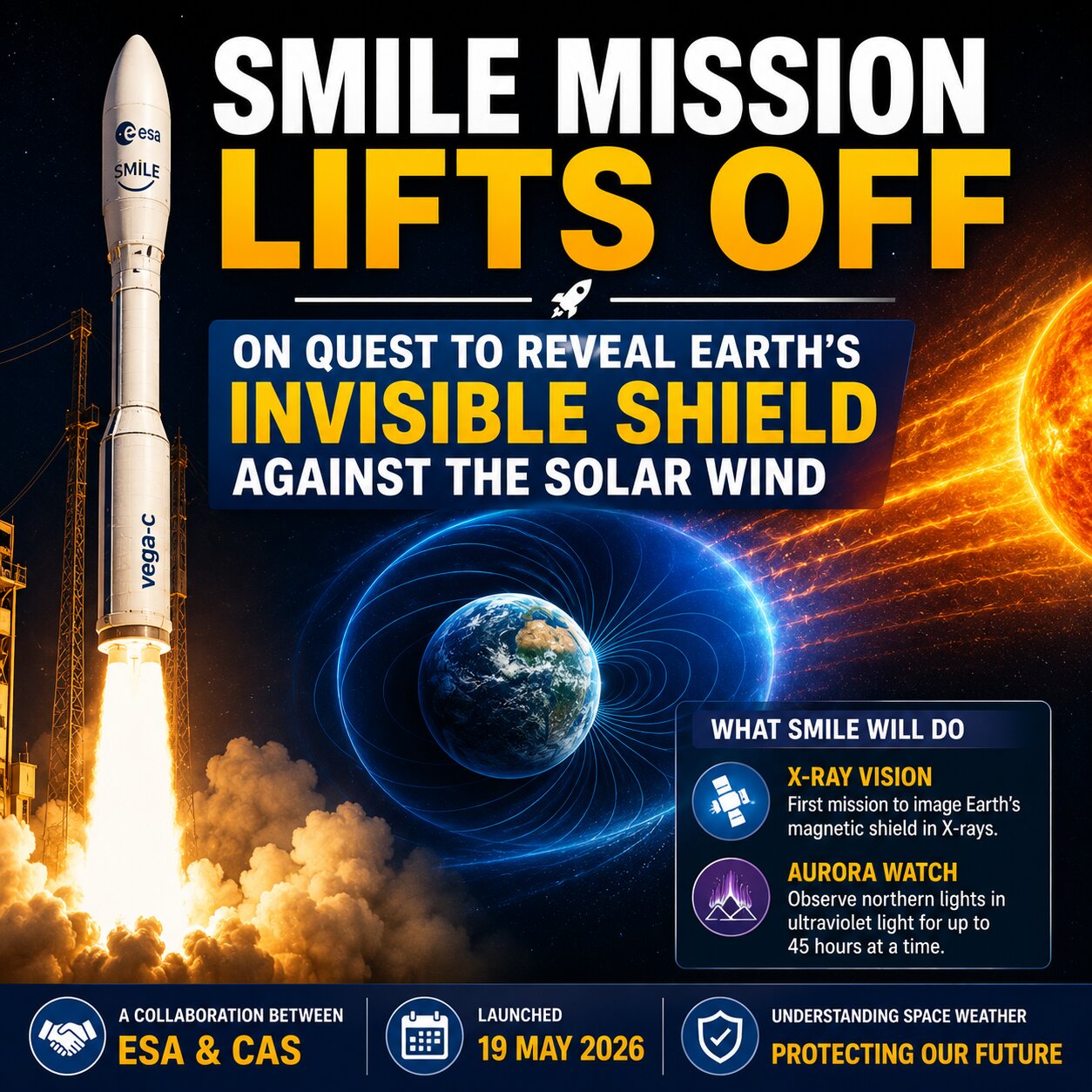

A major new chapter in space science has officially begun as the Smile mission spacecraft successfully launched aboard a Vega-C rocket from Europe’s Spaceport in French Guiana on 19 May 2026. The ambitious mission aims to study how Earth’s invisible magnetic shield protects the planet from powerful solar winds and space weather events.
The mission, known as Smile, is a collaboration between the European Space Agency (ESA) and the Chinese Academy of Sciences (CAS). It will use advanced X-ray and ultraviolet imaging systems to observe Earth’s magnetosphere and auroras in ways never achieved before.
Scientists hope the mission will help improve humanity’s understanding of solar storms, geomagnetic disturbances, and how space weather affects both Earth and future space exploration.
Watching Earth’s magnetic shield in action
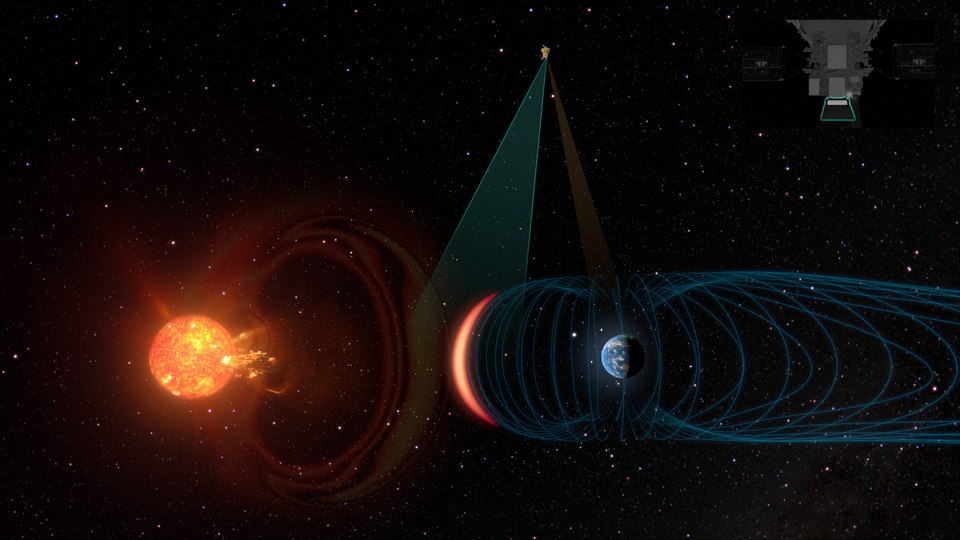
One of the most exciting aspects of the Smile mission is its ability to observe Earth’s magnetosphere using X-ray vision. This protective magnetic bubble shields the planet from dangerous charged particles streaming from the Sun.
Although scientists have studied the magnetosphere for decades, Smile will provide the first complete visual observations of how solar wind impacts Earth’s magnetic defences in real time.
The spacecraft will also continuously monitor the northern lights for up to 45 hours at a time using ultraviolet imaging technology. These observations will help scientists better understand how solar storms trigger auroras near Earth’s poles.
Space weather remains an important scientific field because strong solar storms can disrupt satellites, communication systems, navigation networks, and even power grids on Earth. Missions like Smile could help improve forecasting models and future protection systems.
ESA officials described the mission as one of the most ambitious attempts yet to study how Earth responds to the Sun’s constant bombardment of radiation and energetic particles.
A mission built through international cooperation
The Smile mission represents a major international collaboration between Europe and China. According to ESA, the project involved contributions from numerous scientific institutes, engineering teams, and companies across multiple countries.
European teams contributed several key components, including the spacecraft payload module and the X-ray camera system developed in the United Kingdom. Airbus Defence and Space in Spain also played a major role in building parts of the spacecraft.
The mission demonstrates how international partnerships continue driving modern space exploration forward, especially in complex scientific projects requiring years of research, engineering, and testing.
Some of the major goals of the Smile mission include:
- Studying how solar wind interacts with Earth’s magnetosphere
- Observing geomagnetic storms in real time
- Monitoring auroras using ultraviolet imaging
- Improving space weather prediction models
- Helping protect satellites and future astronauts
The mission is expected to operate for several years as scientists collect and analyse large amounts of new data about Earth’s magnetic environment.
Preparing for years of space science discoveries
Although the launch marks a huge milestone, Smile’s scientific operations are only beginning. Over the next several weeks, the spacecraft will gradually raise its orbit through multiple engine burns before entering a highly elliptical orbit around Earth.
This special orbit will allow the spacecraft to travel far above Earth’s North Pole before descending closer to the Southern Hemisphere, giving it ideal viewing conditions for observing the magnetosphere and auroras.
The spacecraft’s instruments will undergo testing and calibration before full scientific operations begin later this year. Scientists are particularly excited about the mission’s ability to combine X-ray and ultraviolet observations to create a more complete picture of Earth’s interaction with solar activity.
As humanity becomes increasingly dependent on satellites, communications infrastructure, and future crewed space missions, understanding space weather has never been more important.
A new era for studying space weather
The successful launch of Smile marks the beginning of a new era in studying Earth’s invisible magnetic shield and the effects of solar activity on our planet. By combining advanced imaging technologies with international scientific collaboration, the mission could unlock major discoveries about space weather and Earth’s protective magnetosphere.
For astronomers and scientists, Smile represents more than just another spacecraft. It is an opportunity to finally observe one of Earth’s most important natural defence systems in action, helping humanity better understand the dynamic relationship between our planet and the Sun.

