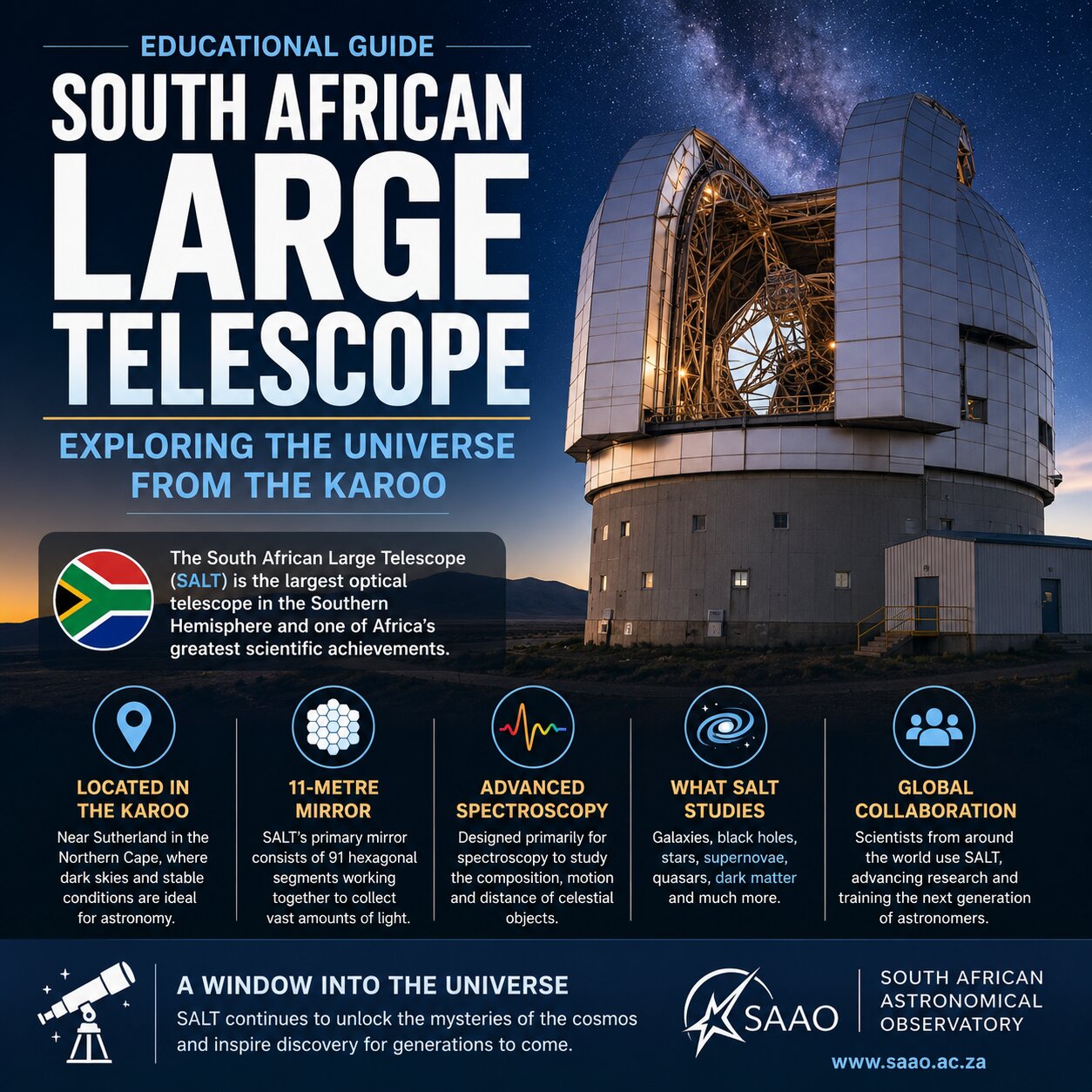

The South African Large Telescope (SALT) is the largest optical telescope in the Southern Hemisphere and one of Africa’s most significant scientific achievements. Located in the remote Karoo region of South Africa, SALT allows astronomers to study distant galaxies, stars, black holes, and other fascinating objects across the universe.
Since beginning scientific operations in 2005, the telescope has contributed to major discoveries while helping establish South Africa as a global leader in astronomy and space science.
Where is SALT located?
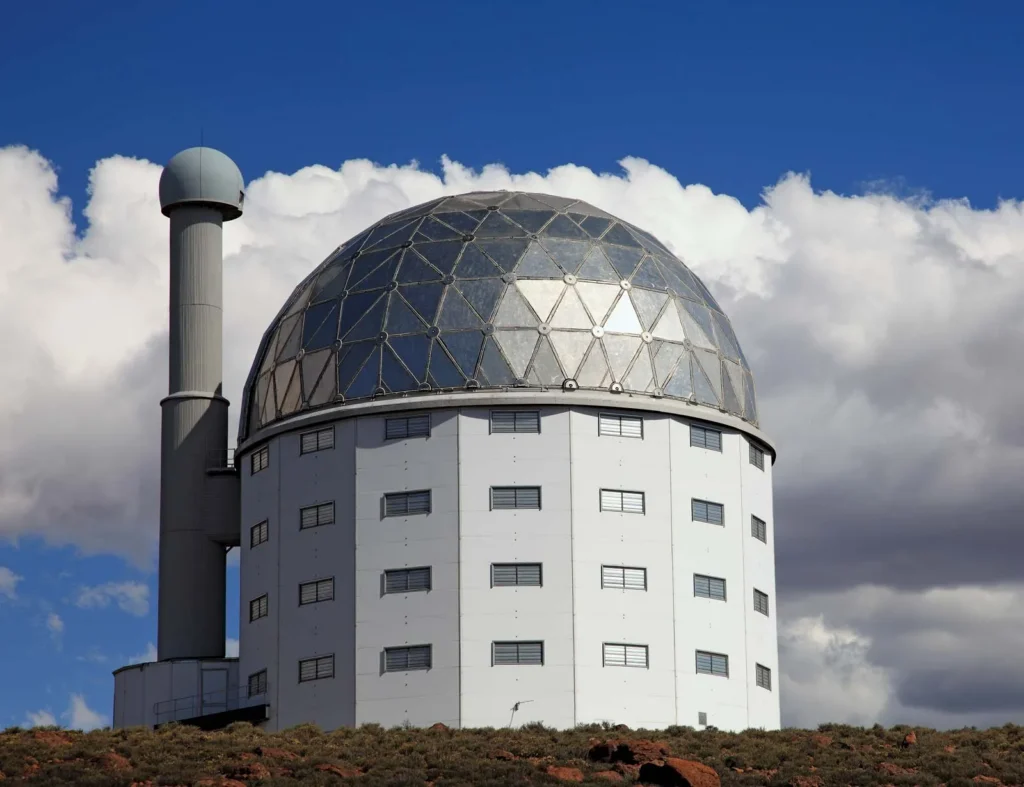
The South African Large Telescope is situated near the small town of Sutherland in the Northern Cape. This region was selected because of its dark skies, low levels of light pollution, dry climate, and stable atmospheric conditions.
These factors make the Karoo one of the best places in the world for astronomical observations. The telescope forms part of the South African Astronomical Observatory’s observing facilities and attracts researchers from around the globe.
Its remote location helps ensure that artificial light does not interfere with sensitive observations of distant celestial objects.
How large is the telescope?
The most impressive feature of the South African Large Telescope is its enormous primary mirror. Rather than using a single piece of glass, SALT’s mirror consists of 91 precisely aligned hexagonal mirror segments.
Together, these segments create an effective mirror diameter of approximately 11 metres, allowing the telescope to collect large amounts of light from extremely faint objects.
This design was inspired by the famous Hobby–Eberly Telescope in Texas, although SALT includes several improvements tailored to its scientific mission.
What does SALT study?
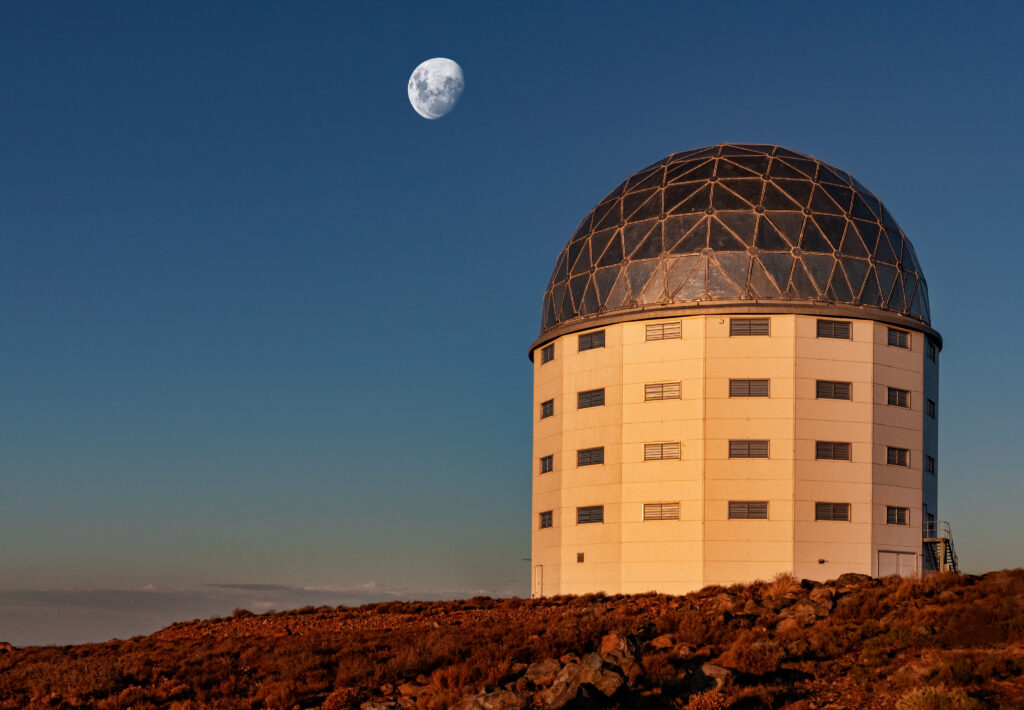
The South African Large Telescope is designed primarily for spectroscopy, a technique that analyses the light emitted by celestial objects.
Scientists use SALT to investigate:
- Distant galaxies
- Black holes
- Supernovae
- Star formation regions
- Variable stars
- Quasars
- Dark matter research
- Planetary nebulae
By studying how light changes across different wavelengths, astronomers can determine the composition, temperature, motion, and distance of objects throughout the universe.
Many observations focus on objects that are billions of light-years away, providing insights into the early history of the cosmos.
Why SALT is important for astronomy
The South African Large Telescope plays a critical role in international astronomy research. Scientists from multiple countries collaborate on observing programmes and share access to the telescope’s capabilities.
Because SALT is located in the Southern Hemisphere, it can observe areas of the sky that many northern observatories cannot easily access. This makes it an important complement to major facilities located elsewhere in the world.
The telescope also helps train the next generation of African astronomers, engineers, and researchers while supporting scientific education across the continent.
A gateway to the southern skies
The South African Large Telescope stands as one of South Africa’s greatest scientific achievements. Its powerful mirror system and advanced instruments allow researchers to explore some of the most distant and mysterious objects in the universe.
From studying black holes and exploding stars to investigating the origins of galaxies, SALT continues to expand humanity’s understanding of the cosmos while showcasing Africa’s growing role in world-class astronomy.
For anyone interested in astronomy, space exploration, or scientific discovery, the South African Large Telescope remains a remarkable window into the universe.