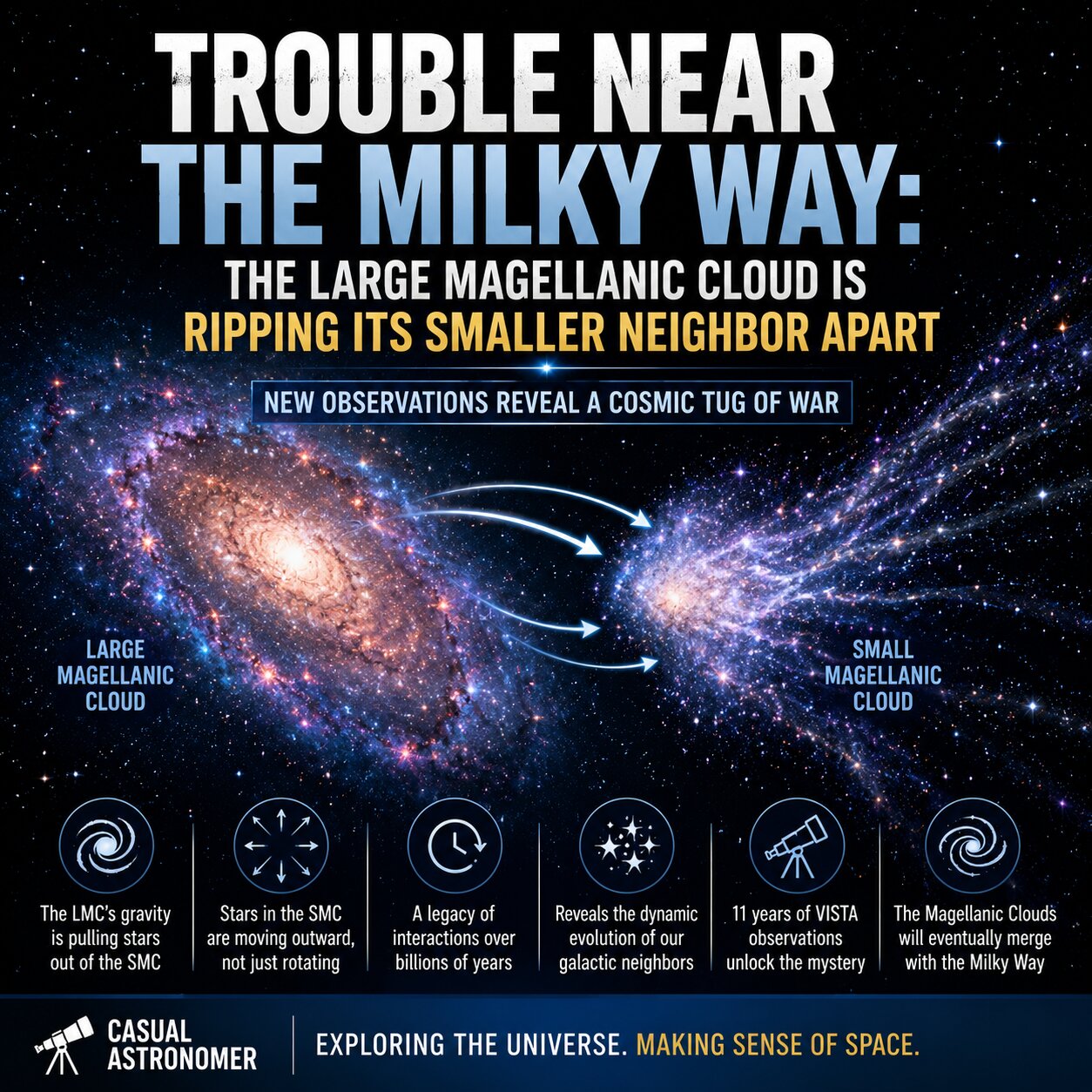

Astronomers have uncovered new evidence showing that the Large Magellanic Cloud (LMC) is actively pulling apart its smaller companion, the Small Magellanic Cloud (SMC). Located in the southern skies and easily visible from South Africa under dark conditions, these two dwarf galaxies have long fascinated both professional and amateur astronomers.
New observations reveal that the relationship between the galaxies is far more dramatic than previously thought. Instead of simply orbiting together through space, the larger galaxy appears to be stretching and disrupting the smaller one through powerful gravitational forces.
The findings provide fresh insight into how galaxies evolve and interact over billions of years.
A Closer Look at the Magellanic Clouds
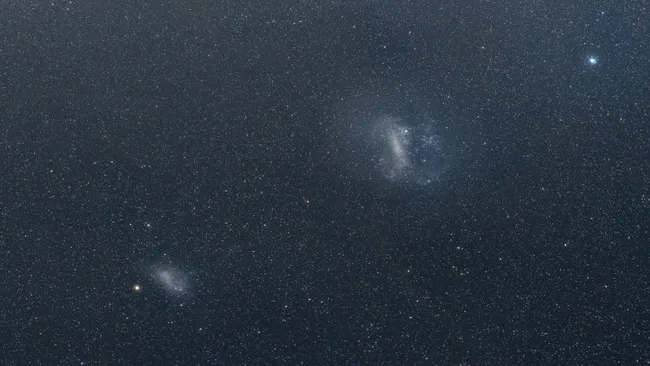
The Large and Small Magellanic Clouds are two dwarf irregular galaxies that travel through space alongside our own Milky Way Galaxy. The LMC lies approximately 163,000 light-years from Earth, while the SMC is located around 200,000 light-years away.
For observers in the Southern Hemisphere, both galaxies appear as faint glowing patches in the night sky. Although they look peaceful through a telescope or binoculars, the reality is far more turbulent.
Astronomers have known for years that both galaxies are influenced by the Milky Way’s gravity. However, recent research suggests that the LMC itself is playing a major role in reshaping the structure of the SMC.
The discovery highlights the complex gravitational interactions taking place within our local galactic neighbourhood.
Tracking Millions of Stars
Researchers used data gathered by the Visible and Infrared Survey Telescope for Astronomy (VISTA) in Chile. Over more than a decade, the survey tracked the movement of millions of stars within both Magellanic Clouds.
By measuring how these stars move through space, astronomers were able to build a detailed picture of the internal behaviour of the SMC. What they found was surprising.
Instead of rotating in an organised manner, many stars appear to be moving outward from the centre of the galaxy. Their motion follows a pattern that points directly back toward the LMC.
This suggests that the stronger gravitational pull of the larger galaxy is gradually stretching the smaller galaxy apart.
What the Evidence Reveals
The observations revealed several important findings:
- Stars within the SMC are moving outward rather than rotating normally.
- The direction of movement aligns with the position of the LMC.
- Gravitational interactions have likely influenced the SMC for billions of years.
- The structure of the SMC may once have been far more compact.
- Older stars preserve evidence of previous gravitational encounters.
- The ongoing distortion is changing the shape of the galaxy.
Together, these findings paint a picture of a galaxy slowly being reshaped by its larger neighbour.
A Glimpse into Galactic Evolution
Galaxies are not static objects. They constantly interact with their surroundings through gravity, collisions, and mergers. The relationship between the Magellanic Clouds provides astronomers with a rare opportunity to observe these processes relatively close to home.
The stellar motions act like a historical record, preserving evidence of events that occurred billions of years ago. By studying these movements, researchers can reconstruct the history of the galaxies and better understand how such interactions influence galactic evolution.
Scientists believe the Magellanic Clouds are still travelling together and will continue interacting for billions of years before eventually becoming part of the Milky Way itself.
Their future may ultimately involve merging with our galaxy as they slowly lose energy through gravitational interactions.
Watching a Cosmic Tug of War
The latest findings reveal that the Large Magellanic Cloud is doing far more than simply accompanying its smaller neighbour across the cosmos. Its gravity appears to be steadily pulling the Small Magellanic Cloud apart, reshaping its structure and influencing the motion of its stars.
For astronomers and stargazers alike, the Magellanic Clouds offer a fascinating reminder that the universe is constantly changing. Even galaxies that appear serene from Earth can be caught in dramatic gravitational battles that unfold over billions of years.
As new observations continue to improve our understanding of these nearby galaxies, the story of this cosmic tug of war is likely far from over.