
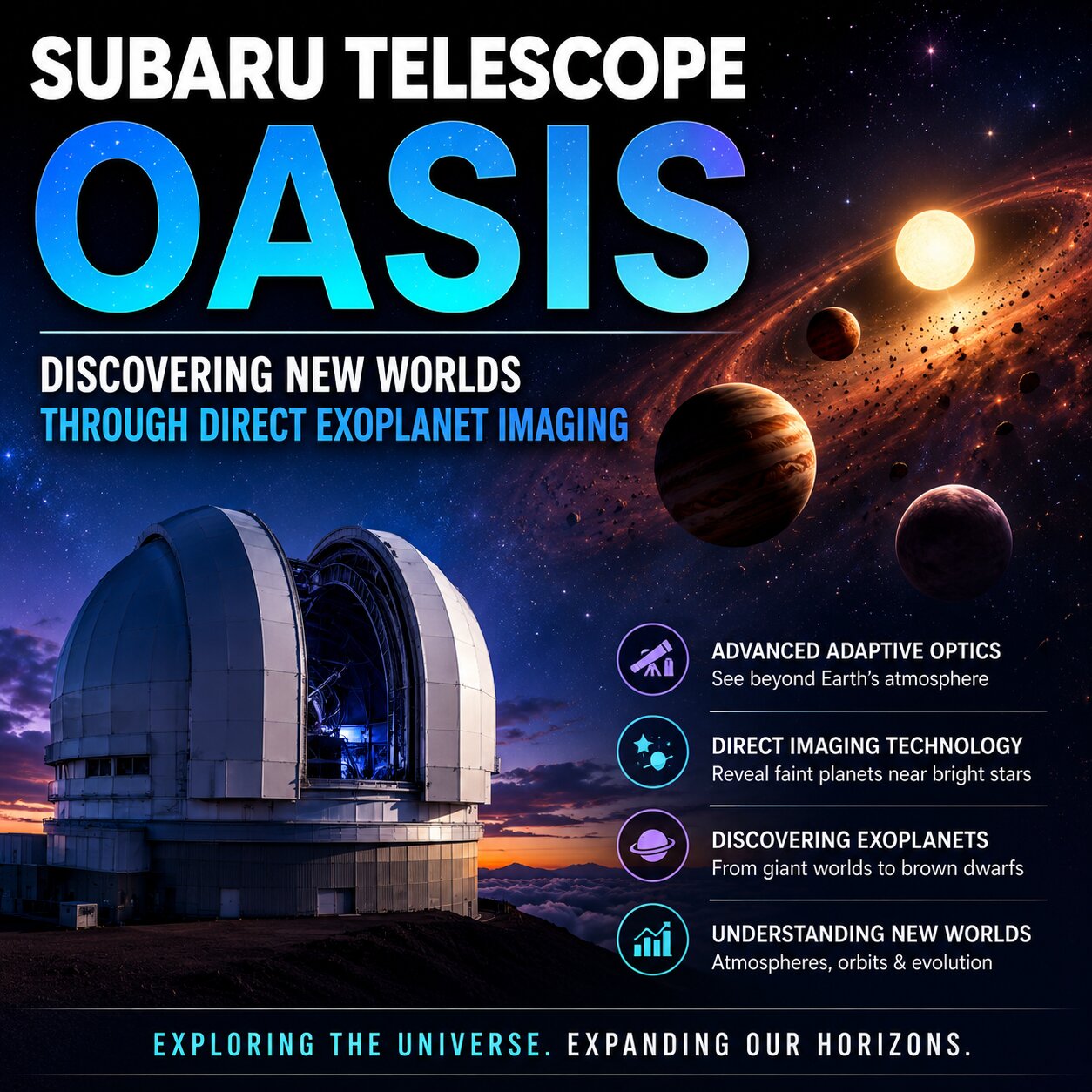

The search for planets beyond our Solar System has entered an exciting new chapter with the Subaru Telescope OASIS survey. Using some of the world’s most advanced adaptive optics technology, astronomers are directly imaging distant planetary systems and brown dwarfs that were previously hidden from view. Rather than relying solely on indirect detection methods, OASIS is allowing scientists to observe these distant worlds in remarkable detail, providing valuable insights into how planetary systems form and evolve.
Located atop Maunakea in Hawaii, the Subaru Telescope has long been at the forefront of astronomical discovery. The OASIS programme builds upon this legacy by combining cutting-edge instrumentation with data from space missions to identify promising planetary companions around nearby stars.
What Is the Subaru Telescope OASIS Survey?

The Subaru Telescope OASIS survey stands for Observing Accelerators with SCExAO Imaging Survey. Its primary goal is to discover and characterise massive exoplanets and brown dwarfs using direct imaging rather than relying exclusively on transit or radial velocity techniques.
Direct imaging is one of astronomy’s most challenging observational methods because planets are vastly fainter than the stars they orbit. OASIS overcomes this challenge through Subaru’s advanced adaptive optics systems, coronagraphs, and high-contrast imaging capabilities.
By suppressing the overwhelming glare of a host star, astronomers can reveal faint planetary companions that would otherwise remain invisible.
The Technology Behind OASIS
One of the key strengths of the Subaru Telescope OASIS programme is its use of the Subaru Coronagraphic Extreme Adaptive Optics (SCExAO) instrument.
SCExAO continuously corrects distortions caused by Earth’s atmosphere, producing exceptionally sharp images. Combined with instruments such as CHARIS, astronomers can both detect and analyse the atmospheres of directly imaged companions.
This combination enables researchers to determine properties including:
- Planet or brown dwarf mass
- Atmospheric temperature
- Orbital characteristics
- Chemical composition
- Evolutionary stage
These observations help scientists compare planetary systems across our galaxy.
First Discoveries from the Survey
The first published results from the Subaru Telescope OASIS survey demonstrated the programme’s tremendous potential.
Astronomers announced the discovery of previously unknown substellar companions orbiting distant stars using a combination of Subaru observations and precision astrometric measurements from the Gaia and Hipparcos space missions. These discoveries included objects massive enough to bridge the gap between giant planets and brown dwarfs, providing valuable laboratories for studying planetary evolution.
Because these companions were directly imaged, researchers could investigate their atmospheres and physical characteristics far more thoroughly than many exoplanets detected through indirect methods.
Why Direct Imaging Matters
Most known exoplanets have been discovered by observing how they affect their parent stars.
Transit surveys detect tiny decreases in starlight when planets pass in front of their stars, while radial velocity techniques measure the subtle gravitational pull planets exert on stellar motion.
Direct imaging offers something different.
Scientists can observe the planet itself, allowing detailed studies of atmospheric chemistry, cloud structures, temperatures, and even weather patterns on distant worlds.
As imaging technology continues to improve, astronomers expect to detect smaller and cooler planets that increasingly resemble those found within our own Solar System.
Subaru’s Continuing Role in Planetary Science

The Subaru Telescope continues to be one of the world’s premier facilities for exoplanet research.
Projects such as OASIS complement other Subaru initiatives, including next-generation adaptive optics upgrades and expanding high-contrast imaging capabilities that will further improve the search for distant planetary systems. These developments are also helping prepare astronomers for future observatories that will investigate Earth-like worlds around nearby stars.
As new discoveries emerge, the Subaru Telescope OASIS survey is expected to reveal even more hidden companions throughout our galactic neighbourhood.
Looking Toward New Planetary Discoveries
The Subaru Telescope OASIS programme demonstrates how modern astronomical technology is transforming our understanding of planetary systems beyond the Solar System.
By combining adaptive optics, coronagraphy, precision astrometry, and direct imaging, researchers are uncovering worlds that were once impossible to observe. Each discovery adds another piece to the puzzle of how planets form, evolve, and survive around their parent stars.
As OASIS continues surveying nearby stellar systems, it promises to deliver exciting new insights into the diversity of planets that populate our galaxy, bringing us one step closer to understanding our place in the universe.

Leave a Reply