
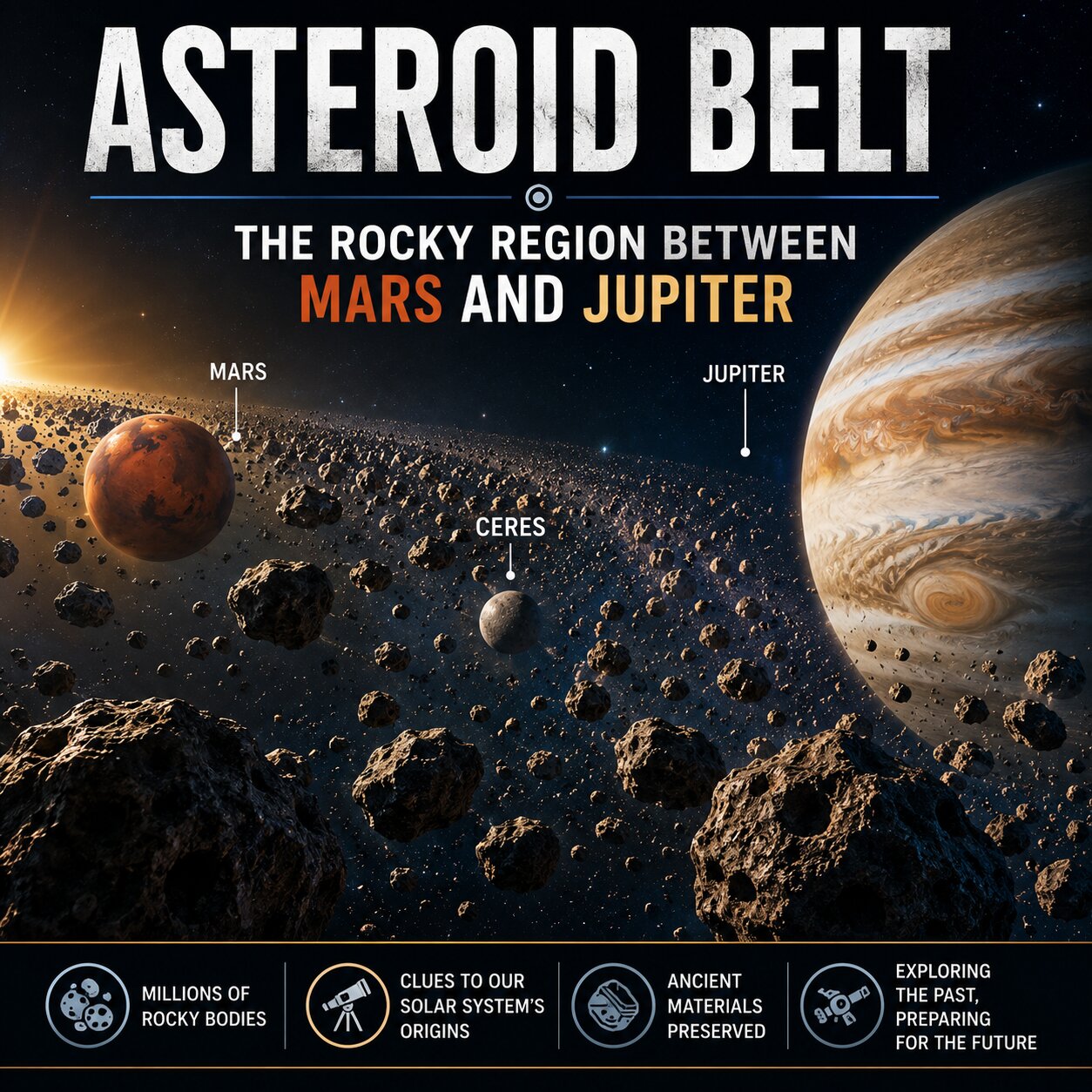

The Asteroid Belt is one of the most fascinating regions of our Solar System. Located between the orbits of Mars and Jupiter, it contains millions of rocky bodies ranging in size from tiny dust particles to dwarf planets hundreds of kilometres across. Although films often portray it as a densely packed obstacle course for spacecraft, the reality is far different, with enormous distances separating most objects.
Studying the Asteroid Belt helps astronomers understand how our Solar System formed approximately 4.6 billion years ago. These ancient rocky bodies preserve clues about the early stages of planetary formation, making the region an important destination for both scientific observation and space exploration.
Where The Asteroid Belt Is Located
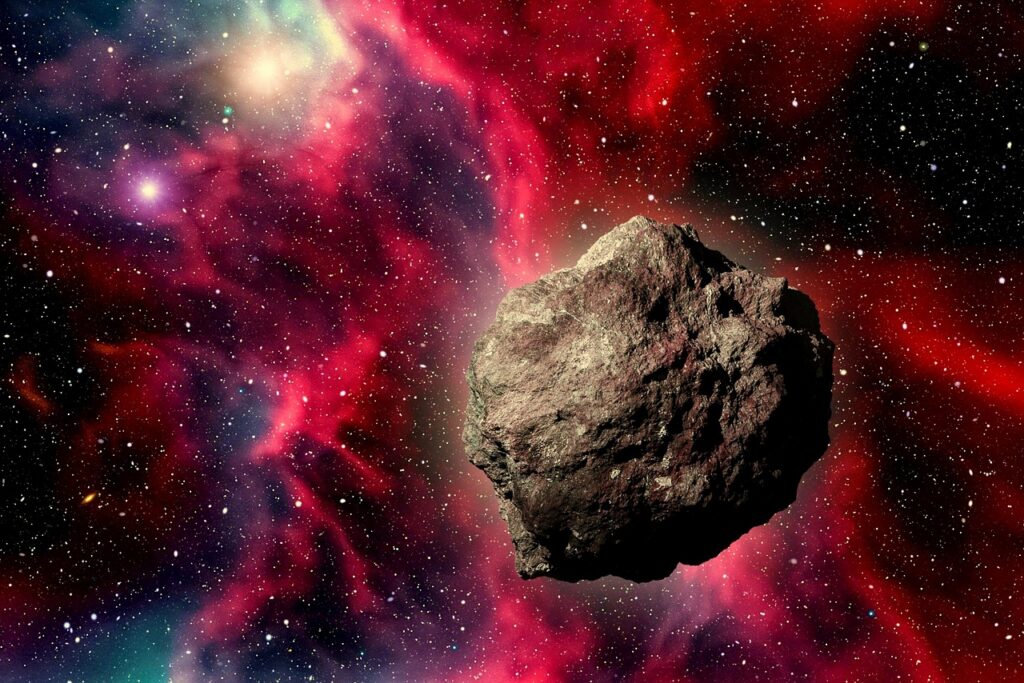
The main Asteroid Belt occupies a broad region extending between the orbits of Mars and Jupiter, roughly 2.1 to 3.3 astronomical units (AU) from the Sun. One astronomical unit represents the average distance between the Earth and the Sun.
Despite containing millions of asteroids, the total mass of the belt is surprisingly small. Scientists estimate that all of its objects combined account for only about four percent of the Moon’s mass.
The largest objects include the dwarf planet Ceres, along with Vesta, Pallas and Hygiea. These bodies account for a significant portion of the belt’s total mass while thousands of smaller asteroids orbit alongside them.
The powerful gravity of nearby Jupiter also influences the orbital paths of many asteroids, creating gaps known as Kirkwood Gaps where relatively few objects are found.
How The Asteroid Belt Formed
Scientists believe the Asteroid Belt formed from the same cloud of gas and dust that created the Sun and planets. During the early Solar System, countless rocky planetesimals collided and gradually combined to form larger worlds.
However, Jupiter’s immense gravitational influence prevented much of the material between Mars and Jupiter from merging into another planet. Instead, frequent collisions and gravitational disturbances left behind millions of smaller rocky bodies.
Over billions of years, many asteroids have collided, fragmented and reshaped one another. Some pieces have been ejected from the belt entirely, while others continue orbiting the Sun today.
These surviving objects provide astronomers with a unique opportunity to study some of the oldest material remaining from the birth of the Solar System.
What Makes The Asteroid Belt Scientifically Important
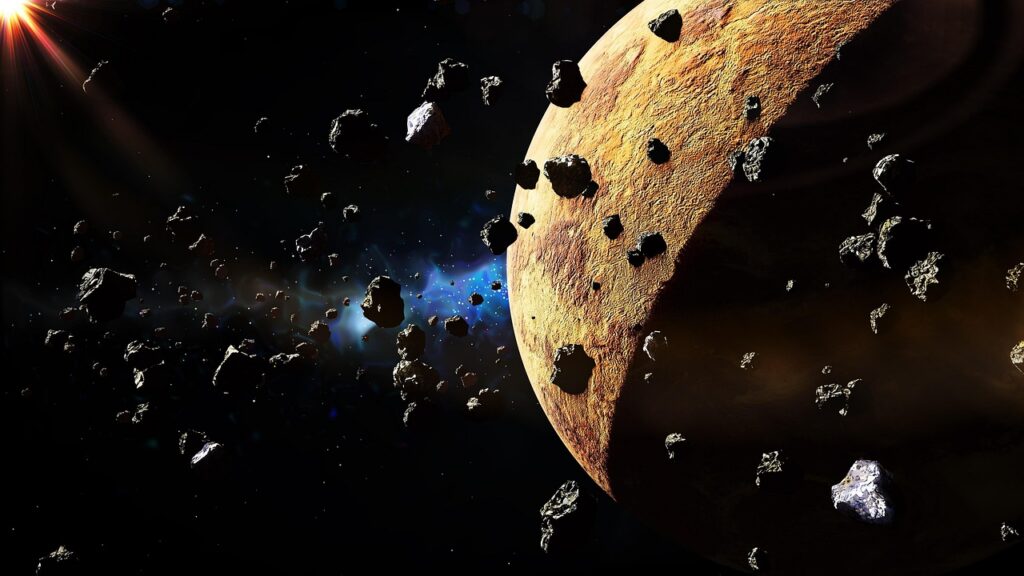
The belt serves as a natural laboratory for planetary science. Because many asteroids have changed very little since they formed, researchers can analyse them to better understand the conditions that existed billions of years ago.
Space missions have visited several major asteroids, collecting detailed information about their composition, geology and history. These missions continue to improve our understanding of how planets formed and evolved.
Important characteristics of the Asteroid Belt include:
- Millions of rocky objects orbiting the Sun.
- Home to the dwarf planet Ceres.
- Influenced by Jupiter’s powerful gravity.
- Contains ancient material from the Solar System’s formation.
- An important destination for robotic space exploration.
Many asteroids also contain valuable minerals and water-bearing materials, making them potential targets for future space resource utilisation.
Continuing To Unlock The Secrets Of The Solar System
The Belt remains one of the most valuable scientific regions in our Solar System. Far from being an empty collection of rocks, it preserves a record of planetary formation that stretches back billions of years.
As new telescopes, robotic spacecraft and future exploration missions continue studying the belt, astronomers expect to uncover even more information about the origins of planets, the evolution of our Solar System and the materials that shaped Earth itself.
Understanding the Belt not only expands our knowledge of space but also provides important insights into humanity’s future exploration beyond our home planet.

