
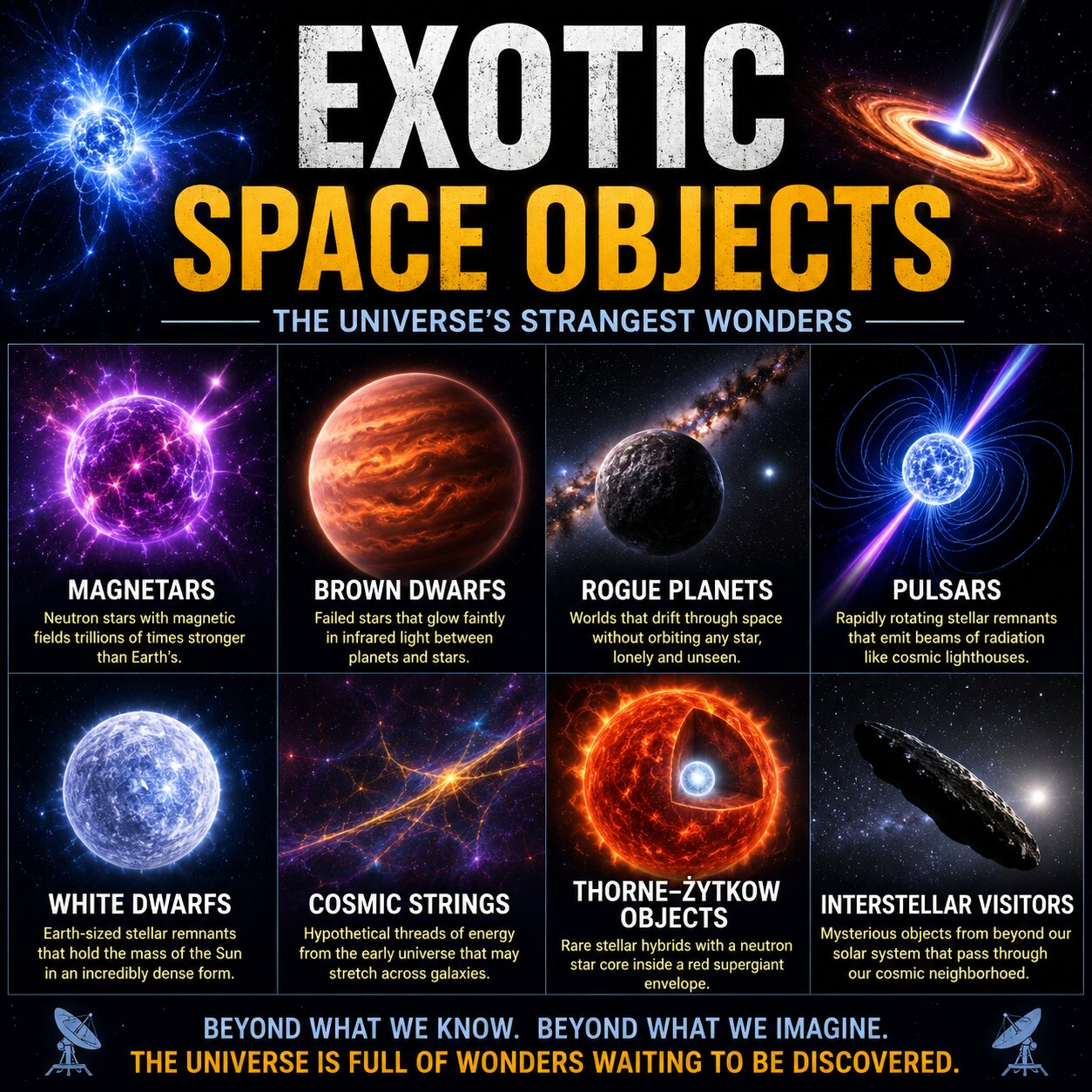

The universe is filled with extraordinary phenomena that challenge our understanding of physics and astronomy. While nebulae, supernovae, neutron stars, quasars, exoplanets, and black holes often dominate discussions, there are many other exotic space objects that are just as fascinating. These rare and unusual objects reveal the incredible diversity of the cosmos and continue to inspire astronomers searching for answers about the origins and evolution of the universe.
In this guide, we explore several remarkable exotic space objects that don’t fit neatly into the more familiar categories but have become important areas of astronomical research.
Magnetars
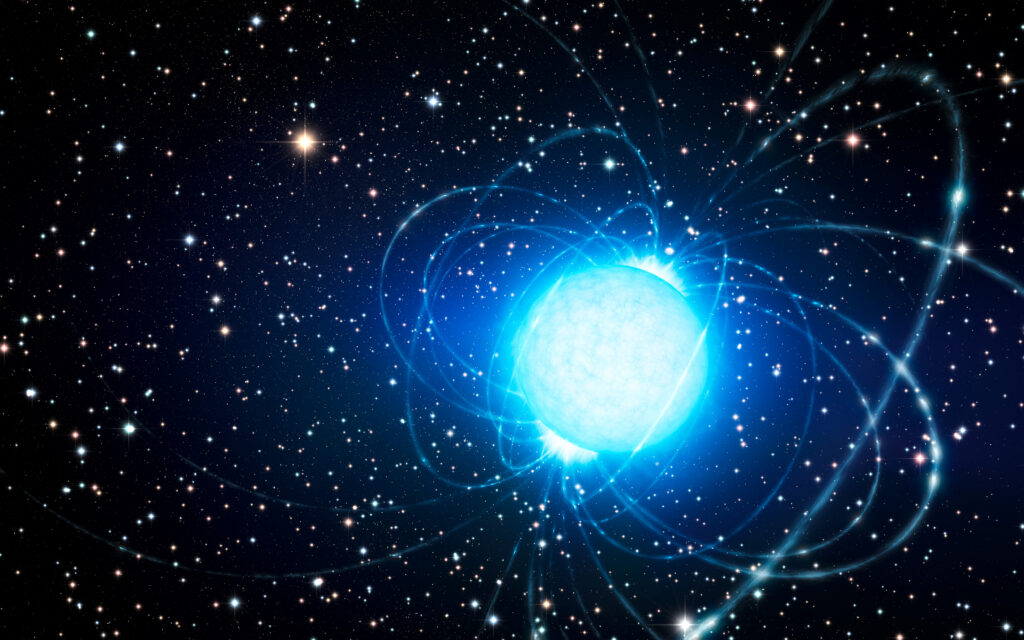
Magnetars are among the most powerful exotic space objects ever discovered. Although they are technically a type of neutron star, their magnetic fields are thousands of times stronger than those of ordinary neutron stars, making them worthy of separate attention.
These incredible objects can release enormous bursts of X-rays and gamma rays when their magnetic fields suddenly shift. A magnetar’s magnetic field is so intense that it would distort the structure of atoms from vast distances.
Fortunately, no known magnetar lies close enough to Earth to pose any danger.
Brown Dwarfs
Brown dwarfs occupy the boundary between planets and stars. They are too massive to be considered planets but not massive enough to sustain the hydrogen fusion that powers true stars.
Because of this unique status, brown dwarfs are often classified among the universe’s most interesting exotic space objects.
Some glow faintly in infrared light, while others possess cloudy atmospheres containing minerals and even iron droplets. Studying brown dwarfs helps astronomers better understand both giant planets and low-mass stars.
Rogue Planets
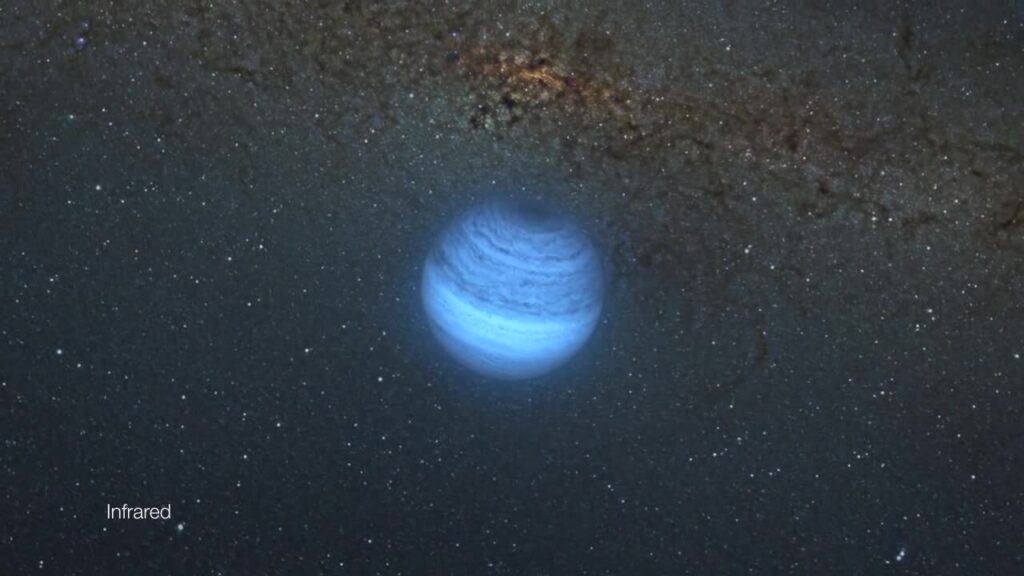
Unlike the planets in our Solar System, rogue planets travel through interstellar space without orbiting any star.
These lonely worlds may have been ejected from their original planetary systems through gravitational interactions or may have formed independently.
Although difficult to detect, astronomers believe our galaxy could contain billions of rogue planets. Some may even possess underground oceans heated by radioactive decay, raising intriguing possibilities about environments beyond traditional habitable zones.
Pulsars
Pulsars are rapidly rotating stellar remnants that emit highly focused beams of radio waves, X-rays, or gamma rays.
As these beams sweep across Earth, they appear as incredibly regular pulses, making pulsars some of the universe’s most accurate natural clocks.
Astronomers use pulsars to study gravitational waves, test Einstein’s theory of general relativity, and measure the structure of the Milky Way with remarkable precision.
White Dwarfs
White dwarfs represent the final evolutionary stage for most stars, including our own Sun.
Although small in size, they contain roughly the same mass as the Sun compressed into a body about the size of Earth.
Many white dwarfs gradually cool over billions of years, while others continue interacting with nearby companion stars, occasionally producing spectacular novae or even Type Ia supernovae under the right conditions.
Cosmic Strings
Unlike the other entries, cosmic strings remain hypothetical. These theoretical structures are believed to be ultra-thin defects in the fabric of space-time that may have formed shortly after the Big Bang.
If they exist, cosmic strings could stretch across entire galaxies while remaining thinner than an atomic nucleus.
Astronomers continue searching for evidence of these fascinating exotic space objects, as confirming their existence would dramatically improve our understanding of the early universe.
Thorne–Żytkow Objects
One of the rarest proposed exotic space objects is the Thorne–Żytkow Object.
This unusual stellar hybrid forms when a neutron star merges with the core of a massive red supergiant. From the outside, it appears almost identical to an ordinary red supergiant, but internally it contains a neutron star hidden deep within its core.
Only a handful of candidate objects have ever been identified, making these stars one of astronomy’s greatest mysteries.
Discover the Universe With Exotic Space Objects!
The universe contains far more than the well-known stars, galaxies, and planets we often see in astronomy books. From rogue planets drifting through interstellar space to theoretical cosmic strings stretching across the cosmos, these exotic space objects remind us that the universe still holds countless mysteries waiting to be explored.
As astronomers develop more powerful telescopes and space missions, we can expect many new discoveries that will expand our understanding of these extraordinary cosmic phenomena and perhaps reveal entirely new classes of exotic objects never before imagined.

Leave a Reply