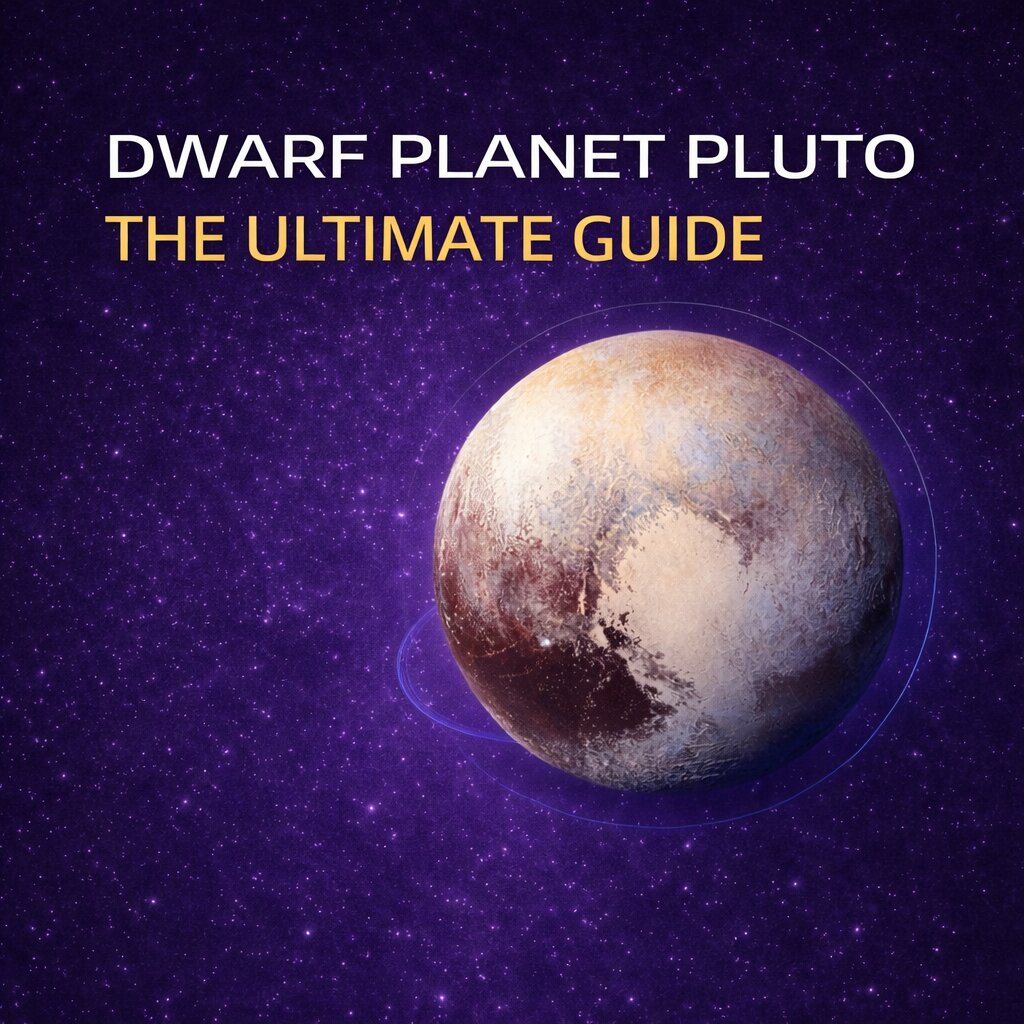

Dwarf planet Pluto is one of the most intriguing objects in our Solar System. Once known as the ninth planet, Pluto was reclassified in 2006, but that hasn’t made it any less fascinating. Located far beyond Neptune in the icy Kuiper Belt, Pluto is a frozen world filled with mountains, glaciers, and a surprisingly active surface.
Despite its distance and size, dwarf planet Pluto has become one of the most important bodies for understanding the outer Solar System and how planetary systems form and evolve.
Quick stats: Dwarf planet Pluto
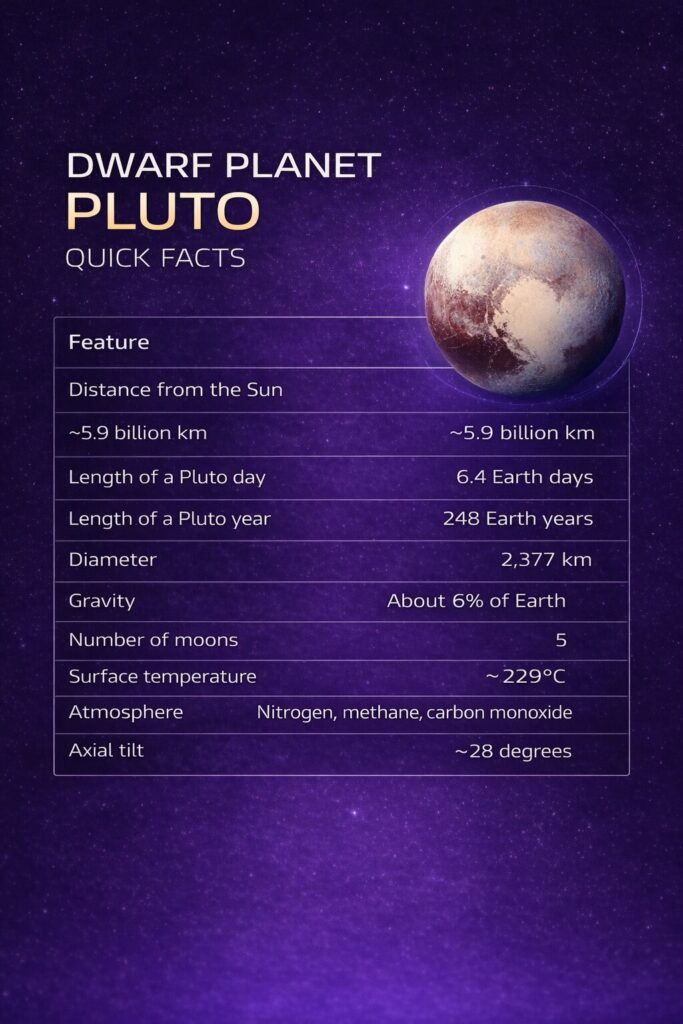
| Feature | Details |
|---|---|
| Distance from the Sun | ~5.9 billion km |
| Length of a Pluto day | 6.4 Earth days |
| Length of a Pluto year | 248 Earth years |
| Diameter | 2,377 km |
| Gravity | About 6% of Earth |
| Number of moons | 5 |
| Surface temperature | ~−229°C |
| Atmosphere | Nitrogen, methane, carbon monoxide |
Pluto’s position in the Solar System

Dwarf planet Pluto orbits in the Kuiper Belt, a vast region beyond Neptune filled with icy remnants from the formation of the Solar System. Its orbit is highly elliptical and tilted, making it quite different from the neat, circular paths of the major planets.
At times, Pluto actually comes closer to the Sun than Neptune, although the two never collide due to their stable orbital resonance. This unusual path is one of the many reasons Pluto stands out among Solar System bodies.
Why Pluto is called a dwarf planet
In 2006, the classification of Pluto changed when astronomers refined the definition of what makes a planet. While Pluto is spherical and orbits the Sun, it does not dominate its orbital region, sharing space with many other icy objects in the Kuiper Belt.
This led to the creation of the dwarf planet category, placing Pluto alongside other similar worlds. While controversial at the time, this decision helped scientists better organise and understand the growing number of objects being discovered in the outer Solar System.
The surface of dwarf planet Pluto
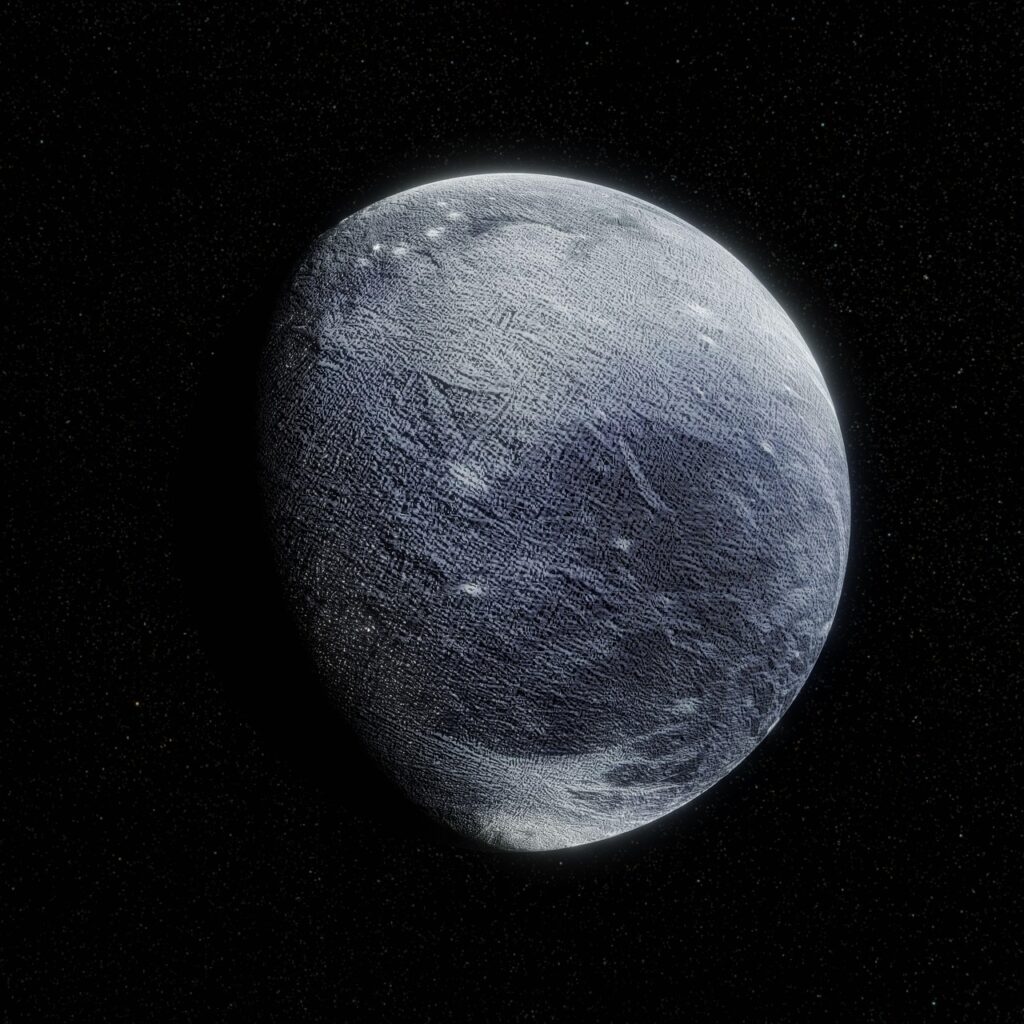
For many years, scientists assumed Pluto would be a frozen, inactive world. However, observations from the New Horizons mission revealed something completely different.
Pluto’s surface is incredibly diverse, with vast plains of nitrogen ice, rugged mountain ranges made of water ice, and deep valleys carved over time. One of the most iconic features is Sputnik Planitia, a massive, heart-shaped region that dominates one side of the dwarf planet.
This region shows signs of convection, where the ice slowly shifts and circulates, suggesting that Pluto is still geologically active despite its extreme cold.
Pluto’s atmosphere: Thin but dynamic
Dwarf planet Pluto has a very thin atmosphere, primarily made of nitrogen, with small amounts of methane and carbon monoxide. This atmosphere behaves in a unique way due to Pluto’s long orbit.
As Pluto moves closer to the Sun, its surface ices begin to sublimate, forming a temporary atmosphere. When it travels farther away, the atmosphere freezes and falls back onto the surface as frost or snow.
This cycle creates a constantly changing environment, with layers of haze forming high above the surface, giving Pluto a soft glow when sunlight passes through.
Moons of dwarf planet Pluto

Pluto is not alone in space. It has five known moons, with Charon being by far the largest. In fact, Charon is so large compared to Pluto that the two orbit a shared centre of gravity outside Pluto itself.
This makes Pluto and Charon more like a binary system than a traditional planet and moon. The smaller moons—Nix, Hydra, Kerberos, and Styx—add further complexity to this distant system.
Exploring Pluto: The New Horizons mission
The true nature of dwarf planet Pluto remained a mystery until NASA’s New Horizons spacecraft flew past it in 2015. Before this mission, Pluto was little more than a blurry dot in telescopes.
New Horizons changed everything, revealing a world rich in detail and activity. It captured high-resolution images of Pluto’s surface, mapped its atmosphere, and provided insights into its internal structure.
This mission transformed Pluto from an unknown object into one of the most studied dwarf planets in the Solar System.
Key features of dwarf planet Pluto

- Located in the Kuiper Belt beyond Neptune
- Has a highly elliptical and tilted orbit
- Features mountains, glaciers, and active surface processes
- Possesses a thin, seasonal atmosphere
- Hosts a unique moon system led by Charon
Pluto and the outer Solar System
Dwarf planet Pluto serves as a gateway to understanding the outer reaches of our Solar System. The Kuiper Belt, where Pluto resides, is filled with countless icy bodies that hold clues to the early stages of planetary formation.
By studying Pluto, scientists gain insight into how these distant objects evolve and how similar systems might exist around other stars.
Dwarf planet Pluto and the frontier of space
Pluto may be small, but it represents one of the most important frontiers in astronomy. Its complex geology, dynamic atmosphere, and unusual orbit challenge our understanding of what planetary bodies can be.
Far from being just a distant icy rock, dwarf planet Pluto is a world full of surprises. As future missions are planned and technology improves, Pluto will continue to reveal more secrets about the outer Solar System and the nature of distant worlds.
Conclusion
Dwarf planet Pluto reminds us that size does not determine importance in space. From its heart-shaped plains to its shifting atmosphere, Pluto stands as one of the most captivating objects in our Solar System.
It marks the beginning of a vast, unexplored region filled with mysteries, making it a key focus for future exploration and discovery.