As humanity prepares to return to the Moon in a big way, scientists are raising an uncomfortable question: are we at risk of damaging the very evidence we hope to study?
New research suggests that increased lunar landings, surface operations, and long-term human presence could unintentionally contaminate some of the Moon’s most scientifically valuable regions. These concerns don’t argue against exploration, but they do challenge how carefully we tread on one of the most pristine environments in the Solar System.
🧪 Moon Mission Science Concerns: What’s the Issue?
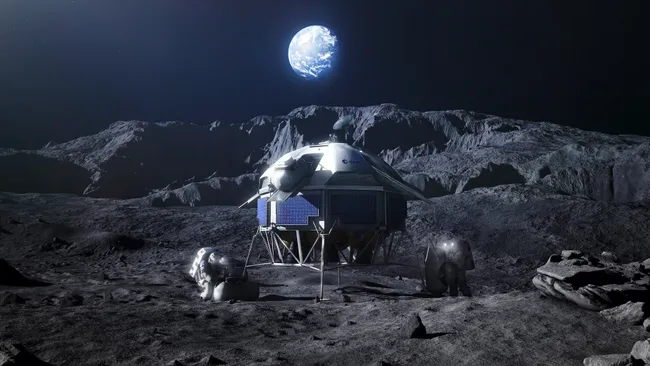
Recent scientific discussions have highlighted how exhaust plumes, surface disturbances, and even microscopic biological contaminants from spacecraft could alter untouched lunar regions. The worry is not about visible damage, but about subtle chemical and isotopic contamination that could compromise future research.
As plans for renewed lunar exploration gather momentum, a growing number of scientists are voicing concerns about how increased human and robotic activity could affect the Moon’s scientific value. The debate centres on whether future missions, particularly those involving repeated landings and long-term surface operations, could unintentionally compromise pristine lunar regions that preserve records of the early Solar System.
Researchers point out that the Moon’s surface acts as a long-term archive. Without an atmosphere, weather, or active geology, lunar soil has retained evidence of ancient solar radiation, micrometeorite impacts, and potentially material ejected from early Earth. These records are subtle and fragile, and once disturbed, they cannot be reconstructed or replaced.
The concern is not limited to large-scale human bases. Even standard lander operations produce powerful exhaust plumes that can alter the chemical composition of lunar regolith. Fine dust kicked up during landings may travel far beyond designated landing sites, settling over areas intended for future scientific study. Over time, the cumulative effect of multiple missions could blur or erase signals scientists rely on to interpret lunar history accurately.
This debate has gained urgency as agencies and private companies plan missions at an unprecedented pace. Programmes such as NASA’s Artemis initiative aim to establish a sustained presence on the Moon, while commercial landers and international partners expand activity across multiple regions. Scientists are now asking whether current planetary protection guidelines are sufficient for this new scale of exploration.
Importantly, the discussion is not framed as opposition to lunar exploration. Instead, researchers are calling for updated policies, clearer preservation zones, and more careful mission planning to ensure that exploration does not outpace scientific understanding. The issue at hand is how to balance progress with responsibility, ensuring that future discoveries are not compromised by the very missions designed to enable them.
🌕 Why the Moon Is a Scientific Time Capsule
Unlike Earth, the Moon has no atmosphere, weather, or plate tectonics. This makes it an extraordinary natural archive.
Key reasons scientists value pristine lunar regions include:
- Preserved solar wind particles trapped in regolith over billions of years
- Undisturbed impact layers that record asteroid and comet history
- Ancient material ejected from early Earth, potentially embedded in lunar soil
Some researchers argue that certain areas of the Moon function more like a museum than a construction site.
🚀 How Human Activity Can Alter Lunar Science
Human activity on the Moon introduces changes that go far beyond footprints on the surface. Modern lunar missions rely on powerful rocket engines, complex landers, and sustained surface operations, all of which interact directly with the lunar environment. Rocket exhaust alone can chemically alter the regolith, changing the composition of surface materials that scientists rely on to study ancient solar and cosmic events.
Unlike Earth, the Moon has no atmosphere to disperse or neutralise contaminants. Dust disturbed by landings can travel vast distances, settling over areas that may never be physically visited by humans. This fine lunar dust can carry exhaust residues, metals, and organic compounds, subtly altering regions that scientists hoped would remain untouched for future study.
As exploration expands, the cumulative effect of repeated missions becomes a growing concern. Long-term infrastructure, such as habitats, power systems, and mobility vehicles, can change local temperature patterns and radiation exposure, potentially disrupting delicate surface records preserved over billions of years. Even robotic missions contribute to this gradual transformation, as every landing adds to the environmental footprint.
These impacts do not destroy the Moon in a dramatic sense, but they risk blurring the scientific signals embedded in its soil and rock. Once altered, these records cannot be reset. For researchers seeking to understand the early Solar System and Earth’s own origins, the concern is not that the Moon is being explored, but that it may be changed before its full scientific story is understood.
🧭 Balancing Exploration and Preservation
Scientists are not calling for an end to Moon missions. Instead, they are advocating for smarter exploration strategies, such as:
- Designating protected scientific zones
- Limiting landings near historically untouched regions
- Developing cleaner propulsion and landing technologies
- Creating international guidelines for lunar preservation
The Moon, they argue, is big enough for exploration and conservation, but only if managed responsibly.
🌌 Why This Debate Matters for the Future of Space Science
The discussion around lunar contamination is not really about the Moon alone. It is about how humanity chooses to conduct science beyond Earth at a time when space exploration is accelerating faster than ever before. The Moon is simply the first major test case in a new era of sustained off-world activity.
For decades, space science has relied on environments that were effectively untouched. The Moon’s surface has remained largely unchanged for billions of years, preserving records of solar radiation, cosmic impacts, and even material ejected from early Earth. These records allow scientists to study periods of Solar System history that no longer exist on our own planet. If those records are altered before they are fully understood, entire lines of research may be lost permanently.
What makes this moment particularly critical is timing. We are returning to the Moon with vastly improved instruments, new analytical techniques, and a deeper understanding of what lunar material can tell us. At the same time, we are planning more landings, more infrastructure, and long-term human presence. Scientific opportunity and scientific risk are increasing together, and decisions made now will determine which one dominates.
This debate also sets a precedent for future exploration. Mars, asteroids, icy moons, and even exoplanetary bodies may one day face similar pressures between exploration, utilisation, and preservation. If humanity cannot balance these priorities on the Moon, a nearby and relatively accessible world, it raises serious questions about how responsibly we will approach more distant and fragile environments.
There is also an ethical dimension to consider. The Moon is not just a destination for the current generation of explorers. It is a shared scientific heritage for future researchers who may ask questions we cannot yet imagine. Preserving scientifically valuable regions is not about halting progress, but about ensuring that progress remains meaningful over the long term.
Ultimately, this debate challenges the idea that exploration and preservation must be in conflict. With thoughtful planning, international cooperation, and updated planetary protection guidelines, it is possible to explore the Moon while safeguarding its most valuable scientific resources. The outcome will shape not only lunar science, but the credibility and integrity of space science as humanity moves deeper into the cosmos.
A Second Chance to Do It Right
The return to the Moon represents a rare second chance in space exploration. The first era proved we could get there. This new era will show whether we can explore responsibly.
As lunar missions accelerate, the challenge is clear: advance human presence without erasing the Moon’s silent history. How we answer that challenge may define the next century of space science.