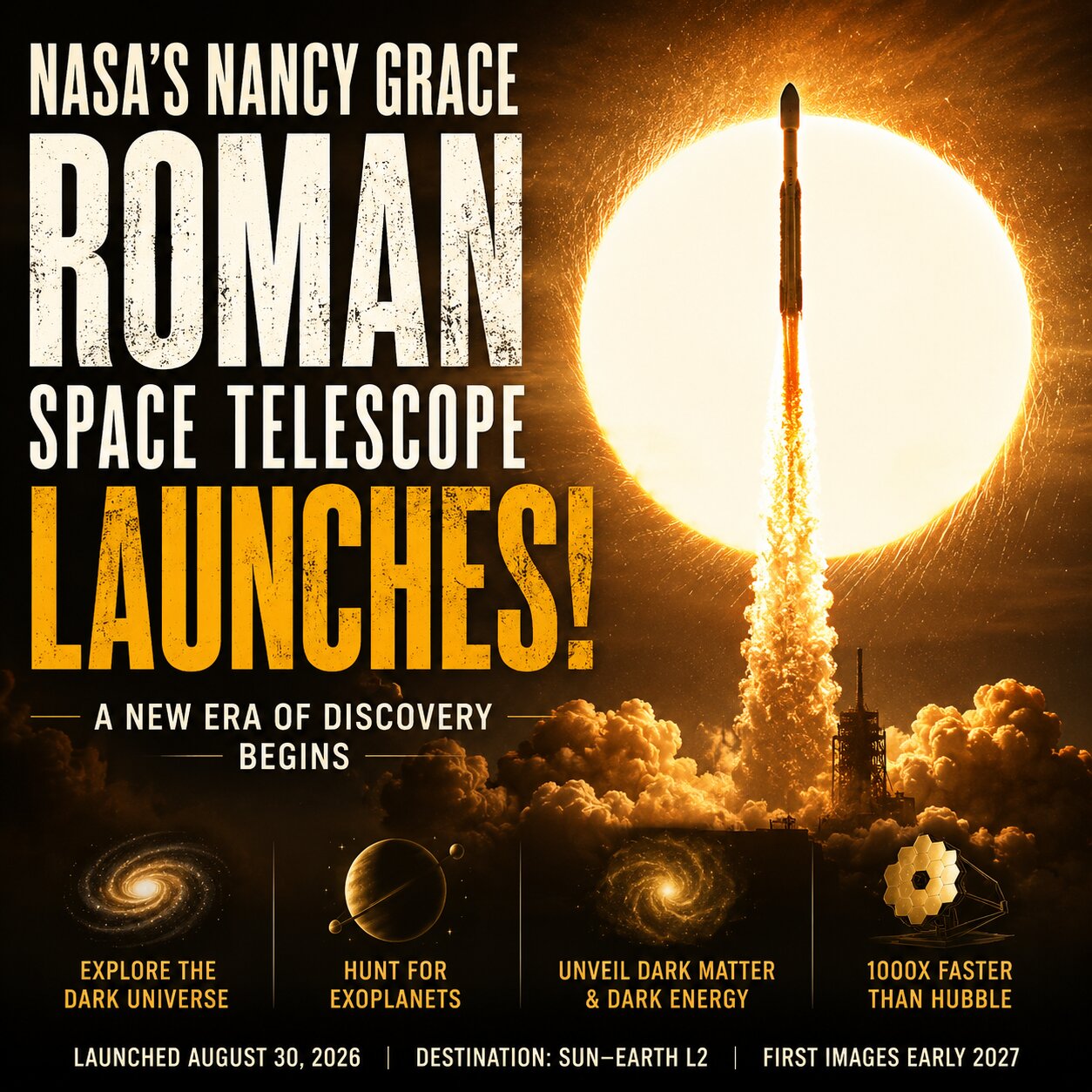

A new era of space astronomy has officially begun. NASA’s Nancy Grace Roman Space Telescope successfully launched on 30 August 2026, beginning a three-month journey towards its operating destination nearly one million miles from Earth.
Roman lifted off at 7:26 a.m. EDT aboard a SpaceX Falcon Heavy rocket from Launch Complex 39A at NASA’s Kennedy Space Center in Florida. The powerful observatory is now travelling towards the second Sun-Earth Lagrange point, known as L2, where it will eventually begin an ambitious scientific mission designed to investigate dark matter, dark energy, exoplanets and the evolution of the universe.
For astronomers, Roman represents an exciting combination: extraordinarily sharp infrared observations paired with a huge field of view. Instead of concentrating exclusively on small regions of space, the telescope will rapidly survey enormous areas of the sky while capturing remarkable detail.
If everything proceeds according to plan during commissioning, NASA expects Roman’s first images to arrive in early 2027.
Roman Begins Its Million-Mile Journey

NASA’s ground control team at the Goddard Space Flight Center began receiving telemetry from Roman only seven minutes after launch.
The Falcon Heavy completed its role successfully, with Roman separating from the rocket approximately 31 minutes after liftoff. The telescope then continued independently on its journey towards L2.
Early deployment milestones have also been completed successfully. NASA confirmed that Roman’s solar panels and lower instrument sunshade deployed approximately one hour and 23 minutes after launch.
Further activities during the opening stages of the mission include deployment of the high-gain antenna and visor-like aperture cover, along with trajectory corrections required to guide Roman towards its destination.
Communication responsibilities also change as the spacecraft moves farther from Earth. NASA’s Near Space Network supports Roman during launch and early orbit before the Deep Space Network takes over for the journey towards L2.
Deep-space communication facilities in Australia, Spain and California will help maintain contact with the observatory.
Why Is Roman Travelling to L2?
The second Sun-Earth Lagrange point has become an exceptionally valuable location for space astronomy.
Situated approximately one million miles from Earth, L2 allows spacecraft to maintain a relatively stable relationship with Earth and the Sun. NASA’s James Webb Space Telescope also operates around this region.
For Roman, this environment will provide the stability necessary to conduct extensive observations of the infrared universe.
Once the telescope reaches its destination, however, it won’t immediately begin its primary science programme. Roman has a three-month commissioning period, during which engineers and scientists will calibrate its systems and thoroughly test its instruments.
Only after these checks are completed will the telescope be ready to begin revealing the universe on an unprecedented scale.
A 300-Megapixel Eye on the Universe
Roman’s primary science instrument is the Wide Field Instrument, an enormous 300-megapixel infrared camera.
It contains 18 detectors, each with approximately 4K resolution. Together, they will collect infrared light from vast regions of space and transform those observations into detailed cosmic panoramas.
What makes Roman particularly powerful isn’t simply image quality.
It’s speed and scale.
According to NASA, Roman has been designed to survey the universe approximately 1,000 times faster than the Hubble Space Telescope. That ability will allow astronomers to investigate enormous populations of galaxies, stars and other astronomical objects rather than studying relatively narrow patches of sky individually.
Roman’s stable optical design also allows it to move efficiently between observations without requiring substantial periods of adjustment.
The result should be an extraordinary astronomical survey machine.
Hunting for Dark Matter and Dark Energy
Two of Roman’s biggest scientific targets cannot actually be observed directly.
Dark matter and dark energy remain among the greatest mysteries in modern cosmology.
Dark matter doesn’t emit, absorb or reflect light in the conventional sense, but astronomers can detect its gravitational influence on galaxies and other structures. Dark energy is the name given to the mysterious phenomenon associated with the accelerating expansion of the universe.
Together, these invisible components appear to dominate the cosmos, while the ordinary matter forming stars, planets and ourselves represents only a relatively small portion of everything that exists.
Roman’s wide-field surveys will allow scientists to examine the distribution and evolution of enormous numbers of galaxies across cosmic history.
By observing how matter is distributed and how the expansion of the universe has changed over time, astronomers hope to place increasingly precise constraints on the nature of the dark universe.
Roman Will Hunt for Exoplanets Too
Cosmology isn’t Roman’s only major objective.
The telescope will also search for exoplanets — worlds orbiting stars beyond our Solar System.
Its enormous surveys should help astronomers discover and characterise planetary systems while contributing to our understanding of how common different types of planets are throughout the Milky Way.
Roman also carries an important technology demonstration called the Coronagraph Instrument.
A coronagraph suppresses the overwhelming glare produced by a star so that much fainter objects orbiting nearby can potentially be observed. Roman’s instrument will attempt to directly image Jupiter-like planets and demonstrate technologies that could eventually contribute to far more ambitious missions.
NASA specifically views this work as an important technological step towards concepts such as the future Habitable Worlds Observatory, which could one day attempt to directly image Earth-like planets around other stars.
Roman therefore isn’t only searching for worlds itself.
It may help develop the technology required for the next generation of planet hunters.
An Incredible 1.4 Terabytes of Data Every Day
Roman’s enormous observing capabilities create another challenge: dealing with everything it discovers.
NASA expects the telescope to transmit approximately 1.4 terabytes of data every day, which would give Roman the highest data rate yet achieved by a NASA astrophysics mission.
Astronomers simply cannot manually inspect that amount of information individually.
Machine learning and artificial intelligence will therefore assist scientists in processing Roman’s observations and identifying potentially significant discoveries. Citizen scientists are also expected to participate, helping researchers examine the torrent of astronomical information arriving from the telescope.
Some of Roman’s most exciting discoveries may consequently involve objects or phenomena that scientists weren’t specifically searching for.
That possibility is one of the most exciting aspects of conducting such an enormous survey.
What Happens Next for the Roman Space Telescope?
Roman now faces several important milestones before the real science begins.
During the coming weeks, engineers will deploy and activate additional systems while monitoring the spacecraft’s journey towards L2. The Wide Field Instrument will be activated several weeks into the voyage, while Roman’s Coronagraph Instrument is scheduled to begin operating earlier in the commissioning process.
Once Roman reaches its destination, scientists will continue calibrating and testing the observatory.
NASA currently expects the first public images from the telescope in early 2027.
Those first observations should provide only a glimpse of what Roman could accomplish over the years that follow.
A New Window Into the Dark Universe
Hubble transformed our view of the cosmos. Webb has taken humanity deeper into the infrared universe than ever before. Roman now joins NASA’s great space observatories with a somewhat different strength: the ability to see an enormous amount of the universe remarkably quickly.
Its observations could help astronomers better understand the invisible matter shaping galaxies, investigate the mysterious force driving cosmic expansion, discover distant worlds and reveal astronomical phenomena nobody anticipated finding.
Roman has already completed the first and most dramatic step.
The rocket has launched. The telescope is healthy. Its journey towards L2 is underway.
Now comes the exciting part.
We get to see what Roman discovers.