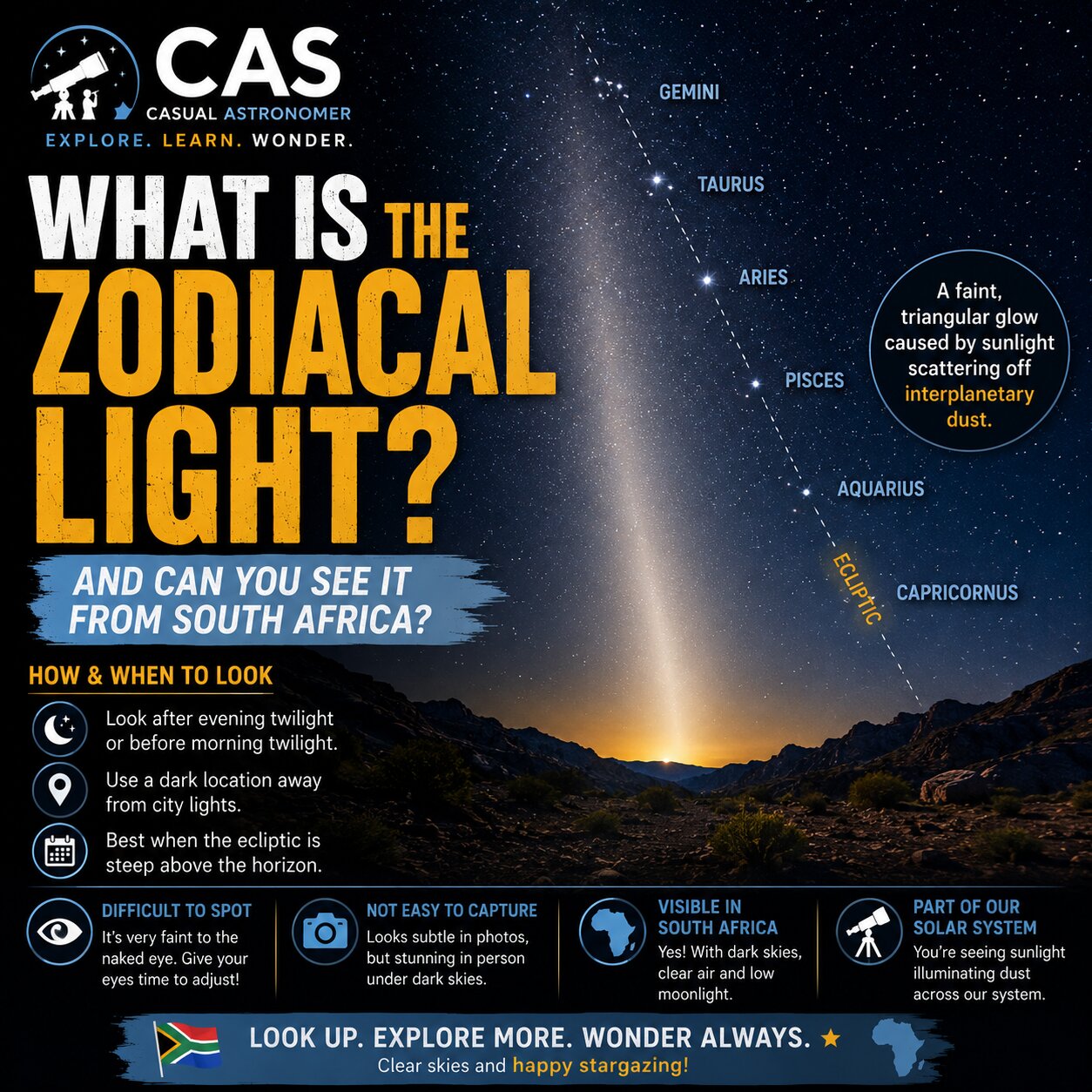

You might spend plenty of time looking for planets, constellations and the Milky Way, but there is another beautiful feature hiding in the night sky. Zodiacal light appears as a faint, roughly triangular glow extending upwards from the horizon along the ecliptic.
Unlike an aurora, zodiacal light isn’t produced by Earth’s atmosphere. It comes from sunlight being scattered by tiny particles of interplanetary dust distributed through the inner Solar System. From a sufficiently dark location, all that scattered light can become visible as a ghostly column rising through the zodiac.
And yes, observers in South Africa can see it.
The trick is escaping light pollution and choosing the right observing conditions. You’ll want a genuinely dark location, a clear sky and as little moonlight as possible. Depending on the season, zodiacal light is best sought after evening twilight or before morning twilight when the ecliptic meets the horizon at a favourable angle.
Don’t expect something as obvious as the Milky Way in a photograph. To the naked eye, zodiacal light can initially appear extremely subtle.
Once you recognise it, however, you’re looking at sunlight illuminating dust scattered across our own Solar System — a remarkable sight hiding almost in plain view.