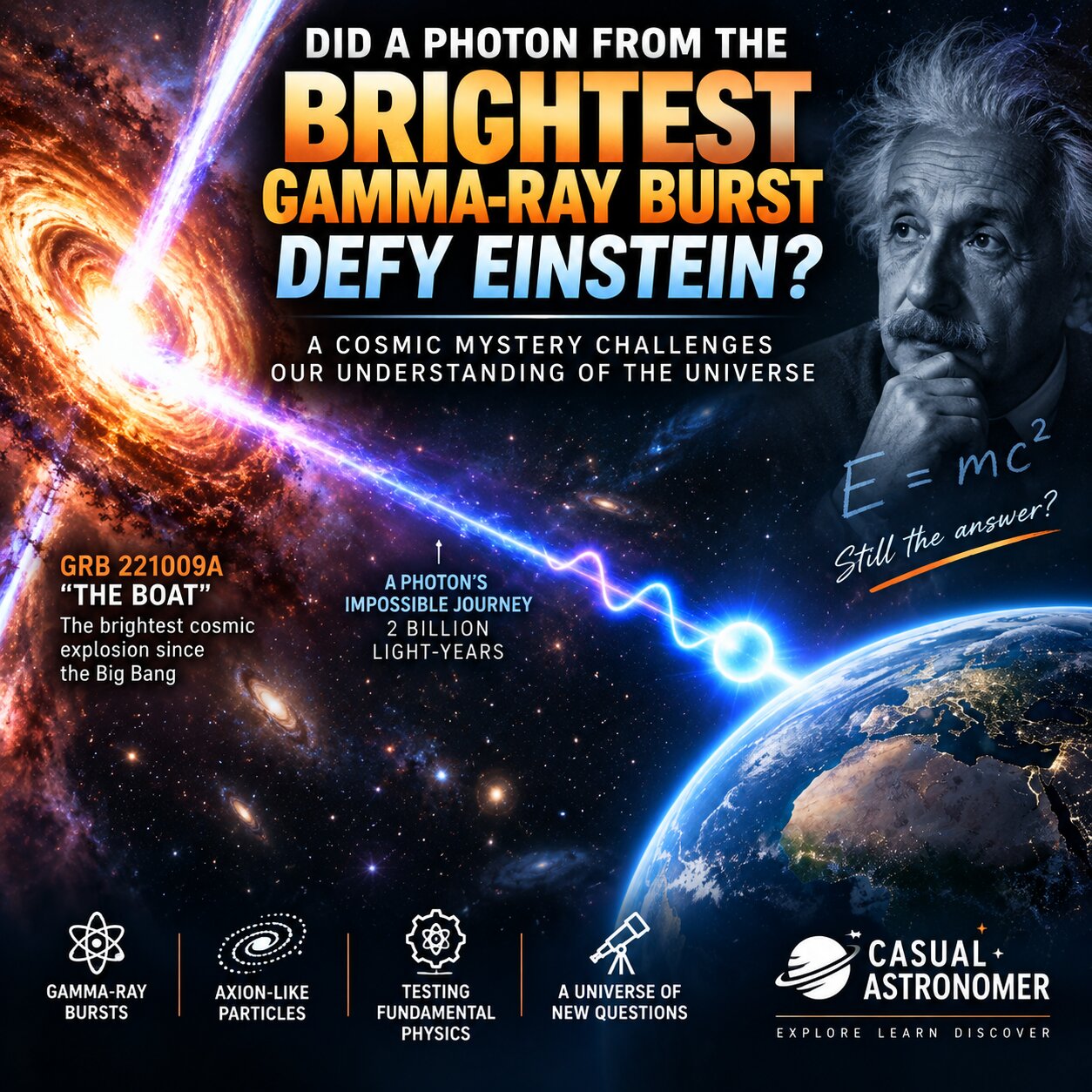

A single particle of light from one of the most extraordinary explosions ever observed has presented physicists with a remarkable puzzle. The photon travelled for more than two billion light-years before reaching Earth, despite conventional physics suggesting that it should never have completed the journey.
The source was GRB 221009A, the record-breaking gamma-ray burst detected on 9 October 2022 and nicknamed the BOAT — Brightest Of All Time.
Among the enormous flood of radiation associated with the event was an exceptionally high-energy photon detected by the Carpet cosmic-ray experiment at the Baksan Observatory. Its arrival has encouraged researchers to investigate whether some of our fundamental assumptions about how light travels through the universe could require modification at extreme energies.
The proposed explanation is fascinating, but it is important to emphasise that scientists have not established that Einstein was wrong. Instead, researchers are investigating an exotic theoretical scenario that could explain an extremely unusual observation.
Why Should the Photon Have Disappeared?

Space may appear empty, but photons travelling across cosmological distances encounter radiation permeating the universe.
One particularly important component is the cosmic microwave background (CMB), the ancient radiation left behind from the early universe.
Extremely energetic gamma-ray photons can interact with lower-energy background photons during their journeys. Under suitable conditions, the interaction can convert their energy into an electron and its antimatter counterpart, a positron.
Consequently, the universe becomes increasingly opaque to sufficiently energetic gamma rays travelling enormous distances.
That creates the mystery surrounding GRB 221009A.
According to the researchers, the photon should have had an extremely low probability of travelling for more than two billion light-years without being absorbed. Yet a photon with extraordinary energy apparently reached Earth.
How?
Could Axion-Like Particles Provide Part of the Answer?
Researchers led by Giorgio Galanti of the Italian National Institute for Astrophysics investigated whether hypothetical particles known as axion-like particles, or ALPs, could help explain the observation.
ALPs have never been conclusively detected, but they appear in several extensions of established particle physics.
Under certain theoretical conditions, photons could convert into axion-like particles while travelling through magnetic fields. Because ALPs would interact differently with background radiation, they could potentially cross distances that would be difficult for extremely energetic photons to survive.
They could then transform back into photons closer to Earth.
However, according to the new work, photon-ALP conversion alone was not sufficient to explain this particular observation.
The scientists therefore combined it with an even more radical possibility.
What Does Lorentz Invariance Have to Do With Einstein?
Lorentz invariance is one of the fundamental principles underlying Einstein’s special theory of relativity.
In simplified terms, it means that the fundamental laws of physics should remain consistent for observers moving at different constant velocities.
Researchers have long investigated whether this principle could behave differently at extraordinarily high energies, particularly when attempting to understand how gravity might eventually be reconciled with quantum mechanics.
The team considered a scenario involving both axion-like particles and a possible Lorentz invariance violation.
Under those conditions, the way extremely energetic photons propagate through space could change. The universe might effectively become more transparent to them than conventional models predict.
That could provide GRB 221009A’s mysterious photon with a route to Earth.
An Unexpected Arrival Time Adds to the Mystery
There is another intriguing element.
The researchers’ proposed model predicts that the extremely energetic photon should have reached Earth roughly one hour after lower-energy photons from the gamma-ray burst.
According to the researchers, that timing is consistent with what was observed.
It does not prove the theory. Alternative explanations and uncertainties surrounding such extraordinary observations still need to be investigated.
Nevertheless, it gives physicists another feature against which the proposed model can be tested.
The Universe Could Become a Quantum Gravity Laboratory
If future observations of gamma-ray bursts reveal similar high-energy photons behaving in the same way, the implications could become enormous.
Particle accelerators on Earth allow scientists to investigate matter at incredible energies, but even our most powerful machines cannot reproduce every physical condition found throughout the cosmos.
Gamma-ray bursts provide nature with an entirely different laboratory.
If extremely energetic photons really experience subtle departures from familiar physical laws during billion-light-year journeys, astronomers could potentially use them to investigate physics associated with quantum gravity.
That would connect some of the largest phenomena in the universe with some of the deepest unanswered questions in fundamental physics.
Einstein Hasn’t Been Overthrown Yet
Headlines suggesting that a photon has “defied Einstein” certainly capture attention, but the scientific reality is more nuanced.
The observation does not demonstrate that special relativity is incorrect. Axion-like particles remain hypothetical, and Lorentz invariance violation has not been established by this result.
Instead, scientists have developed a theoretical framework capable of explaining an observation that appears difficult to reconcile with conventional expectations.
The research has been accepted for publication in Physical Review Letters, making future observations particularly important. If other distant cosmic explosions produce similarly unexpected high-energy photons, researchers will have more opportunities to test whether this was an exceptional event, an incomplete understanding of the observation or evidence of previously unknown physics.
For now, the photon from the BOAT gamma-ray burst has done something perhaps even more exciting than overturning Einstein: it has given physicists a new mystery to investigate.