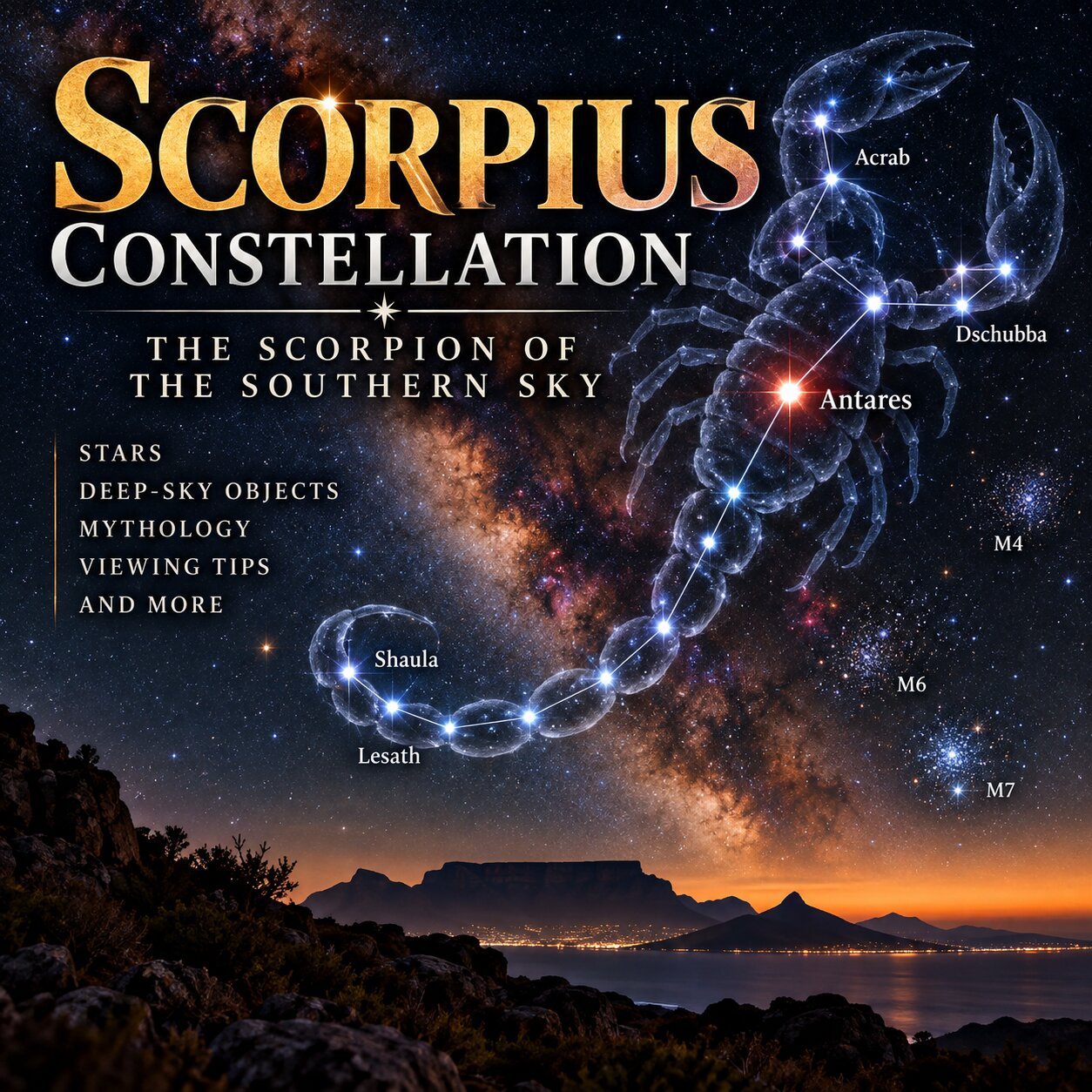

The Scorpius constellation is one of the most recognisable patterns in the night sky. With a bright red star marking the heart of the Scorpion and a long, curving trail of stars forming its body and tail, Scorpius is an excellent constellation for beginner astronomers to learn.
For observers in South Africa and elsewhere in the Southern Hemisphere, Scorpius is particularly rewarding. It rises prominently during the cooler months and passes through a spectacular region of the Milky Way filled with star clusters, nebulae and dense stellar fields.
The constellation is perhaps best known for Antares, a brilliant red supergiant whose colour can be noticeable even without binoculars. However, Antares is only the beginning. Scorpius contains numerous fascinating stars and several deep-sky objects accessible to amateur astronomers.
Let’s explore the Scorpion, discover its mythology and learn how to find the Scorpius constellation from South Africa.
Scorpius Constellation Quick Facts
| Feature | Details |
|---|---|
| Latin Name | Scorpius |
| Abbreviation | Sco |
| Meaning | The Scorpion |
| Brightest Star | Antares (Alpha Scorpii) |
| Constellation Family | Zodiac |
| Zodiac Constellation | Yes |
| Hemisphere | Best viewed from the Southern Hemisphere and lower northern latitudes |
| Notable Objects | M4, M6, M7, NGC 6231 |
| Best Viewing From South Africa | Approximately May to September |
| Neighbouring Constellations | Sagittarius, Ophiuchus, Libra, Lupus, Norma, Ara and Corona Australis |
Where Is The Scorpius Constellation?

Scorpius lies along the ecliptic, the apparent path followed by the Sun across the sky during the year. This position makes it one of the traditional constellations of the zodiac.
The constellation sits between Libra and Sagittarius and occupies an especially rich portion of the Milky Way. When viewed from a dark location, the surrounding region can appear crowded with stars compared with quieter parts of the night sky.
South African observers are well positioned to see the constellation. During its main observing season, Scorpius can climb high into the sky, making its distinctive shape relatively easy to recognise.
Once you have identified Antares, follow the stars downward through the body before tracing the sweeping curve of the Scorpion’s tail.
How To Find Scorpius From South Africa
The easiest starting point when searching for the Scorpius constellation is Antares.
Look for a bright star with a noticeable orange-red appearance. Antares represents the heart of the Scorpion and sits near the middle of the constellation’s distinctive stellar pattern.
From there, trace the stars extending away from Antares. One direction leads towards the claws and head, while the opposite direction curves dramatically through the Scorpion’s tail.
At the end of this curve are Shaula and Lesath, two stars that sit close together and mark the Scorpion’s sting.
For South African observers, Scorpius becomes increasingly prominent during autumn and winter. By the middle of winter, it can dominate the evening sky from sufficiently dark observing locations.
Antares: The Heart Of The Scorpion
Antares is the brightest star in Scorpius and one of the most famous stars visible from Earth.
Its designation is Alpha Scorpii, and it lies roughly 550 light-years away. Antares is a red supergiant: an enormous evolved star considerably larger than the Sun.
Its distinctive reddish-orange appearance inspired its name. Antares is often interpreted as meaning “rival of Ares”, referring to the Greek god associated with Mars. The comparison comes from the star’s red colour, which can resemble the appearance of the planet Mars.
Antares is also part of a multiple-star system, although its companions are much more difficult to observe than the brilliant primary star.
Through binoculars or a telescope, the surrounding region becomes even more impressive because of the dense Milky Way star fields behind it.
Other Notable Stars In Scorpius

Although Antares receives most of the attention, several other stars help create the Scorpion’s unmistakable shape.
Shaula (Lambda Scorpii) is one of the constellation’s brightest stars and forms part of the curved tail. Its name is associated with the Scorpion’s sting.
Nearby Lesath (Upsilon Scorpii) sits close to Shaula in the sky. Together, the two stars form a striking pair that can help observers identify the end of the constellation.
Other notable stars include Dschubba (Delta Scorpii), Acrab (Beta Scorpii) and Sargas (Theta Scorpii).
Learning these stars gradually makes it much easier to recognise the entire constellation rather than relying only on Antares.
Deep-Sky Objects In Scorpius
The Scorpius constellation is an excellent region for exploring deep-sky objects because it lies against the Milky Way.
Several impressive targets are available to observers:
- Messier 4 (M4) – a large globular star cluster located close to Antares and an excellent target for binoculars and small telescopes.
- Messier 6 (Butterfly Cluster) – an open star cluster whose arrangement of stars has been compared to the wings of a butterfly.
- Messier 7 (Ptolemy Cluster) – a bright open cluster that can be visible to the unaided eye from sufficiently dark locations.
- NGC 6231 – a brilliant young open cluster containing numerous hot, luminous stars.
- NGC 6302 (Butterfly Nebula) – a dramatic planetary nebula produced by a dying star.
Binoculars can reveal many additional stars and clusters that are difficult to distinguish with the unaided eye.
Scorpius In Greek Mythology
Scorpius has one of the most famous stories associated with the constellations.
In Greek mythology, the Scorpion is commonly connected with Orion, the legendary hunter. Different versions of the story explain the encounter differently, but many involve a giant scorpion being sent to confront or kill Orion.
Both eventually became constellations.
Their placement in the sky creates an interesting celestial relationship. As Scorpius rises, Orion moves towards setting, meaning the two constellations generally do not dominate the night sky simultaneously.
This apparent celestial chase has helped preserve the story of Orion and the Scorpion for generations.
Scorpius As A Zodiac Constellation
Scorpius is one of the 13 astronomical constellations crossed by the ecliptic, although traditional Western astrology divides the zodiac into 12 signs.
The Sun passes through the astronomical boundaries of Scorpius for a relatively short period each year before entering neighbouring Ophiuchus.
It is important to distinguish between astronomical constellations and astrological signs. Constellations are officially defined regions of the celestial sphere, while zodiac signs are divisions used within astrological traditions.
For astronomers, Scorpius is primarily interesting because of its stars, stellar evolution, clusters and exceptionally rich position against the Milky Way.
Best Time To See Scorpius In South Africa
South African observers can enjoy excellent views of Scorpius during the country’s longer winter nights.
The constellation begins becoming increasingly convenient for evening observation during autumn. During June, July and August, it is particularly prominent, while useful evening viewing can extend roughly from May into September.
The exact position depends on the date and time of observation.
A dark location away from city lights will provide the best experience. Although Antares and the main stars remain visible under moderate light pollution, the Milky Way and many of the surrounding clusters become dramatically more impressive beneath darker skies.
Winter also provides the advantage of longer nights, giving observers more time to explore the region.
Viewing Scorpius With Binoculars And Telescopes
You don’t need expensive equipment to enjoy the Scorpius constellation.
Start with your eyes. Identify Antares and trace the Scorpion’s shape from its upper stars through the curved tail to Shaula and Lesath.
Binoculars are arguably one of the best instruments for exploring the region. Their wide field of view is ideal for scanning the dense Milky Way star fields and finding large open clusters such as M6 and M7.
A small telescope allows closer examination of M4 and numerous other clusters. Larger instruments can reveal fainter objects and more structure within targets such as planetary nebulae.
Rather than immediately increasing magnification, spend some time sweeping slowly through the constellation. Scorpius rewards wide-field observing.
Why Scorpius Is Perfect For Beginner Astronomers
Few constellations combine an easily recognisable shape, a brilliant colourful star and so many accessible deep-sky objects.
For South African beginners, Scorpius is also an excellent constellation for learning how to navigate the Milky Way. Once you recognise Antares and the Scorpion’s tail, nearby constellations and deep-sky objects become easier to locate.
Return to the constellation several times throughout the observing season and watch how its position changes from month to month.
The Scorpius constellation offers much more than a familiar zodiac name. It is a gateway into stellar evolution, mythology, open clusters, globular clusters and some of the richest star fields visible from Earth.
On the next clear winter evening, find the glowing red heart of the Scorpion and follow its tail across the Milky Way. There is an extraordinary amount of the night sky waiting along the way.