


Among the many fascinating southern constellations, Pyxis may not be the brightest, but it carries a rich history closely tied to exploration and navigation. Representing a mariner’s compass, this small constellation reminds us of the centuries when sailors relied on the stars to guide them across vast oceans.
For observers in the Southern Hemisphere, including South Africa, Pyxis offers an interesting target that complements some of the better-known constellations surrounding it. Although it lacks brilliant stars, its historical significance makes it well worth seeking out during your stargazing sessions.
The History of Pyxis
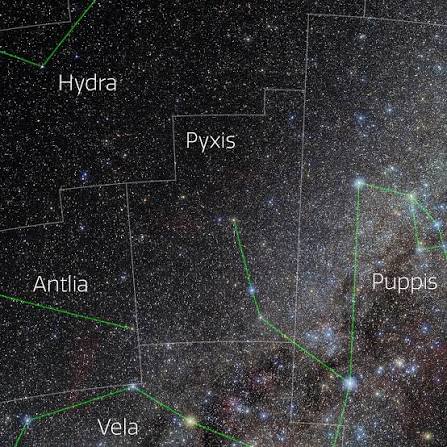
Unlike many constellations rooted in ancient Greek mythology, Pyxis is a relatively modern addition to the night sky. It was introduced during the 18th century by French astronomer Nicolas-Louis de Lacaille, who created several southern constellations based on scientific instruments.
Pyxis represents the mariner’s compass, an essential tool for navigation long before the advent of GPS and modern electronics. It was deliberately placed near the remnants of the enormous ancient constellation Argo Navis, the legendary ship of Jason and the Argonauts.
Today, Argo Navis has been divided into the constellations Carina, Vela, and Puppis, with Pyxis fitting naturally alongside them as another symbol of maritime exploration.
Finding Pyxis in the Night Sky
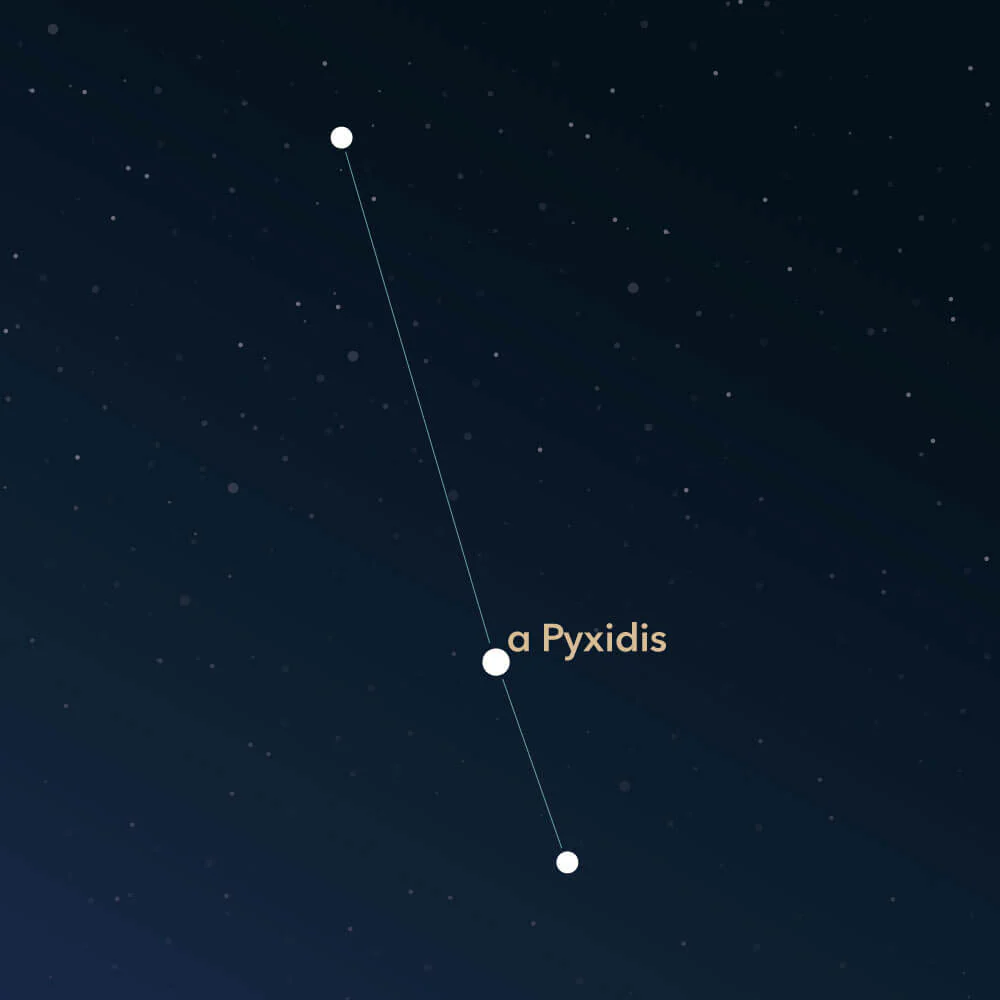
Pyxis lies just south of the celestial equator and is best viewed from southern latitudes during late summer and autumn.
The constellation is bordered by Puppis, Vela, Antlia, and Hydra. Although its stars are relatively faint, locating Puppis first makes Pyxis much easier to identify.
Its brightest star, Alpha Pyxidis, shines at around magnitude 3.7, making it visible to the naked eye under reasonably dark skies. A pair of binoculars can reveal many more of the constellation’s stars and add depth to the surrounding Milky Way region.
Because Pyxis sits within a rich star field, patient observers will enjoy sweeping through the area even if the constellation itself is subtle.
Highlights Within Pyxis

While Pyxis is not famous for spectacular deep-sky objects, it still offers interesting sights for amateur astronomers.
Some highlights include:
- Alpha Pyxidis, the constellation’s brightest star.
- T Pyxidis, a remarkable recurrent nova that periodically erupts in dramatic fashion.
- Several attractive double stars for binocular and telescope observers.
- Rich Milky Way star fields surrounding the constellation.
- Nearby views of Puppis and Vela, making for an enjoyable observing session.
Astrophotographers may also appreciate Pyxis as part of wider-field images that capture multiple southern constellations together.
Why Pyxis Matters
Pyxis serves as a reminder of humanity’s long relationship with exploration. Before satellites and digital navigation, sailors trusted simple instruments and the night sky to chart courses across unfamiliar seas.
Its placement alongside the former Argo Navis reinforces this theme, linking the practical compass with one of astronomy’s most famous celestial ships.
Although easily overlooked in favour of brighter constellations, Pyxis demonstrates that every part of the night sky has a story to tell. Sometimes the quieter constellations reveal just as much about human history as they do about the universe itself.
A Hidden Treasure of the Southern Sky
Not every constellation needs dazzling stars to capture our imagination. Pyxis stands out because of its symbolism, history, and connection to the great age of navigation.
The next time you explore the southern sky, take a moment to locate this modest mariner’s compass. It offers an opportunity to appreciate both the science of astronomy and the remarkable journeys that once depended upon the stars above.
As we continue our journey through the southern constellations here at Casual Astronomer, Pyxis reminds us that every constellation, no matter how small, plays its part in the vast celestial map that has inspired explorers for generations.


Leave a Reply