The Sombrero Galaxy is one of the most unusual and visually striking galaxies ever discovered. Famous for its glowing central bulge and dark dust lane, it resembles a giant cosmic sombrero floating through deep space.
Astronomers and astrophotographers are especially fascinated by the Sombrero Galaxy because of its unique structure and brilliant appearance. Unlike many spiral galaxies, its massive central region and sharply defined dust ring create a dramatic shape that stands out clearly in telescope images.
In this guide, we explore the Sombrero Galaxy, where it is located, how it formed, and why it remains one of the most iconic galaxies in the night sky.
What is the Sombrero Galaxy?
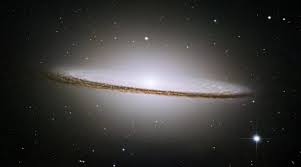
The Sombrero Galaxy is officially known as Messier 104, or M104. It is located in the constellation Virgo and sits approximately 31 million light-years from Earth.
The galaxy earned its nickname because of its appearance. When viewed from Earth, its bright central bulge and surrounding dust lane resemble a traditional Mexican sombrero hat. This distinct shape makes it one of the easiest galaxies to recognise in astronomy photographs.
The Sombrero Galaxy is classified as a peculiar spiral galaxy, although some astronomers believe it also shares characteristics with elliptical galaxies. Its enormous central bulge is far larger than what is normally seen in standard spiral galaxies.
Because of its brightness and unusual structure, the Sombrero Galaxy has become an important object for both scientific research and public astronomy education.
A closer look at its structure
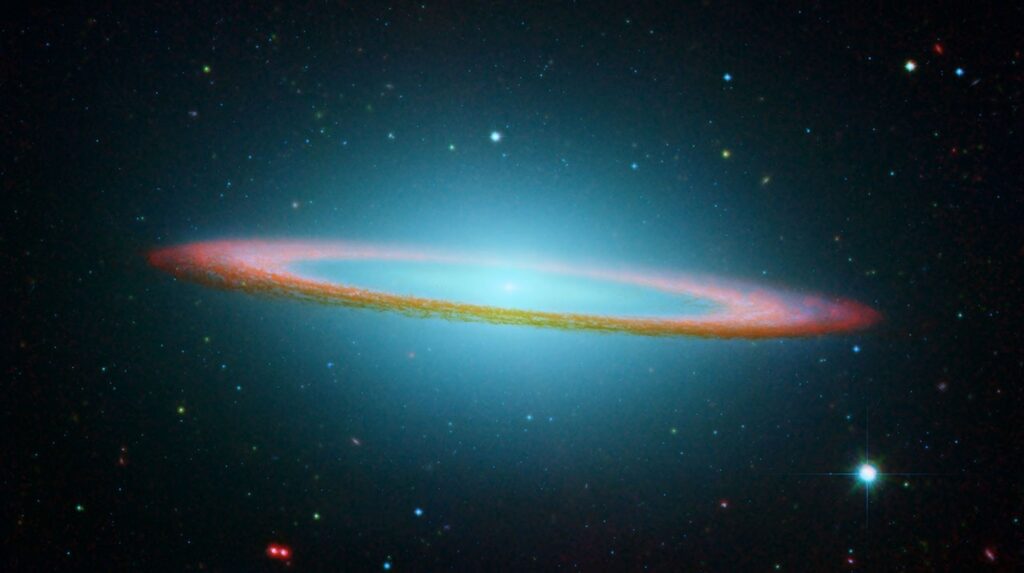
One of the most impressive features of the Sombrero Galaxy is its massive glowing core. This bright central region contains billions of stars packed tightly together, creating the galaxy’s brilliant appearance.
Surrounding the core is a thick ring of dark dust and gas that forms the famous “hat brim” shape. This dust lane blocks some of the light behind it, creating strong contrast and making the galaxy visually dramatic.
The Sombrero Galaxy also contains a supermassive black hole at its centre. Scientists estimate that this black hole may contain the mass of around one billion suns, making it one of the larger black holes discovered in nearby galaxies.
Despite appearing calm from a distance, the galaxy contains complex motion, star formation activity, and gravitational interactions that continue shaping its structure over time.
Where is the Sombrero Galaxy located?
The Sombrero Galaxy is located in the constellation Virgo, one of the largest constellations in the night sky. It lies relatively close to the Virgo Cluster, a massive collection of galaxies spread across space.
Although the galaxy is extremely distant, its brightness allows amateur astronomers to observe it with moderate telescopes under dark skies. Small telescopes usually reveal a glowing oval shape, while larger telescopes may show hints of the dark dust lane cutting across the galaxy.
For observers in the Southern Hemisphere, including South Africa, the Sombrero Galaxy can be viewed during autumn and early winter evenings when Virgo rises higher above the horizon.
Clear skies and low light pollution greatly improve visibility when attempting to observe deep-space galaxies like M104.
Why the Sombrero Galaxy is important
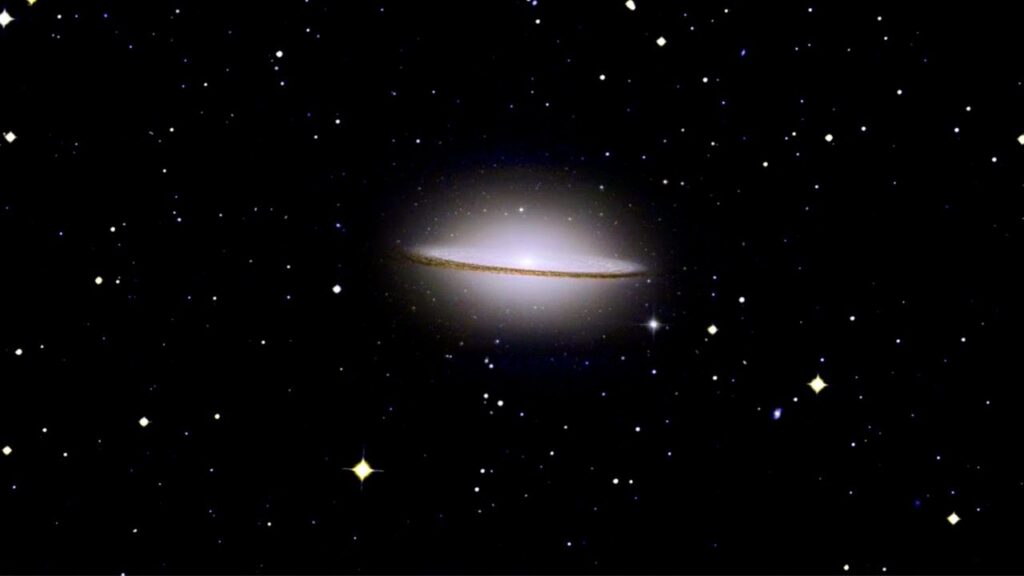
The Sombrero Galaxy continues to play an important role in astronomical research because of its unusual composition and structure. Scientists use it to study galaxy evolution, black holes, star populations, and dust formation.
Important reasons the Sombrero Galaxy matters include:
- Its unusually large central bulge
- Its prominent dust lane structure
- Its massive central black hole
- Its role in studying galaxy classification
- Its visibility for amateur astronomy and astrophotography
The galaxy also helps researchers compare the differences between spiral and elliptical galaxies. Its mixed characteristics challenge simple classification systems and improve our understanding of galactic evolution.
Because of its brightness and beauty, the Sombrero Galaxy is frequently photographed by both professional observatories and amateur astrophotographers around the world.
Observing the Sombrero Galaxy
Observing the Sombrero Galaxy can be a rewarding experience for astronomy enthusiasts. Under good conditions, it appears as a bright elongated glow with a concentrated centre.
Moderate telescopes are usually sufficient for spotting the galaxy, although seeing the dark dust lane requires darker skies and larger aperture equipment. Astrophotography reveals far more detail, including the dramatic contrast between the glowing core and surrounding dust ring.
The best viewing conditions occur during moonless nights with stable atmospheric conditions. Observers should also allow their eyes time to adapt to darkness for improved deep-sky visibility.
Many astronomers consider the Sombrero Galaxy one of the most photogenic galaxies visible from Earth because of its clean structure and distinctive appearance.
A galaxy unlike any other
The Sombrero Galaxy remains one of the most recognisable and fascinating galaxies in the observable universe. Its glowing core, dramatic dust lane, and hat-like appearance make it a favourite subject for astronomers, educators, and astrophotographers alike.
By studying galaxies like M104, scientists continue learning more about black holes, galactic evolution, star systems, and the structure of the universe itself.
Whether viewed through a telescope or captured in deep-space photography, the Sombrero Galaxy offers a breathtaking reminder of the beauty and complexity that exists far beyond our own Milky Way.