
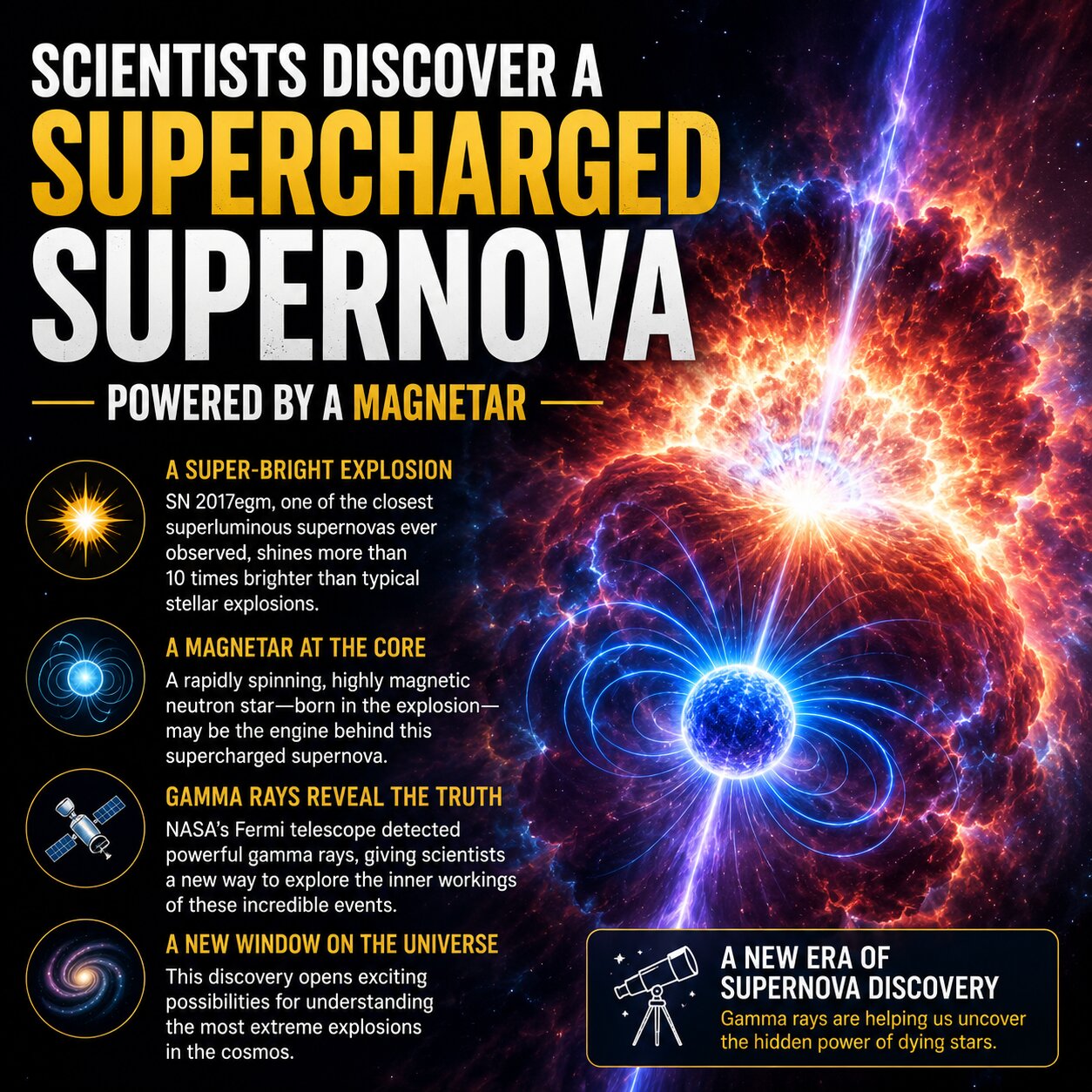

Astronomers have uncovered fascinating new evidence suggesting that a powerful supernova explosion may have been fuelled by one of the most extreme objects in the universe: a magnetar.
Using observations from NASA’s NASA Fermi Gamma-ray Space Telescope, scientists detected energetic gamma rays coming from the superluminous supernova known as SN 2017egm. Researchers now believe the incredible energy behind this cosmic explosion may have originated from a rapidly spinning, highly magnetic neutron star created during the supernova itself.
The discovery gives astronomers an exciting new way to study the violent deaths of massive stars and could help explain why some supernovas shine far brighter than others.
What makes this supernova so unusual?

Most supernovas occur when massive stars collapse under their own gravity at the end of their lifespans. These explosions are already among the most energetic events in the universe, but some rare examples become even more extreme.
SN 2017egm belongs to a category called “superluminous supernovas,” which can produce more than ten times the visible light of typical core-collapse supernovas. Scientists have long debated what powers these unusually bright explosions.
Researchers now believe the answer may lie in magnetars. These are a rare type of neutron star with magnetic fields so powerful that they are considered the strongest known magnetic objects in the universe.
When the core of a massive star collapses, it can compress material so densely that a neutron star forms within a sphere only around 20 kilometres wide. Despite their tiny size, neutron stars can contain more mass than the Sun and spin hundreds of times per second.
The rapid compression also intensifies the star’s magnetic field dramatically, potentially creating a magnetar capable of releasing enormous amounts of energy.
Gamma rays reveal the hidden engine
The breakthrough came after scientists analysed gamma-ray emissions from SN 2017egm using the Fermi telescope.
Gamma rays are the highest-energy form of light and are extremely difficult to detect from distant supernovas. Researchers examined several nearby superluminous supernovas observed during the first 16 years of Fermi’s mission, but only SN 2017egm showed convincing evidence of gamma-ray activity.
The supernova exploded around 440 million light-years away inside the galaxy NGC 3191, making it one of the closest superluminous supernovas ever observed from Earth.
Scientists believe the newborn magnetar created a “magnetar wind nebula,” a cloud of particles and antimatter surrounding the dead star. When particles and antimatter collide, they annihilate each other and release enormous bursts of gamma rays.
Those gamma rays then interact with the expanding shell of supernova debris, helping generate the intense visible brightness observed from Earth.
Why this discovery matters
The discovery could open an entirely new field of supernova research.
Until now, astronomers mainly studied supernovas using visible light, radio waves, and X-rays. Detecting gamma rays directly from a superluminous supernova gives researchers another powerful tool for investigating the inner workings of these violent stellar explosions.
Some of the key findings from the study include:
- Evidence supporting the magnetar-powered supernova theory
- Confirmation that superluminous supernovas can emit powerful gamma rays
- New insight into how matter and antimatter interact inside exploding stars
- Better understanding of neutron stars and magnetars
- Future opportunities for advanced gamma-ray observatories
Scientists also believe future telescopes, including the upcoming Cherenkov Telescope Array Observatory, could help detect similar events across even larger distances in space.
As more observations become possible, astronomers hope to better understand how these cosmic explosions evolve and why only certain supernovas become superluminous.
A New Window Into The Most Violent Stellar Explosions
The universe continues revealing just how extreme and mysterious it truly is.
The discovery of gamma rays from SN 2017egm provides compelling evidence that magnetars may act as hidden engines behind some of the brightest explosions ever observed in space. These findings could reshape how scientists study supernovas, neutron stars, and the life cycles of massive stars in the future.
With next-generation observatories preparing to explore the cosmos in even greater detail, astronomers may soon uncover many more supercharged supernovas hiding across the universe.


Leave a Reply