
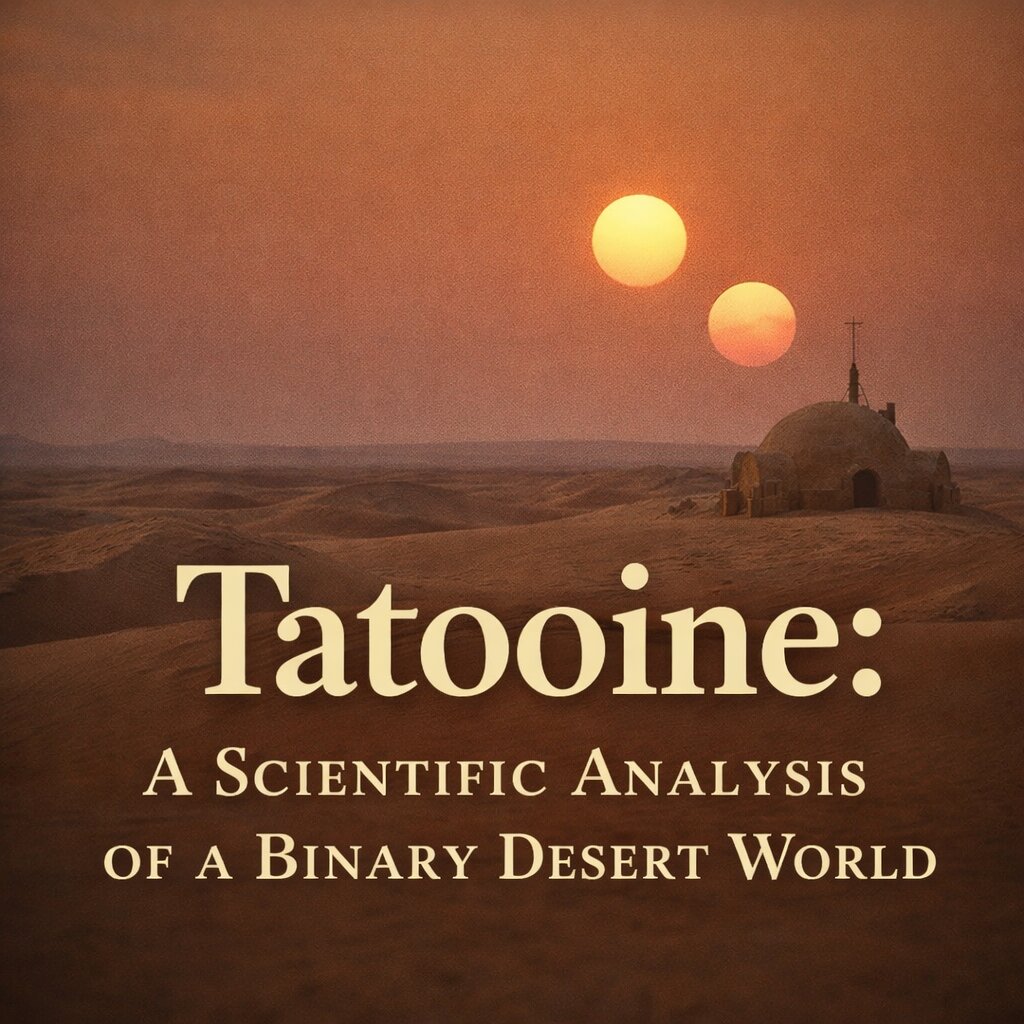

What if Tatooine were real?
The twin-sunned desert world from the Star Wars movies is one of the most iconic fictional planets ever imagined. Its endless dunes, scattered settlements, and dramatic double sunsets have become embedded in pop culture. But from a scientific perspective, could a planet like Tatooine actually exist?
In this article, we analyse Tatooine as though it were a real astronomical body. We will examine its binary star system, orbital stability, climate conditions, geological history, and potential demographics using real astrophysics and planetary science principles.
This is a speculative exploration grounded in real science.
Disclaimer: This article is a fictional scientific exercise inspired by the Star Wars universe and written for educational and entertainment purposes.
The Twin Suns: A Circumbinary System
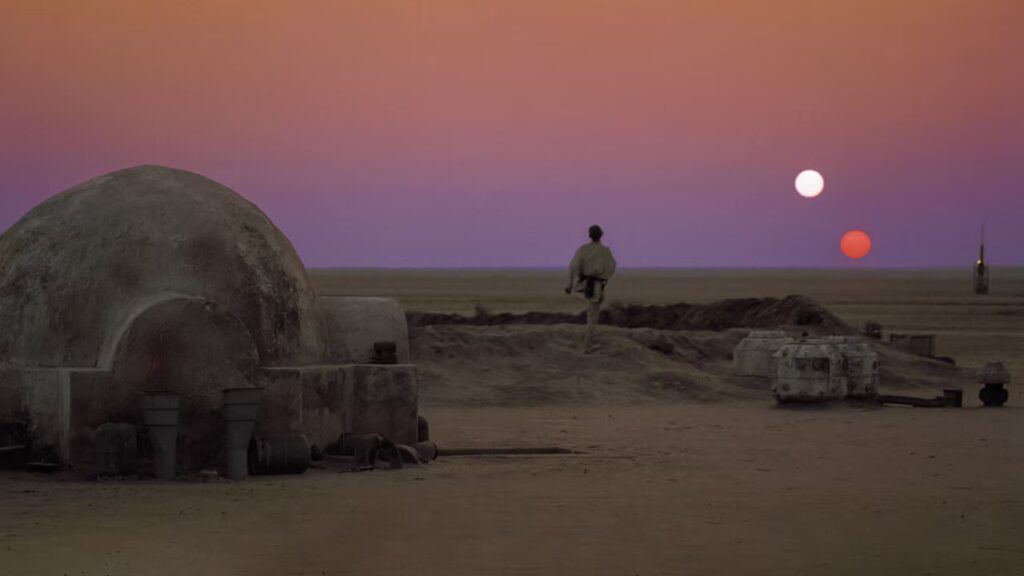
Tatooine is located in the Tatoo system, a binary star system (featuring stars Tatoo I and Tatoo II) situated within the Arkanis sector of the Outer Rim Territories. Since Tatooine orbits two stars, it is a circumbinary planet. While this may sound purely fictional, circumbinary planets are very real. Astronomers have already confirmed multiple exoplanets orbiting binary star systems. One of the most famous is Kepler-16b, often nicknamed the “real-life Tatooine.”
For orbital stability, a planet like Tatooine would need to orbit far enough away from both stars so that their gravitational forces act together rather than tear the planet’s orbit apart. This means the two stars would likely orbit each other relatively closely, forming a gravitational pair, while the planet travels around them at a safe distance.
The result would be complex illumination cycles. Depending on the relative positions of the stars, the surface would sometimes receive combined stellar radiation and at other times slightly reduced intensity. This dynamic could influence temperature variation and seasonal behaviour in ways unlike anything we experience on Earth.
Surface and Climate: A Desert World
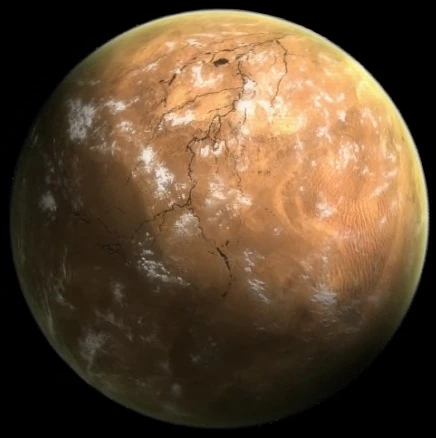
Tatooine is depicted as almost entirely desert. For a planet to become this arid, it would likely have experienced significant atmospheric water loss over geological time.
Several real mechanisms could explain such dryness. Intense radiation from two suns could accelerate evaporation and atmospheric stripping. If the planet lacked a strong magnetic field early in its history, solar wind could have gradually eroded its atmosphere and removed lighter elements, including water vapour.
Another possibility is a runaway greenhouse effect. If early oceans evaporated due to high stellar output, water vapour would have amplified surface heating, eventually leading to the collapse of stable hydrological cycles.
The planet’s vast dune systems suggest long-term wind erosion across ancient sedimentary layers. In planetary science terms, Tatooine may represent a world that once had surface water but lost it through stellar evolution or atmospheric instability.
Atmospheric Viability
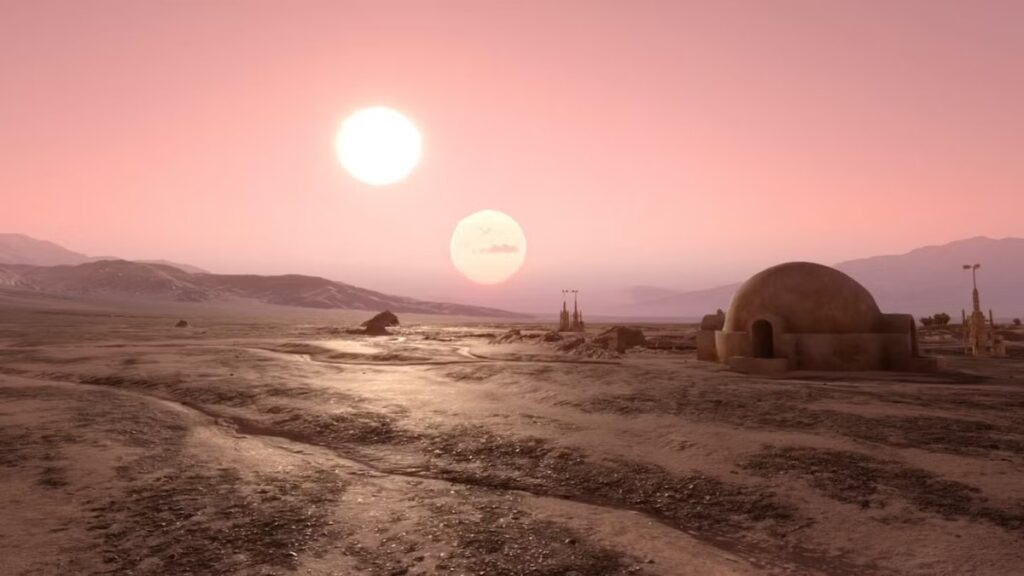
One of the most interesting scientific questions is whether Tatooine’s atmosphere could realistically support humanoid life without protective equipment.
For breathable conditions, the atmosphere would require stable pressure and an oxygen-nitrogen composition similar to Earth’s. This alone would imply either biological oxygen production or long-term atmospheric stability mechanisms.
However, twin stars would increase ultraviolet radiation exposure. Without a strong ozone layer and magnetosphere, surface life would face significant radiation risk. For a planet like Tatooine to remain habitable, it would require both sufficient gravity to retain atmospheric gases and magnetic shielding to prevent erosion by stellar winds.
If those conditions were met, breathable desert regions would be scientifically plausible, though environmental stress would remain high.
Geological Structure and Terrain
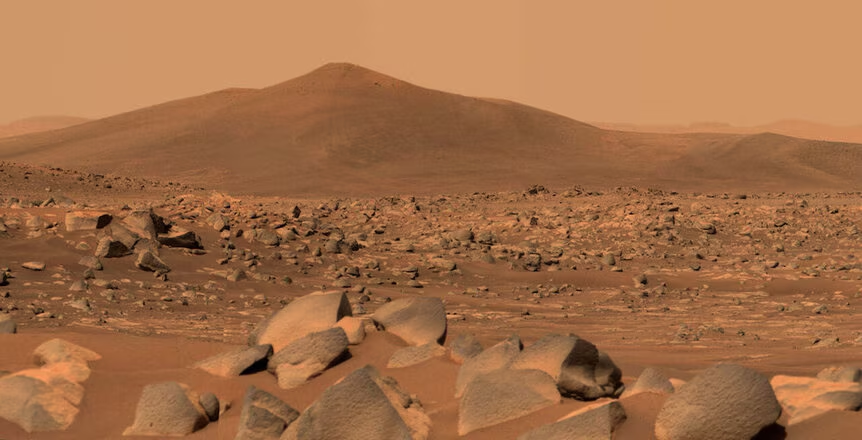
The landscapes shown in cinematic depictions of Tatooine include vast sand seas, rocky outcrops, canyon systems, and isolated plateaus. From a geological perspective, this suggests prolonged wind erosion, tectonic stability, and minimal surface water activity in recent epochs.
Large dune fields indicate persistent atmospheric movement. Rocky formations imply exposed bedrock that has resisted erosion more effectively than surrounding sediments. Canyon systems could be remnants of ancient water flows, carved during a time when the planet may have supported rivers or seasonal runoff.
If Tatooine once possessed oceans or lakes, their disappearance would leave mineral deposits and salt flats beneath the dunes. Over millions of years, wind-driven redistribution of sediments would create the planetary-scale desert terrain observed.
Population and Settlement Patterns
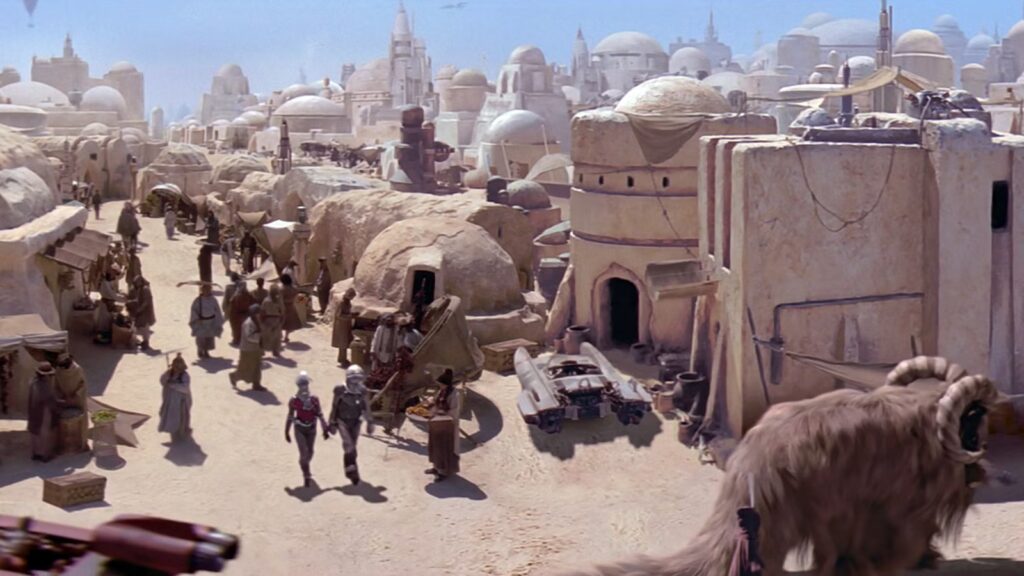
Within the fictional universe, Tatooine supports scattered settlements, moisture farms, and trade hubs. If treated as a real planetary environment, such settlement patterns make sense for a harsh desert world.
Populations would likely cluster around subsurface water reserves or engineered water extraction systems. Surface agriculture would be nearly impossible without advanced irrigation or atmospheric moisture harvesting technology.
Low population density would be expected. Harsh climates limit expansion, and infrastructure would concentrate around trade routes, transport corridors, and stable geological regions.
In real planetary colonisation models, desert worlds demand high technological dependence. Survival would require energy infrastructure, cooling systems, and efficient water recycling. The scattered habitation seen in fictional portrayals aligns with how scientists envision early off-world desert colonies.
Could a Planet Like Tatooine Exist?
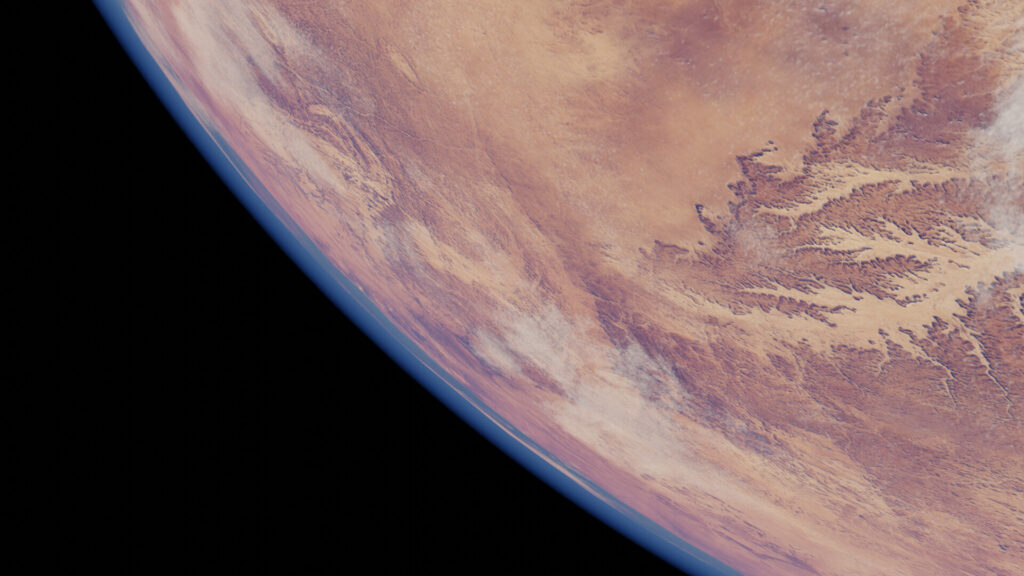
The scientific foundation of Tatooine is stronger than many assume.
Binary star systems are common in our galaxy. Circumbinary planets are confirmed. Desert exoplanets likely exist. Atmospheric collapse scenarios are well understood in planetary science.
The most challenging aspect would be maintaining long-term atmospheric stability and surface habitability under dual stellar radiation. But if the stars were moderately sized and the planet’s orbit were carefully positioned within a stable habitable zone, a desert circumbinary world is not outside the realm of possibility.
Tatooine, while fictional, rests on surprisingly realistic astrophysical concepts.
Why Exploring Fictional Planets Matters
Analysing fictional worlds through real science encourages curiosity about exoplanets, orbital mechanics, and planetary evolution. It bridges imagination and astrophysics.
When audiences watch twin suns setting over a desert horizon, they are unknowingly engaging with real astronomical principles. Circumbinary dynamics, stellar radiation, atmospheric chemistry, and planetary geology are not science fiction. They are active areas of research.
Somewhere in our galaxy, there may already be a world with two suns casting long shadows across alien dunes.
And if we ever discover it, we might finally have a real Tatooine.

