
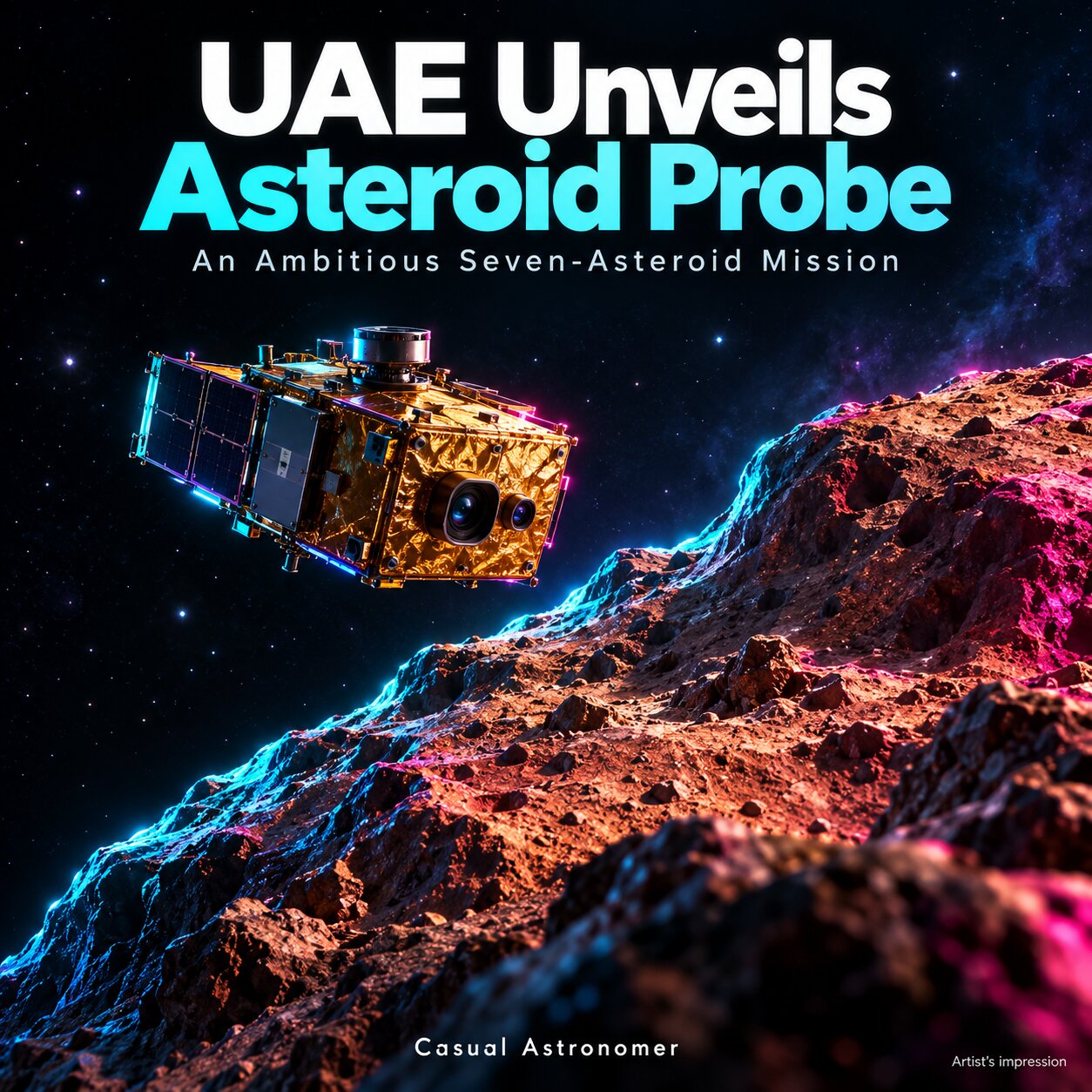

The United Arab Emirates has unveiled a small spacecraft with a remarkable destination: the surface of the unusually red asteroid 269 Justitia. Developed by the Technology Innovation Institute (TII), the probe will accompany the Emirates Mission to the Asteroid Belt, which is targeting a March 2028 launch.
The mission combines encounters with seven asteroids, an approximately eight-year journey and a final descent that the probe is not expected to survive. For scientists, the reward could be a close look at an object that preserves clues to the early Solar System.
A New Milestone for the Emirates Asteroid Mission

TII announced the probe’s completion on 1 October 2026. Designed, built and tested in Abu Dhabi, it is due to travel to Colorado for integration with the mission’s main spacecraft, MBR Explorer. The smaller probe is the mission’s only deployable payload.
The project follows the UAE’s Hope mission, which reached Mars in 2021. This time, the scientific focus shifts to the small bodies orbiting between Mars and Jupiter, with several encounters planned before the spacecraft reaches its principal target.
According to the supplied Space.com report, the unveiling included a half-scale model of the probe. That distinction matters: the public display represents hardware being prepared for an interplanetary mission, rather than a spacecraft already exploring its destination.
Seven Asteroids Across a Long Journey
MBR Explorer’s planned route covers approximately five billion kilometres. Gravity assists from Venus, Earth and Mars will help shape its trajectory, allowing it to visit multiple targets during one mission.
The planned asteroid sequence is:
- 10253 Westerwald
- 623 Chimaera
- 13294 Rockox
- 88055 Ghaf
- 23871 Ousha
- 59980 Moza
- 269 Justitia, the final rendezvous and surface-probe target.
The first six encounters will be flybys, while Justitia will receive a much longer investigation. This gives scientists opportunities to compare several bodies before concentrating on one particularly unusual object.
Researchers are already studying the targets from Earth. A September 2026 preprint analysed years of telescope observations to estimate their rotation and surface characteristics. Its results suggest a varied collection of objects, although some classifications remain uncertain and need further observations.
Why Justitia’s Red Colour Matters
Justitia stands out because its reflected light resembles that of some distant outer Solar System objects. Its unusually red spectrum has prompted scientists to investigate whether it formed much farther from the Sun before migrating into the main asteroid belt.
Research published in 2021 identified Justitia and another asteroid, Pompeja, as exceptionally red objects. The observations suggested that complex organic material could be present on their surfaces, supporting the possibility of an origin in the outer Solar System. This remains an interpretation to investigate, rather than a confirmed history.
“Organic” in this context refers to carbon-based chemistry; it does not establish the presence of life. Understanding that distinction keeps the scientific question clear: researchers want to investigate the materials preserved on Justitia and what they reveal about planetary formation.
If its proposed origin is supported, Justitia could provide access to outer Solar System material without requiring a spacecraft to travel all the way beyond Neptune. That makes its current location especially interesting.
A Descent with a Hard Ending
The mission plan includes roughly seven months studying Justitia from orbit before releasing the probe. During its descent, the smaller craft will photograph the surface and transmit observations to MBR Explorer above. TII describes this close-range investigation as a central purpose of the deployable spacecraft.
However, “lander” should not suggest a gentle touchdown. The supplied Space.com report says engineers expect contact at approximately 15–27 metres per second, with survival considered unlikely. Much of the probe’s value will therefore come from the information gathered before impact.
The report also describes a possible brief operating period if the probe survives. That would be a bonus rather than something readers should assume will happen. Likewise, while impact may disturb surface material, obtaining useful observations of newly exposed material will depend on how the encounter unfolds.
A Probe Designed to Make Its Own Decisions
TII says the probe is designed to operate without receiving commands from Earth or MBR Explorer after launch. Its onboard processing will determine when to capture images and which observations to retain.
Two cameras will provide different views, combining wider context with closer detail. The institute also says imaging will begin during the journey, with data transmitted at approximately six-month intervals.
This autonomy is an engineering requirement, not a promise that nothing can go wrong. The hardware and software must remain capable of performing their tasks after years in space. The final descent will put that preparation to the test when there is little opportunity to recover from a problem.
What to Watch Before Launch
The next major steps include integration, testing and preparation for the planned March 2028 departure. The route depends on a narrow launch window, making readiness particularly important.
For Casual Astronomer readers, the strongest scientific question is what Justitia will actually reveal. Its colour offers a tantalising clue, but close observations are needed to test ideas about its composition and origins.
If successful, the Emirates Mission to the Asteroid Belt will connect observations of several small worlds with an intimate final encounter. A probe’s last images could help illuminate a much older story: how material moved through the young Solar System as the planets took shape.


