
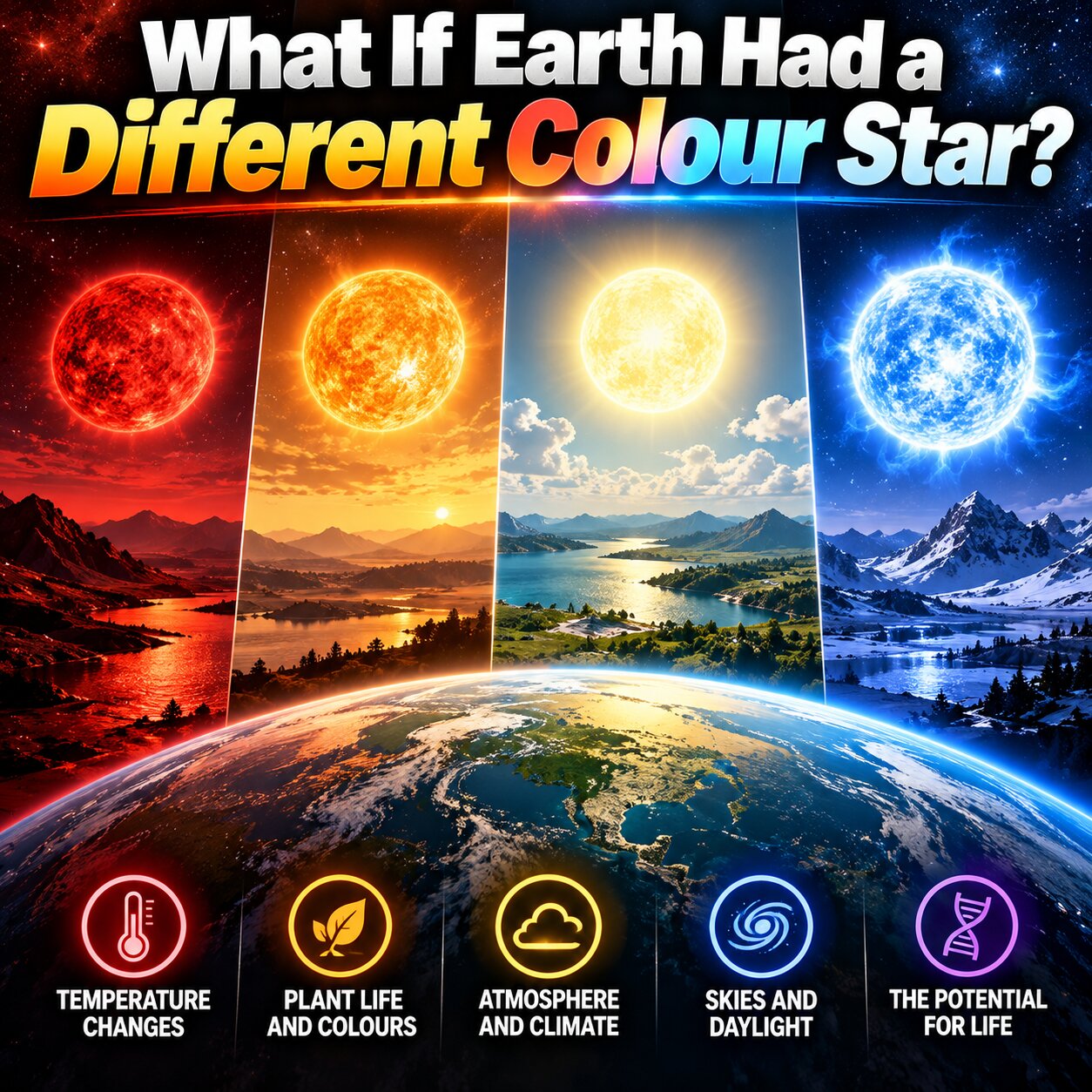

Imagine stepping outside and discovering that our familiar yellowish-white Sun had been replaced by a glowing red, orange or blue star. Would our skies change colour? Could plants survive? And would Earth remain habitable? Exploring what might happen if Earth orbited a different colour star reveals just how important our Sun is to life.
Living Beneath a Red Star
Red dwarf stars are smaller and cooler than the Sun, emitting much of their energy at longer wavelengths.
If Earth orbited a red dwarf at its present distance, it would generally receive far less energy, causing temperatures to plummet.
However, moving Earth closer could provide sufficient warmth for liquid water. Unfortunately, some red dwarfs produce powerful stellar flares, potentially threatening planetary atmospheres and surface conditions.
Daylight would also have a different spectral balance, although atmospheric scattering and human colour perception mean the sky wouldn’t necessarily appear bright red.
What About an Orange Star?
Orange K-type stars are slightly cooler than the Sun and can remain stable for exceptionally long periods.
An Earth-like planet orbiting within an orange star’s habitable zone could potentially maintain suitable temperatures for liquid water.
The sunlight would contain a greater proportion of longer wavelengths, potentially influencing the appearance of landscapes and the evolution of photosynthetic organisms.
Some researchers consider these stars promising candidates when searching for potentially habitable planets.
A Brilliant Blue Star
Blue stars are considerably hotter and generally more luminous than our Sun.
Their intense ultraviolet radiation could present significant challenges for life, particularly without adequate atmospheric protection.
Massive blue stars also have relatively short lifespans, sometimes lasting only millions of years rather than billions.
That creates a serious obstacle for complex life, which took billions of years to develop on Earth.
Would Plants Still Be Green?
Plants evolved their pigments under the spectrum of sunlight reaching Earth’s surface.
Around a different colour star, photosynthetic organisms might develop alternative pigments better suited to the available wavelengths.
Possible colours could include darker greens, purples or nearly black surfaces, although the actual outcome would depend on atmospheric conditions and evolutionary processes.
Our Sun Is More Than Just a Colour
A different colour star wouldn’t simply change the appearance of our daytime sky. It could influence planetary temperatures, atmospheric chemistry, biological evolution and the amount of time available for life to develop.
Our Sun’s particular combination of luminosity, stability and lifespan has helped make Earth the remarkable world we know today.
Perhaps somewhere in the galaxy, life is flourishing beneath an orange sunset or a dim red sun. The universe may hold more colourful possibilities than we can imagine.


