A Chinese Long March 7A rocket exploded approximately 85 seconds after liftoff on 10 August 2026, resulting in the loss of both the launch vehicle and the communications satellite it was carrying.
The rocket lifted off from the Wenchang Space Launch Site in China’s Hainan province at approximately 8:02 p.m. local time. The flight initially appeared to proceed normally, but the vehicle was destroyed while it was still climbing through Earth’s atmosphere. Images and video of the incident show a dramatic fireball forming in the sky as debris separated from the vehicle.
The failed mission was carrying the Zhongxing-4B, also known as ChinaSat 4B, communications satellite, which was expected to travel towards geostationary transfer orbit.
With the rocket failing less than a minute and a half into flight, investigators will now need to determine exactly what went wrong and whether the problem could affect other upcoming missions using related launch technology.
What Happened During the Long March 7A Launch?
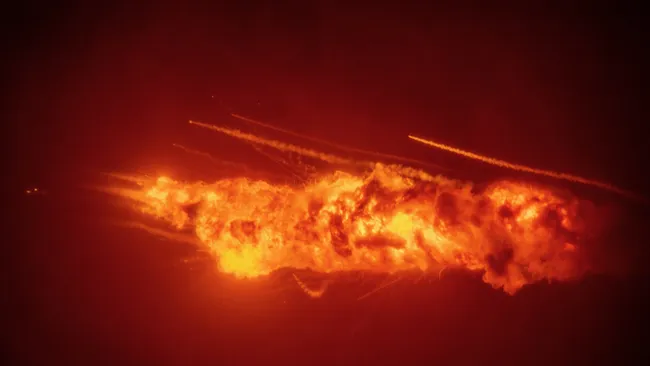
The Long March 7A launched from Wenchang shortly after 8 p.m. local time on 10 August.
Approximately 85 seconds after liftoff, the mission suffered a catastrophic failure. This occurred well before the rocket’s normal first-stage separation, which takes place just under three minutes after launch. The vehicle was therefore still performing its initial powered ascent when it was lost. (Space)
Footage captured from the ground shows the ascending rocket before a sudden, enormous fireball develops in the sky.
At this early stage, however, the visual spectacle tells us considerably less than the eventual engineering investigation will.
A rocket exploding does not by itself reveal the component responsible for the failure. Investigators will need telemetry and other mission data to establish the sequence of events immediately preceding the vehicle’s destruction.
ChinaSat 4B Lost Alongside the Rocket
The payload aboard the Long March 7A was ChinaSat 4B, also referred to as Zhongxing-4B.
The spacecraft was a communications satellite and was apparently intended for geostationary transfer orbit. China’s Zhongxing satellite family supports telecommunications services, including data and communications applications.
Because the failure occurred so early during ascent, the satellite had no opportunity to separate from the launch vehicle or reach a useful orbit.
The incident therefore represents a complete mission loss rather than a situation where a spacecraft entered an incorrect orbit and could potentially recover using its own propulsion.
For satellite missions, this demonstrates the enormous importance of the launch phase. Years of spacecraft development can depend on only minutes of rocket operation before the payload reaches space.
What Is the Long March 7A?
The Long March 7A is part of China’s newer generation of launch vehicles and is designed particularly for missions requiring access to higher-energy orbits.
Standing approximately 60 metres tall, the rocket combines stages derived from the Long March 7 architecture with an additional upper stage using liquid hydrogen and liquid oxygen. It can deliver roughly seven tonnes to geostationary transfer orbit.
The configuration includes four side boosters surrounding the core vehicle.
Its first flight took place in March 2020 — and that mission also failed. Subsequent investigation traced the inaugural failure to an engine-related problem occurring after first-stage separation. The rocket later returned successfully to flight and accumulated numerous missions before the latest accident.
The 10 August 2026 failure is notably different in timing because the vehicle did not survive long enough to reach first-stage separation.
Why the Failure Matters Beyond This Mission
Investigators will be particularly interested in determining whether the failure resulted from a component unique to the Long March 7A or technology shared with other Chinese launch vehicles.
Rocket families frequently share engines, stages and other systems. This can reduce development and manufacturing costs, but it also means a serious problem identified in one configuration may require engineers to examine related vehicles.
The standard Long March 7, for example, is used to transport Tianzhou cargo spacecraft to China’s Tiangong space station. Its most recent cargo mission launched in May 2026.
The significance of the latest accident will therefore depend heavily on what investigators discover.
Potential consequences could include:
- Additional inspections of Long March 7A vehicles
- Review of telemetry from the failed flight
- Examination of systems shared with related rockets
- Possible schedule changes for future missions
- Corrective modifications before the vehicle returns to flight
None of these potential consequences should be assumed until the cause of the failure becomes clearer.
Rocket Failures Remain an Important Part of Spaceflight
Modern orbital rockets are extraordinarily complex machines operating close to their engineering limits.
During launch, engines must generate tremendous thrust while the vehicle experiences vibration, aerodynamic forces, changing atmospheric pressure and rapidly increasing velocity. Thousands of components and systems must operate correctly within carefully controlled sequences.
A failure occurring 85 seconds into flight could potentially originate from propulsion, structural, guidance, electrical or numerous other systems. Determining the cause requires considerably more information than can be obtained from external video alone.
That is why post-flight investigations are so important.
Telemetry can allow engineers to reconstruct events down to fractions of a second, helping determine whether the visible explosion was itself the original failure or merely the final consequence of something that had already gone wrong elsewhere in the vehicle.
What Happens Next for the Long March 7A?
Attention now turns towards the investigation into the loss of the Long March 7A and ChinaSat 4B.
The immediate question is what caused a rocket with an established flight history to fail during the first stage of ascent. The answer will determine whether corrective work is limited to the Long March 7A or whether other vehicles and missions require additional scrutiny.
For observers, the dramatic fireball captured above Wenchang provides the most visible evidence of the accident. For engineers, however, the most important information will be contained within the final seconds of telemetry transmitted before the vehicle was lost.
Spaceflight inevitably carries risk, even after a launch vehicle has completed successful missions.
The 10 August 2026 Long March 7A failure is another reminder that reaching orbit remains one of the most demanding engineering challenges humans routinely attempt — and that sometimes, understanding a failed launch can become as important to future missions as celebrating a successful one.