
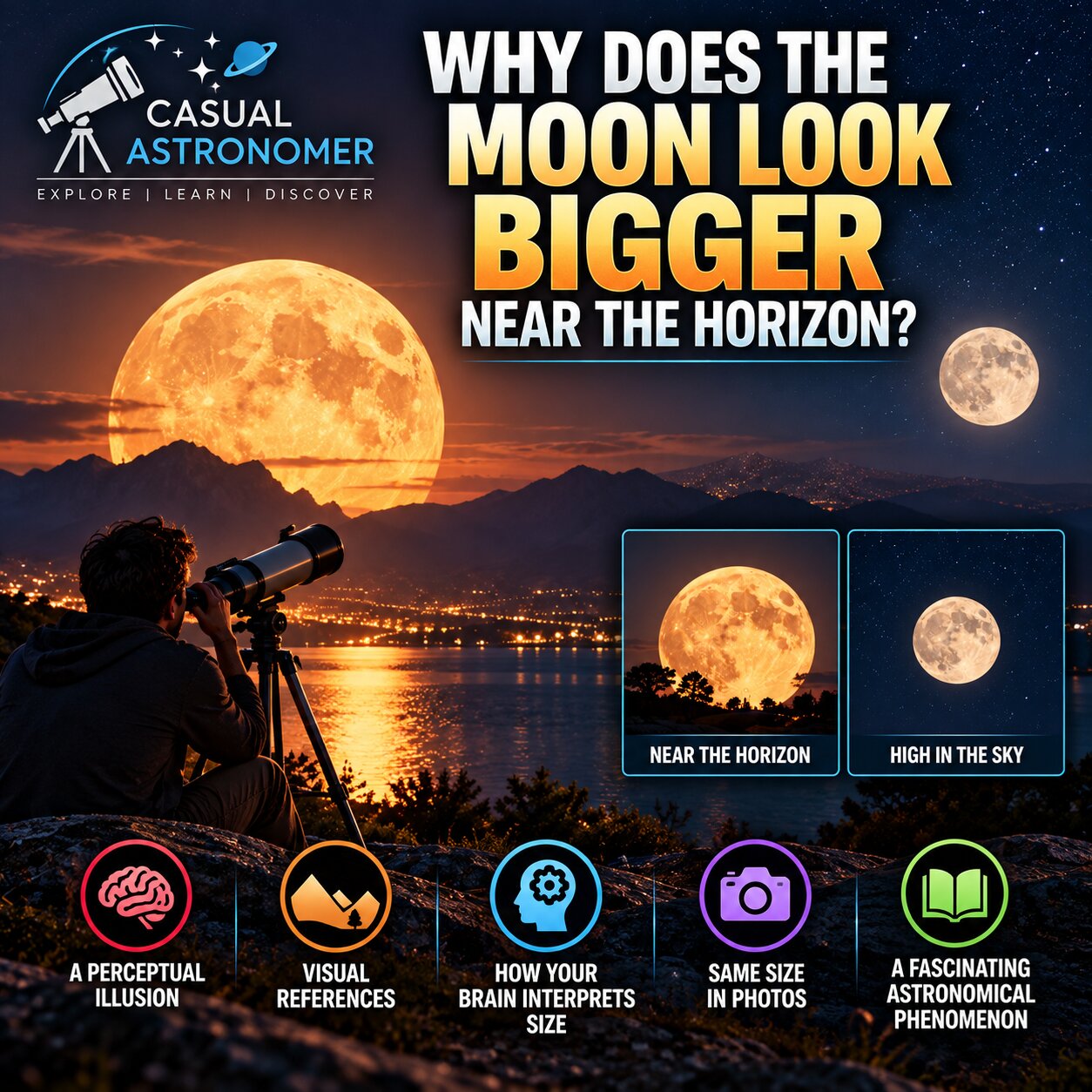

You’ve probably seen an enormous full Moon rising above distant buildings, mountains or trees. A few hours later, when that same Moon is high in the sky, it somehow seems much smaller.
Did the Moon suddenly move significantly farther away?
No. You’re experiencing the famous Moon illusion.
Your Brain Is Playing a Trick on You
The apparent size difference is primarily a perceptual effect. When the Moon is near the horizon, we see it alongside familiar objects such as trees, houses and landscapes.
Those visual references appear to influence how our brains interpret the Moon’s size and distance.
When the Moon rises higher, it becomes surrounded by an enormous, relatively featureless sky. Without the same terrestrial references, it can appear smaller.
You can test the illusion yourself. Photograph the Moon using the same camera and zoom settings when it is near the horizon and again when it is higher in the sky. Comparing its apparent diameter in the photographs reveals that the dramatic visual change you perceived isn’t reflected in the images.
An Ancient Astronomical Illusion
Humans have discussed the Moon illusion for centuries, and the precise psychological explanation behind its strength remains an interesting subject of study.
The next time an enormous Moon appears above the horizon, enjoy the spectacle — but remember that one of the most impressive sights in the night sky is partly being created inside your own mind.

Leave a Reply