
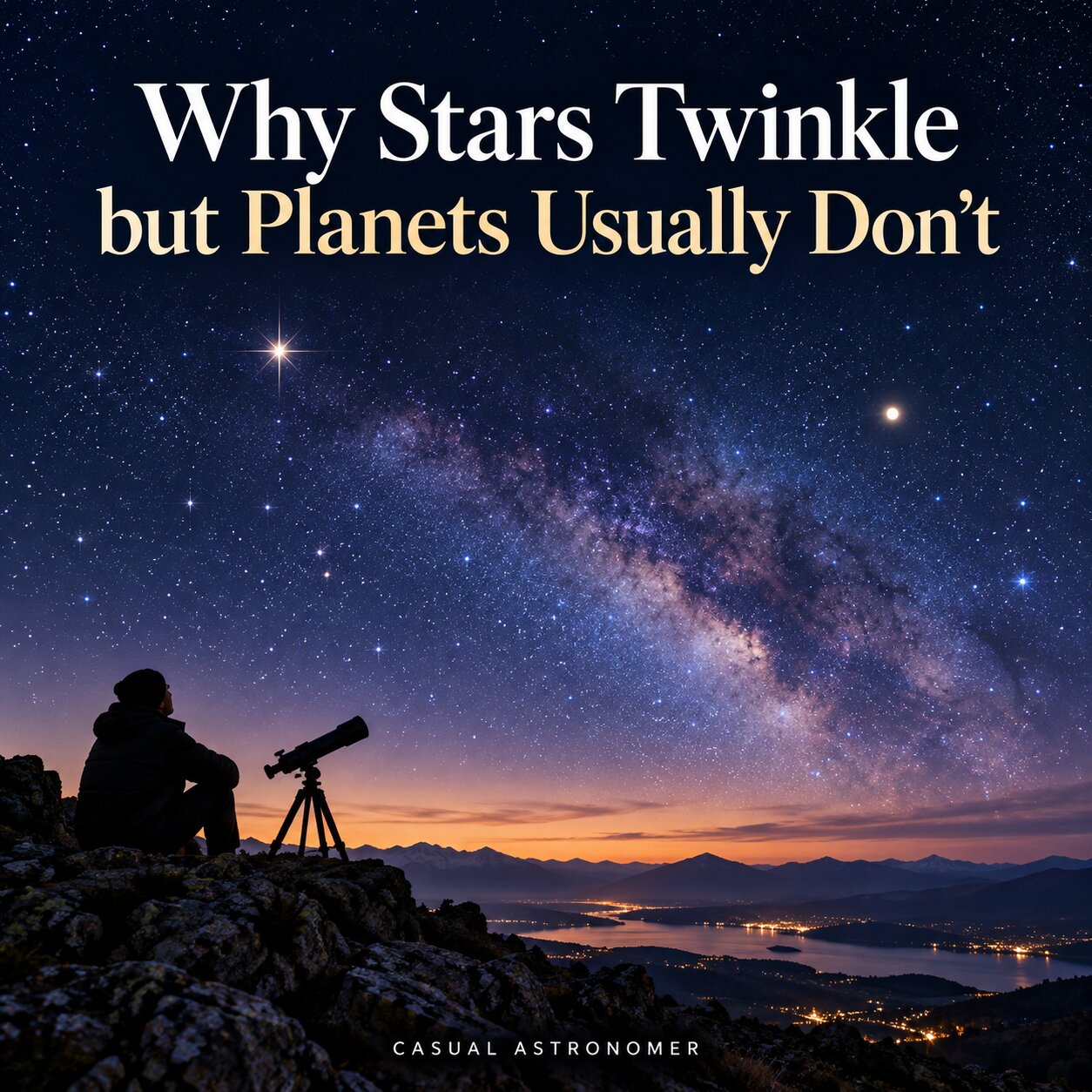

Look up on a clear night and you may notice stars flickering while nearby planets appear steadier. The difference is mainly caused by Earth’s atmosphere and how large these objects appear from our viewpoint.
Starlight passes through moving layers of air with different temperatures and densities. These layers bend the light unevenly, causing rapid changes in its apparent brightness and position. Astronomers call this effect scintillation.
Why Planets Look Steadier
Stars are so distant that they appear as tiny points of light. Atmospheric disturbances can therefore noticeably affect the light we receive from each one.
Planets are much closer and appear as small discs, even when our eyes cannot resolve them. Variations across different parts of that disc tend to average out, reducing the twinkling effect.
When observing the sky, remember:
- Stars usually twinkle more strongly near the horizon.
- Turbulent air can make the effect more noticeable.
- Planets can also twinkle, especially when low in the sky.
Twinkling is therefore a useful clue, rather than a guaranteed identification method.
Try Comparing Them Tonight
Choose a bright star and a visible planet at similar heights above the horizon. Watch each for a moment and compare how steadily its light shines.

Leave a Reply