A powerful geomagnetic storm could light up the skies on March 19, with northern lights potentially visible much further south than usual. Space weather experts are watching an incoming solar event that may create ideal conditions for widespread aurora displays.
The storm is being driven by a coronal mass ejection (CME) launched from the sun on March 16 during a moderate solar flare. If it hits Earth as expected, it could trigger a geomagnetic storm strong enough to push auroras into mid-latitude regions.
For skywatchers, this could be one of the best chances in months to witness the northern lights, especially with seasonal conditions already favouring stronger displays.
What is causing the geomagnetic storm?
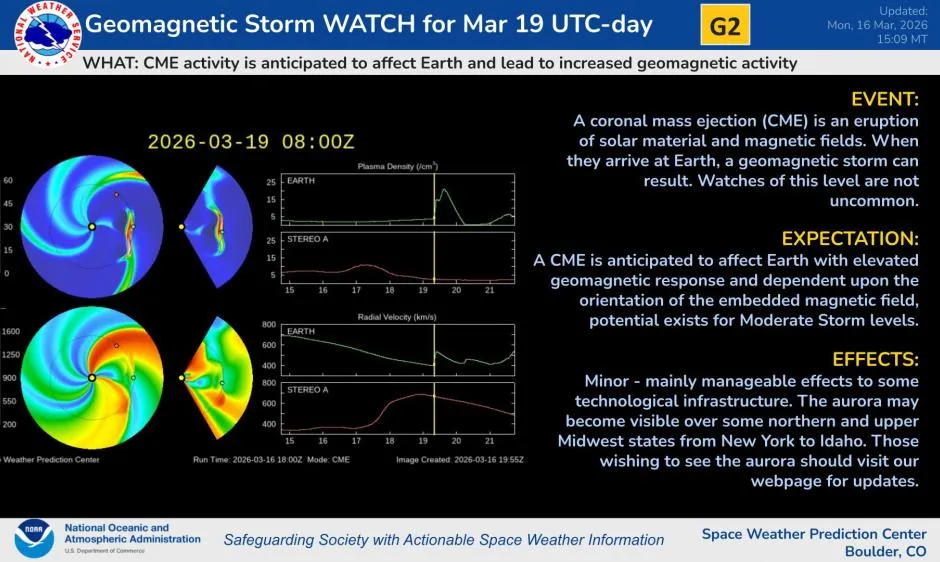
The upcoming aurora activity is linked to a CME, a massive burst of plasma and magnetic fields released from the sun. When these solar eruptions travel toward Earth and interact with our planet’s magnetic field, they can disturb it and create geomagnetic storms.
The current forecast comes from the National Oceanic and Atmospheric Administration (NOAA), which has issued a G2-level geomagnetic storm watch for March 19.
Geomagnetic storms are measured on a scale from G1 (minor) to G5 (extreme). A G2 storm is considered moderate, but strong enough to produce visible auroras beyond their usual polar regions.
There is also a possibility that the storm could intensify to G3 levels, which would increase both the brightness and reach of the auroras.
How far south could the northern lights be seen?
If the storm reaches its predicted strength, auroras could be visible much further south than usual. Typical viewing locations are high-latitude regions such as Canada, Alaska, and northern Europe.
However, during stronger geomagnetic storms, the auroral oval expands. This means regions much further south may get a chance to see the lights.
Forecasts suggest visibility could extend into areas such as:
- Northern United States regions like New York and Idaho
- Mid-latitude states including Illinois and Oregon if conditions strengthen
- Similar latitude regions in the Southern Hemisphere
Of course, visibility will depend on local weather conditions, light pollution, and timing.
Why March is a great time for auroras
This geomagnetic storm arrives at one of the best times of year for aurora viewing. Around the spring equinox, Earth’s position makes it easier for solar activity to interact with our magnetic field.
This phenomenon is known as the Russell-McPherron effect.
During this period, the alignment between Earth’s magnetic field and incoming solar wind becomes more favourable. This allows charged particles from the sun to enter the atmosphere more efficiently.
As a result, even moderate solar events can produce stronger and more widespread auroras than at other times of the year.
What to expect from this event
Skywatchers can expect increased auroral activity during the night of March 19, though exact timing will depend on when the CME reaches Earth.
Auroras may appear as shimmering curtains or arcs of green, pink, and purple light dancing across the sky. In stronger events, they can become bright enough to be seen even in areas with some light pollution.
For the best chance of seeing the northern lights:
- Head to dark areas away from city lights
- Look toward the northern horizon (or southern in the Southern Hemisphere)
- Check local space weather updates in real time
- Be patient, as auroras can appear in waves
Even if the storm does not reach its peak intensity, there is still a strong chance of a beautiful display.
Keep your eyes on the skies
With a CME on its way and seasonal conditions aligned, March 19 could deliver an impressive aurora show for many parts of the world.
While space weather is never perfectly predictable, the current forecasts suggest a strong possibility of expanded northern lights visibility. For both seasoned aurora chasers and casual stargazers, this is an event worth watching.
If skies are clear where you are, take a moment to look up. You might just catch one of nature’s most breathtaking light displays.