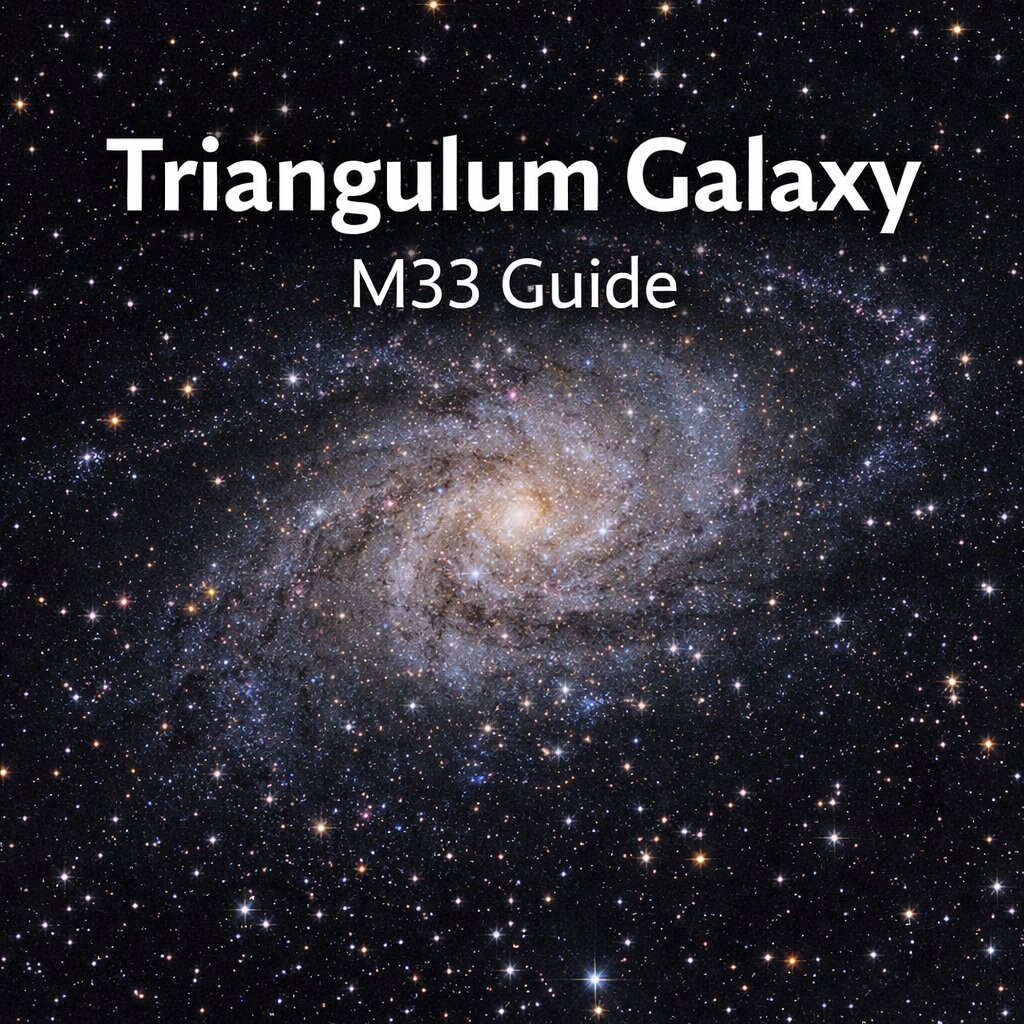

The Triangulum Galaxy is one of the closest spiral galaxies to our own, making it an important object of study for astronomers and an exciting target for skywatchers. Located in the constellation Triangulum, it is the third-largest member of our local group of galaxies, after the Milky Way and Andromeda.
Despite its relatively large size, the Triangulum Galaxy is faint and can be challenging to observe without dark skies. However, its structure and active star-forming regions make it one of the most fascinating galaxies in our cosmic neighbourhood.
In this guide, we explore what the Triangulum Galaxy is, how it formed, and how you can observe it from Earth.
What is the Triangulum Galaxy?
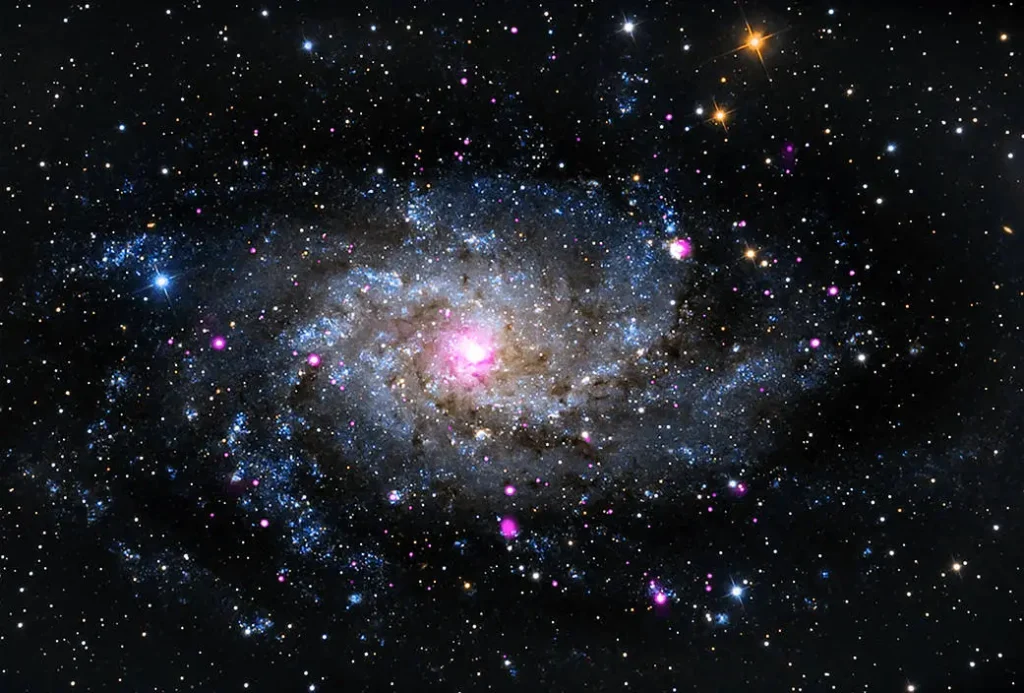
The Triangulum Galaxy is a spiral galaxy located about 2.7 million light-years away from Earth. It is often referred to as Messier 33 or M33, as it was catalogued by Charles Messier in the 18th century.
Unlike the Milky Way, it does not have a prominent central bulge, giving it a more open and loosely structured appearance. This makes it an excellent example of a “pure” spiral galaxy.
It is also gravitationally linked to the Andromeda Galaxy, and together they form part of the Local Group, a cluster of galaxies that includes our own.
Key facts about the Triangulum Galaxy
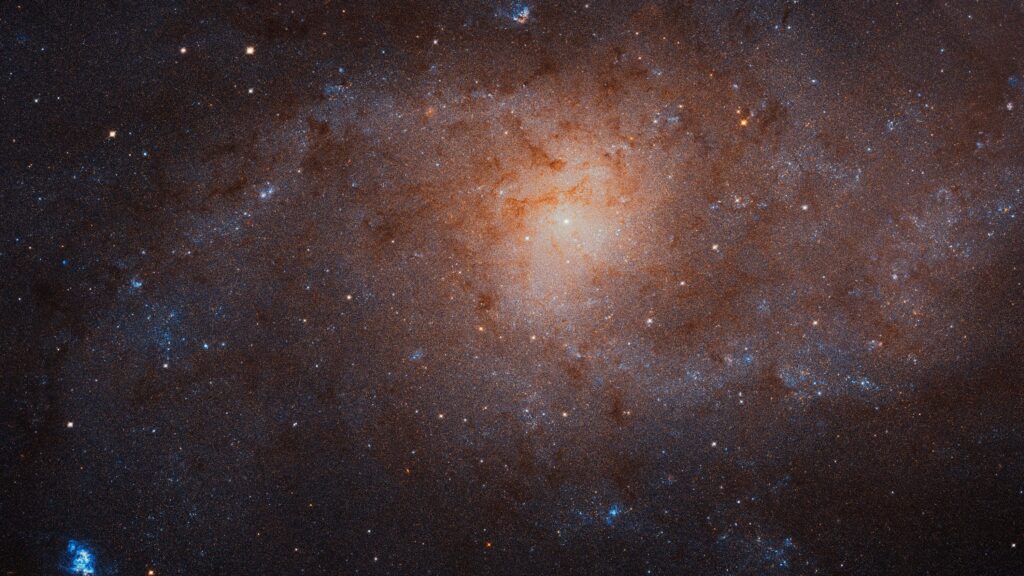
- Distance from Earth: ~2.7 million light-years
- Diameter: ~60,000 light-years
- Type: Spiral galaxy
- Also known as: Messier 33 (M33)
- Location: Constellation Triangulum
These characteristics make the Triangulum Galaxy one of the most accessible galaxies for studying spiral structures outside our own.
Structure and star formation
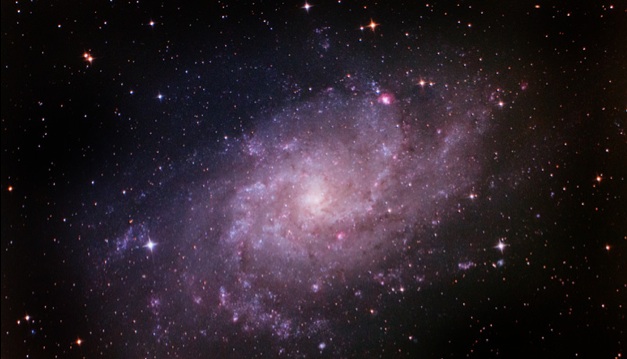
One of the most interesting features of the Triangulum Galaxy is its high rate of star formation. It contains numerous regions where new stars are actively being born.
The most famous of these is NGC 604, one of the largest star-forming regions in the Local Group. It is even larger than the Orion Nebula and can be observed with powerful amateur telescopes.
Because it lacks a dense central bulge, the galaxy’s spiral arms are more open and clearly visible. This gives astronomers a better view of how stars and gas are distributed.
Relationship with the Andromeda Galaxy
The Triangulum Galaxy is closely associated with the Andromeda Galaxy and may even be a satellite galaxy of it. The two are connected through gravitational interactions within the Local Group.
Some studies suggest that Triangulum may have interacted with Andromeda in the past, influencing its structure and star formation activity.
This relationship helps astronomers understand how galaxies evolve and interact over time, especially within clusters like our own.
How to find the Triangulum Galaxy
Finding the Triangulum Galaxy can be a rewarding challenge for amateur astronomers. It is located in the small constellation Triangulum, near the more prominent constellation Andromeda.
To locate it:
- Find the Andromeda Galaxy first
- Look south of Andromeda toward the triangular shape of Triangulum
- Use binoculars or a telescope for better visibility
- Observe from a dark-sky location for best results
Because it has a low surface brightness, it is best viewed on clear, moonless nights.
Can you see it with the naked eye?
Under ideal conditions, the Triangulum Galaxy can be seen with the naked eye, but this requires very dark skies with little to no light pollution.
In most locations, binoculars are enough to reveal it as a faint, hazy patch of light. A small telescope will provide more detail, including hints of its spiral structure.
For astrophotographers, it is a popular target due to its size and relatively close distance.
Why the Triangulum Galaxy matters
The Triangulum Galaxy plays an important role in helping scientists understand how spiral galaxies form and evolve. Its simple structure makes it easier to study compared to more complex galaxies.
It also provides insight into star formation processes, as its active regions allow astronomers to observe stellar birth in detail.
As one of our closest galactic neighbours, it serves as a bridge between studying our own galaxy and understanding the wider universe.
A nearby galaxy worth exploring
The Triangulum Galaxy may not be as famous as Andromeda, but it is just as fascinating in its own way. Its open spiral structure, active star-forming regions, and proximity make it a valuable object for both scientists and stargazers.
Whether you are observing through a telescope or capturing it with a camera, this nearby galaxy offers a glimpse into the dynamic processes shaping the universe.
If you have access to dark skies, take the time to seek it out. You will be looking at one of the most beautiful and important galaxies in our cosmic neighbourhood.