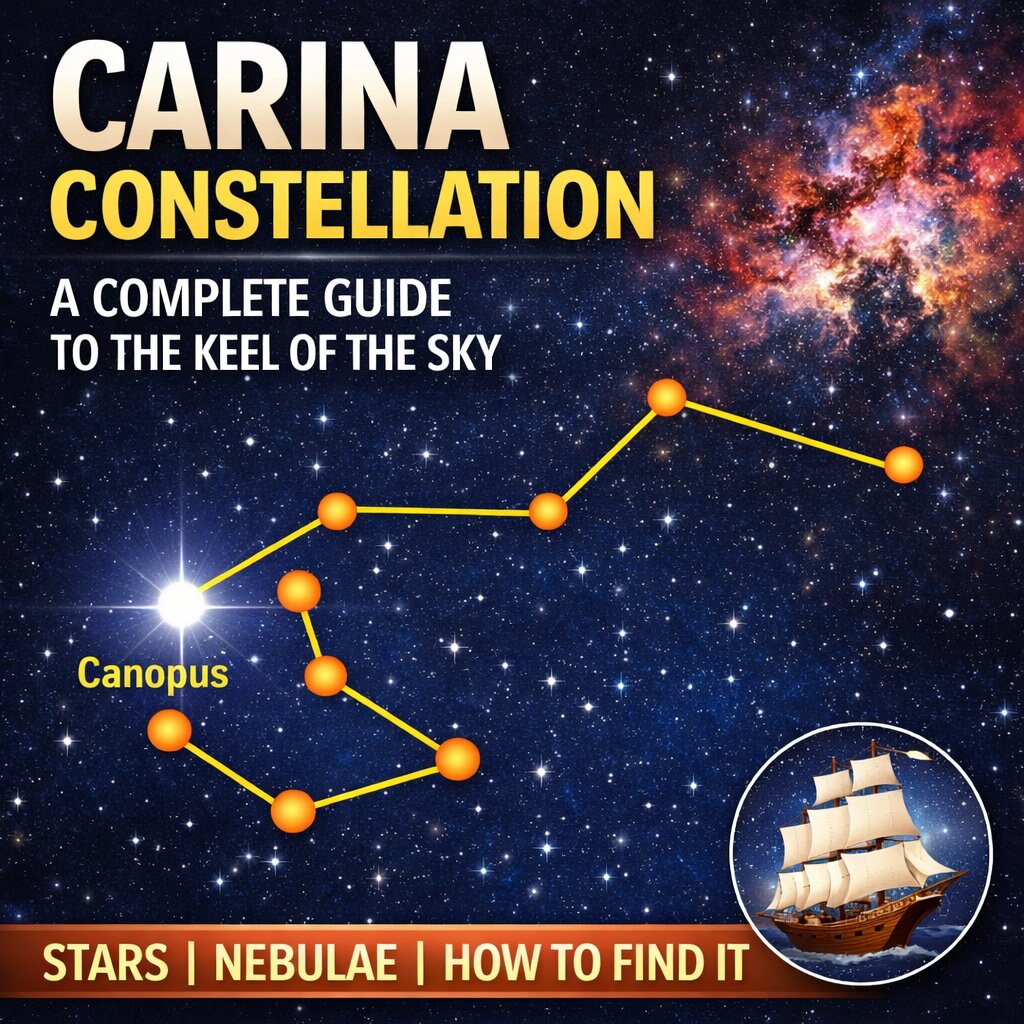

The Carina constellation is one of the most impressive and scientifically important constellations in the southern night sky. Representing the keel of the legendary ship Argo Navis, Carina contains some of the brightest stars and most spectacular deep-sky objects visible from Earth. From the brilliant star Canopus to the vast Carina Nebula, this region of space is a treasure trove for astronomers and astrophotographers alike.
Located deep within the Milky Way, the Carina constellation is rich with stellar nurseries, massive stars and complex nebulae. Many of these objects help scientists study how stars are born, evolve and eventually die in powerful cosmic explosions. Because it lies in the southern hemisphere, Carina is especially well placed for observers in regions such as South Africa, Australia and South America.
In this guide, we explore the history, stars and fascinating astronomical objects that make the Carina constellation one of the most remarkable areas of the night sky.
The history and mythology of the Carina constellation
The Carina constellation has its roots in one of the largest constellations ever recognised: Argo Navis, the mythical ship of Jason and the Argonauts in Greek mythology. According to legend, Jason sailed this vessel on a quest to retrieve the Golden Fleece, accompanied by many famous heroes of Greek lore.
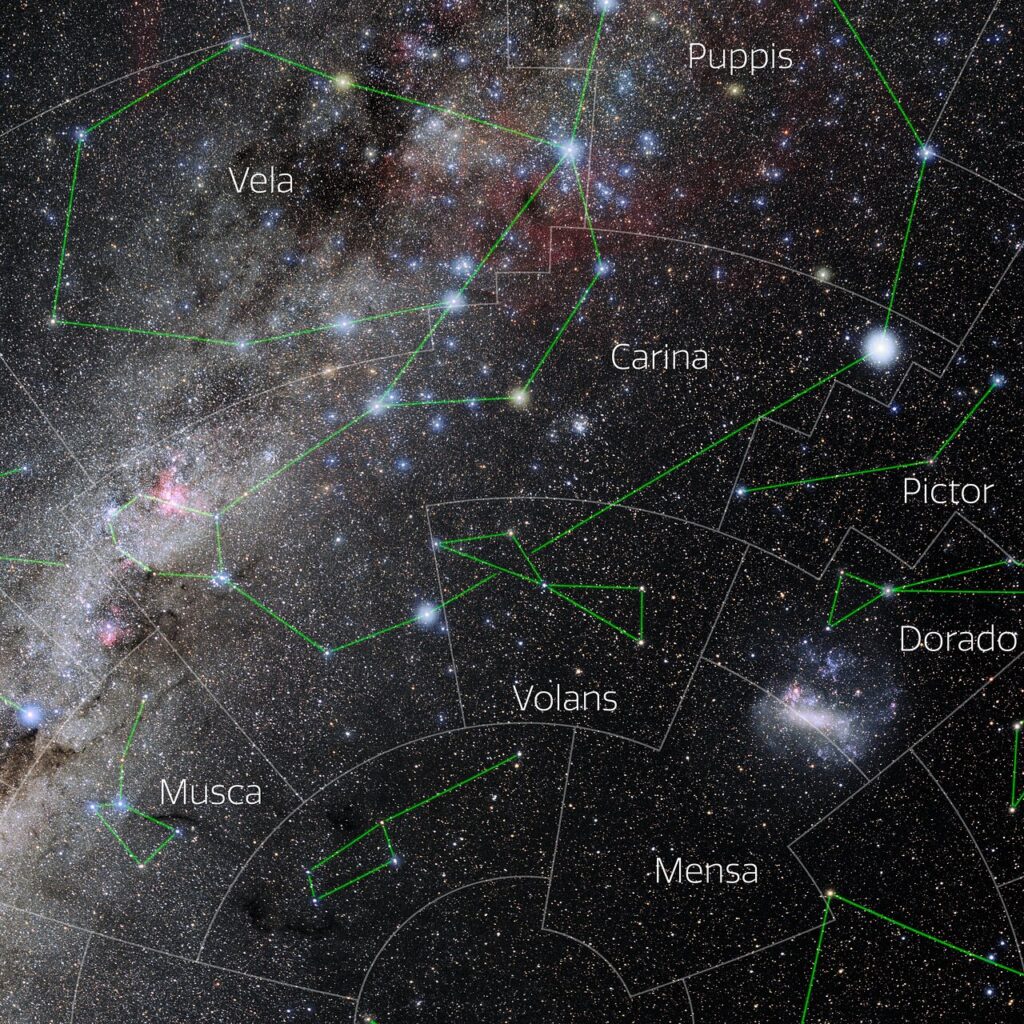
For centuries, Argo Navis appeared as a single massive constellation. However, its enormous size made it difficult to map and organise. In the 18th century, French astronomer Nicolas-Louis de Lacaille divided it into three separate constellations to make astronomical cataloguing easier.
These three sections became:
- Carina – the keel of the ship
- Vela – the sails
- Puppis – the stern
Carina represents the central structural backbone of the ship. Even today, many star designations still reflect the original Argo Navis system, which is why some star names in Carina seem unusual or out of sequence.
Where the Carina constellation is located in the sky
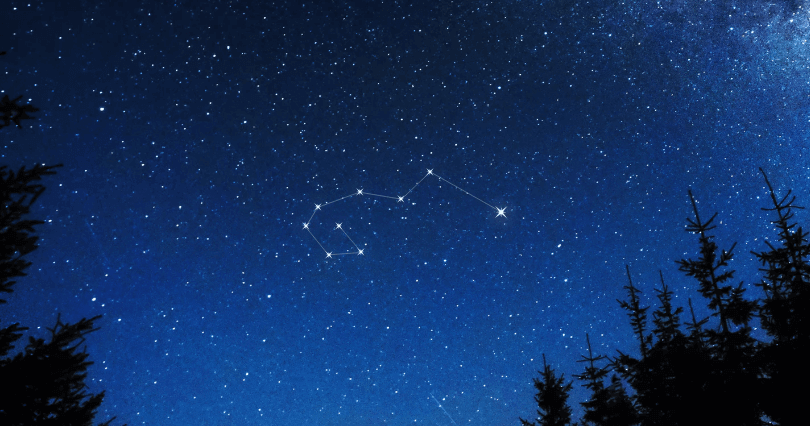
The Carina constellation lies deep in the southern celestial hemisphere and is one of the brightest constellations visible from southern latitudes. Because it sits along the dense star fields of the Milky Way, it is packed with stars, nebulae and open clusters.
Key location details include:
- Declination: roughly −50° to −75°
- Best visibility: January to April in the evening sky
- Hemisphere: Southern sky
Carina is surrounded by several notable constellations, including:
- Vela
- Puppis
- Centaurus
- Crux (Southern Cross)
- Musca
- Chamaeleon
Observers in the northern hemisphere rarely see the Carina constellation because it lies so far south. However, for observers in the southern hemisphere, it dominates the summer sky with bright stars and rich Milky Way scenery.
The brightest stars in the Carina constellation

Carina contains several prominent stars that stand out even against the bright background of the Milky Way.
Canopus
The most famous star in the Carina constellation is Canopus, the second brightest star in the entire night sky after Sirius.
Key facts about Canopus:
- Distance from Earth: about 310 light-years
- Spectral type: A-type supergiant
- Apparent magnitude: −0.74
Canopus has been used for centuries as an important navigation star. Ancient sailors relied on it to determine their position in the southern hemisphere, and spacecraft navigation systems have even used it as a reference point.
Miaplacidus
Miaplacidus is the second brightest star in Carina and is a white star located about 111 light-years away. Its name comes from a combination of Arabic and Latin roots meaning “calm waters,” fitting the nautical theme of the constellation.
Avior
Avior is another bright star in the Carina constellation and forms part of the false cross asterism sometimes mistaken for the Southern Cross. It is actually a complex binary star system, with two stars orbiting each other.
Aspidiske
Aspidiske is a luminous giant star located several hundred light-years from Earth. Although not as bright as Canopus, it contributes to the rich stellar landscape that defines the Carina constellation.
Famous deep sky objects in Carina
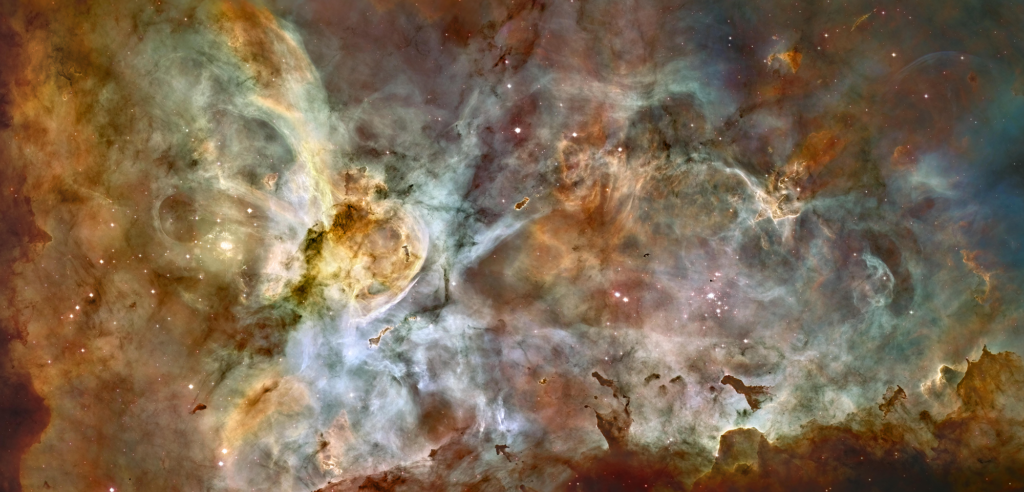
The Carina constellation is one of the richest regions of the Milky Way for deep sky observation. Several spectacular objects lie within its boundaries.
Carina Nebula (NGC 3372)
The Carina Nebula is one of the largest and brightest emission nebulae in the sky. It is a massive region of gas and dust where new stars are forming.
Located about 7,500 light-years away, the nebula spans hundreds of light-years and contains numerous young star clusters. Through telescopes and astrophotography, the Carina Nebula reveals intricate clouds, glowing hydrogen regions and pillars of star-forming material.
Eta Carinae
One of the most fascinating stars in the sky resides within the Carina Nebula: Eta Carinae.
This enormous star system is extremely unstable and has already experienced a massive eruption known as the Great Eruption in the 19th century. During that event, Eta Carinae briefly became one of the brightest stars in the sky.
Astronomers believe Eta Carinae could eventually explode as a supernova or even a hypernova, making it one of the most closely studied massive stars in the Milky Way.
Keyhole Nebula
Within the Carina Nebula lies a smaller dark region known as the Keyhole Nebula. This dense cloud of dust blocks light from the glowing nebula behind it, creating the distinctive keyhole shape seen in telescopes.
Southern Pleiades (IC 2602)
The Southern Pleiades is a bright open star cluster located in Carina. Despite its name, it is unrelated to the famous Pleiades cluster in Taurus. However, its brilliant blue stars create a similar appearance through binoculars and small telescopes.
How to find the Carina constellation
Finding the Carina constellation in the southern sky is relatively easy once you know where to look.
Follow these simple steps:
- Locate Crux (the Southern Cross) in the night sky
- Look below Crux toward the Milky Way
- Find the bright star Canopus, which marks the upper region of Carina
- Scan the surrounding Milky Way for dense star clouds and nebulae
Because this region lies along the Milky Way, even binoculars can reveal stunning star fields and clusters.
Carina in modern astronomy
The Carina constellation plays an important role in modern astrophysics because it hosts some of the most extreme stellar environments known.
Astronomers study this region to understand:
- Massive star formation
- Supernova precursors
- Nebula evolution
- Stellar winds from giant stars
The Carina Nebula in particular acts as a laboratory for studying how radiation from massive stars shapes the surrounding gas and triggers new generations of star formation.
Observations from telescopes such as the Hubble Space Telescope and the James Webb Space Telescope have revealed extraordinary detail within this region, including towering pillars of gas and newborn stars hidden within dense clouds.
Why the Carina constellation fascinates astronomers
Few constellations offer as much beauty and scientific value as the Carina constellation. Its bright stars, massive nebulae and complex stellar environments provide a window into the processes that shape our galaxy.
For observers in the southern hemisphere, Carina is one of the most rewarding constellations to explore with binoculars or telescopes. The region combines brilliant stars like Canopus with dramatic cosmic structures such as the Carina Nebula, making it both visually stunning and scientifically important.
Whether viewed with the naked eye or studied with powerful telescopes, the Carina constellation remains one of the most extraordinary regions of the Milky Way.