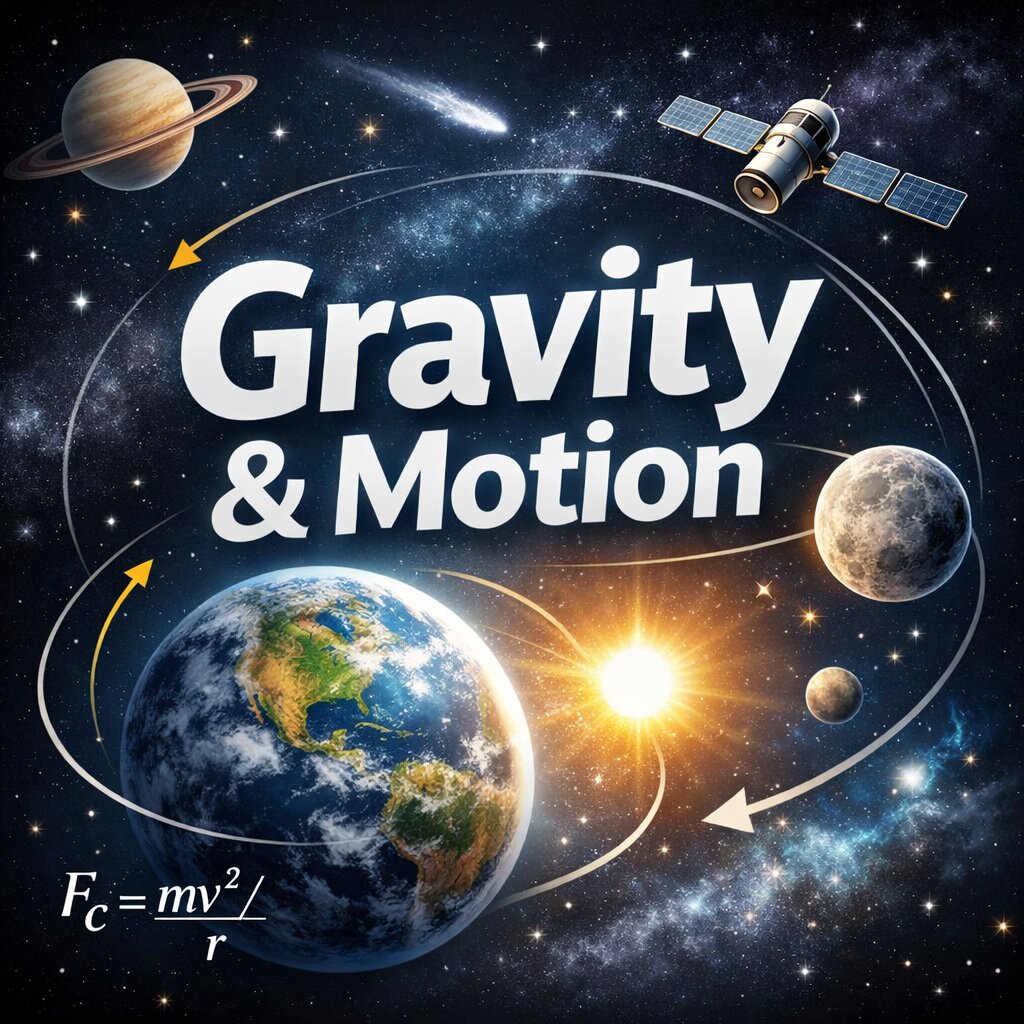

Gravity and motion form one of the most fundamental relationships in physics, governing how objects move from the smallest scales to the largest structures in the universe. Whether analysing a falling object on Earth or the orbit of a planet around a star, the principles of gravity and motion provide the framework through which these behaviours can be understood and predicted.
At its core, motion describes how an object changes position over time, while gravity is the force that influences that movement when mass is involved. These two concepts are inseparable. Motion does not occur in isolation, and gravity is one of the primary forces shaping how motion unfolds, particularly in astronomical systems where it dominates over all other interactions.
Historically, the study of gravity and motion has evolved through several key scientific breakthroughs. Early interpretations of motion, such as those proposed by Aristotle, suggested that objects required a constant force to remain in motion. This view was later challenged and refined during the scientific revolution, most notably through the work of Isaac Newton. Newton’s laws of motion and his law of universal gravitation established a unified framework that could explain both everyday motion on Earth and the movement of celestial bodies.
This unification marked a turning point in science. For the first time, the same principles of gravity and motion could be applied universally, linking terrestrial and cosmic phenomena under a single set of laws. Falling apples and orbiting moons were no longer separate mysteries but expressions of the same underlying physics.
However, the story does not end there. While Newton’s framework remains highly accurate for many applications, further developments in physics, particularly Albert Einstein’s theory of general relativity, revealed that gravity is not simply a force acting at a distance. Instead, it can be understood as a curvature of spacetime caused by mass and energy, fundamentally altering how motion occurs in extreme conditions such as near massive stars or black holes.
Despite these advancements, the classical understanding of gravity and motion remains essential. It provides the tools needed to analyse most physical systems, from engineering applications to planetary orbits. By building a strong foundation in these principles, it becomes possible to explore more complex and nuanced models of the universe.
As this module progresses, you will move from these foundational ideas into deeper analysis, examining how forces produce motion, how gravity operates across distances, and how these principles combine to explain phenomena such as orbits, trajectories and energy systems.
Understanding gravity and motion is not simply about learning equations. It is about recognising the underlying structure that governs movement throughout the universe.
Table of Contents
Newton’s Laws of Motion
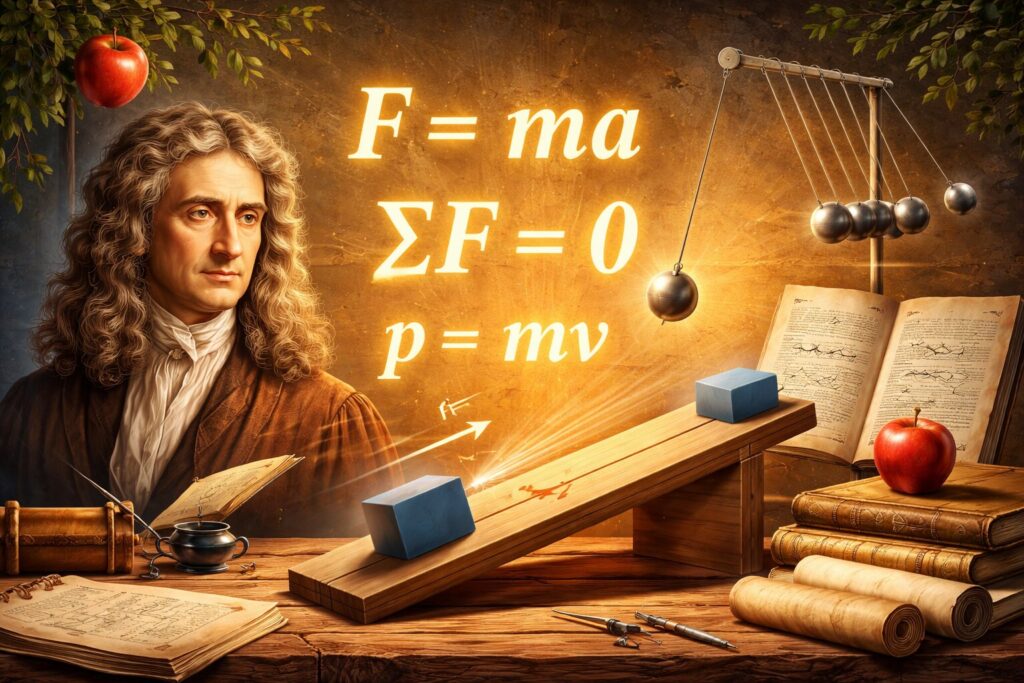
Newton’s Laws of Motion provide the foundational framework for understanding how forces influence movement. Within the study of gravity and motion, these laws establish the principles that allow us to describe, predict and analyse how objects behave under the influence of forces, including gravitational interaction.
Rather than viewing motion as something that requires continuous cause, Newton reframed the concept entirely. He showed that motion is a natural state, and that changes in motion occur only when forces act upon an object. This shift in understanding is essential when studying gravity and motion, as it allows us to see gravity not as something that creates motion from nothing, but as something that alters existing motion.
The First Law: Inertia and Natural Motion
Newton’s First Law states that an object will remain at rest, or continue moving at a constant velocity in a straight line, unless acted upon by an external force.
This principle introduces the concept of inertia, which is the tendency of an object to resist changes in its state of motion. In the absence of forces, motion does not stop. It continues indefinitely.
In the context of gravity and motion, this law is crucial. It explains why objects in space, such as planets or satellites, would continue moving in straight lines if gravity were not present. Gravity does not create their motion. Instead, it continuously redirects it, preventing straight-line travel and producing curved paths.
This idea forms the basis for understanding orbital motion, where objects are in constant motion but never move in a straight line due to gravitational influence.
The Second Law: Force and Acceleration
Newton’s Second Law provides the quantitative relationship between force and motion. It states that the acceleration of an object is directly proportional to the net force acting on it and inversely proportional to its mass.
This relationship is expressed as:
F=ma
Within gravity and motion, this law allows us to calculate how gravitational forces affect objects. When gravity acts on an object, it produces acceleration, changing the object’s velocity over time.
For example, near the Earth’s surface, gravity produces a nearly constant acceleration, which is why objects fall at a predictable rate. In larger systems, such as planetary motion, gravitational acceleration varies depending on distance and mass, leading to more complex motion.
The Second Law connects the abstract concept of force to measurable changes in motion, making it one of the most powerful tools in physics.
The Third Law: Interaction and Mutual Forces
Newton’s Third Law states that for every action, there is an equal and opposite reaction. This means that forces always occur in pairs, with two objects exerting forces on each other simultaneously.
In the study of gravity and motion, this law reveals an important insight. When a planet is pulled by the gravity of a star, the planet also exerts an equal gravitational force on the star. The difference in motion arises because of the difference in mass, not the strength of the force.
This mutual interaction explains why systems such as binary stars orbit a shared centre of mass, rather than one object remaining completely stationary.
The Third Law reinforces the idea that gravity is not a one-sided effect. It is a relationship between masses, influencing the motion of all objects involved.
Newton’s Laws as the Foundation of Gravity and Motion
Together, Newton’s Laws of Motion establish the framework through which gravity and motion can be understood in a consistent and predictive way. They define how motion behaves in the absence of forces, how forces alter that motion, and how interactions between objects are structured.
These principles are not limited to simple systems. They extend from everyday experiences, such as objects falling to the ground, to the motion of planets, moons and spacecraft.
By understanding these laws, you gain the ability to analyse motion not as a series of isolated events, but as part of a coherent system governed by universal rules. This foundation is essential as we move forward into gravitational forces, orbital dynamics and more advanced models of motion.
Newton’s Law of Universal Gravitation
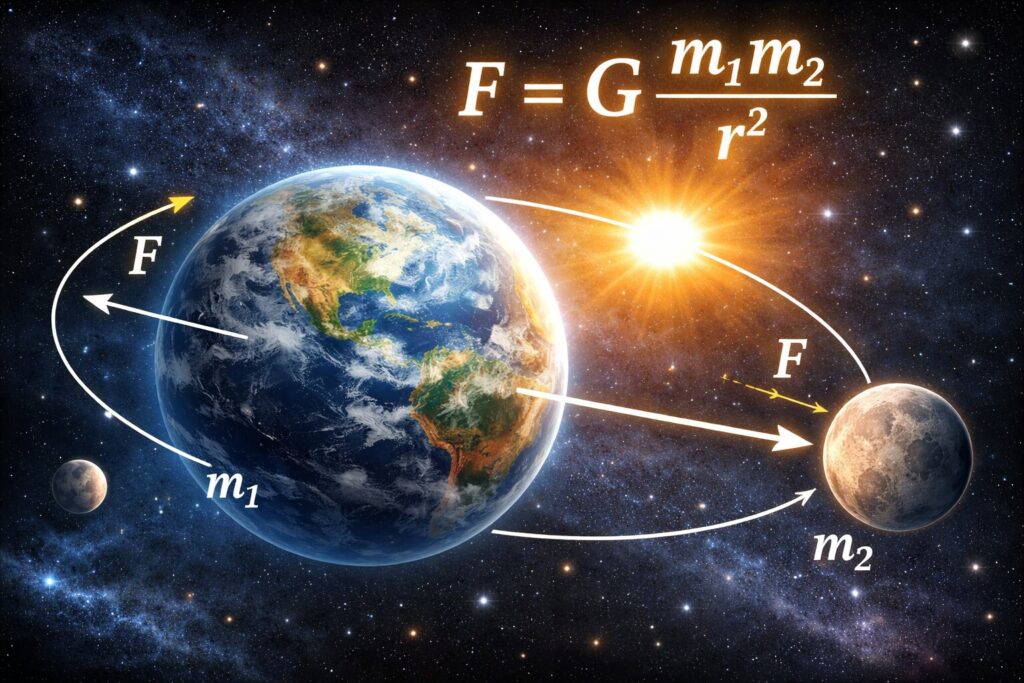
Newton’s Law of Universal Gravitation extends the principles established in the laws of motion by introducing a precise description of how masses attract one another. Within the study of gravity and motion, this law provides the missing link between force and large-scale movement, explaining why objects do not simply travel in straight lines but instead follow curved paths under gravitational influence.
At its core, this law states that every mass in the universe exerts an attractive force on every other mass. This interaction is not limited by distance, meaning that even objects separated by vast stretches of space continue to influence one another. While these forces may be extremely small at large distances, they become dominant when massive bodies such as planets, stars and galaxies are involved.
The inverse-square relationship
The strength of the gravitational force depends on two key factors: the masses of the objects involved and the distance between them. Newton showed that this force increases with mass and decreases rapidly as distance grows.
This relationship is expressed mathematically as:
F=Gr2m1m2
In this equation, the force is proportional to the product of the two masses and inversely proportional to the square of the distance between them. The inverse-square nature of the law is particularly important in understanding gravity and motion, as it explains why gravitational influence weakens so quickly with distance, yet never truly disappears.
This behaviour shapes the structure of the universe, from the motion of planets around stars to the formation of galaxies.
Gravity as a universal interaction
One of the most profound implications of Newton’s Law of Universal Gravitation is its universality. The same law applies to all objects, regardless of size or location. The force that causes an apple to fall to the ground is the same force that keeps the Moon in orbit around the Earth.
This insight unified previously separate areas of study. Before Newton, celestial motion and terrestrial motion were often treated as fundamentally different phenomena. By applying a single law to both, Newton demonstrated that gravity and motion operate consistently across all scales.
This universality allows us to use the same principles to analyse systems ranging from simple falling objects to complex planetary systems.
Gravity and orbital motion
Newton’s Law of Universal Gravitation also provides the foundation for understanding orbital motion. When an object moves through space, it tends to follow a straight path due to inertia, as described by the First Law of Motion. However, when gravity is present, it continuously pulls the object toward another mass.
The result is a curved trajectory rather than a straight line. If the conditions are right, this curved motion becomes an orbit, where the object is constantly falling toward the central body but also moving forward fast enough to avoid collision.
In this way, gravity does not simply pull objects inward. It works in combination with motion to create stable, repeating paths. This relationship is central to the study of gravity and motion and explains why planets, moons and satellites remain in predictable orbits.
From force to field
Although Newton described gravity as a force acting between masses, later developments in physics introduced the concept of gravitational fields. Instead of thinking of gravity as a direct interaction at a distance, it can be understood as a field that surrounds a mass and influences other objects within it.
This perspective does not replace Newton’s law but builds upon it, providing additional tools for analysing gravity and motion. By considering fields, it becomes easier to visualise how gravity operates across space and how objects respond to it.
This transition from force to field marks an important step in the development of physics, paving the way for more advanced theories while still relying on the principles established by Newton.
The significance of universal gravitation
Newton’s Law of Universal Gravitation remains one of the most important principles in physics. It allows us to calculate forces, predict motion and understand the structure of systems throughout the universe.
Within the broader framework of gravity and motion, this law provides the mechanism through which motion is shaped and sustained. It explains why objects accelerate toward one another, why orbits exist and why large-scale structures form in the way they do.
As we continue through this module, this law will serve as a foundation for more advanced topics, including gravitational fields, energy systems and orbital dynamics, all of which build upon the relationship between gravity and motion.
Gravitational Fields and Potential
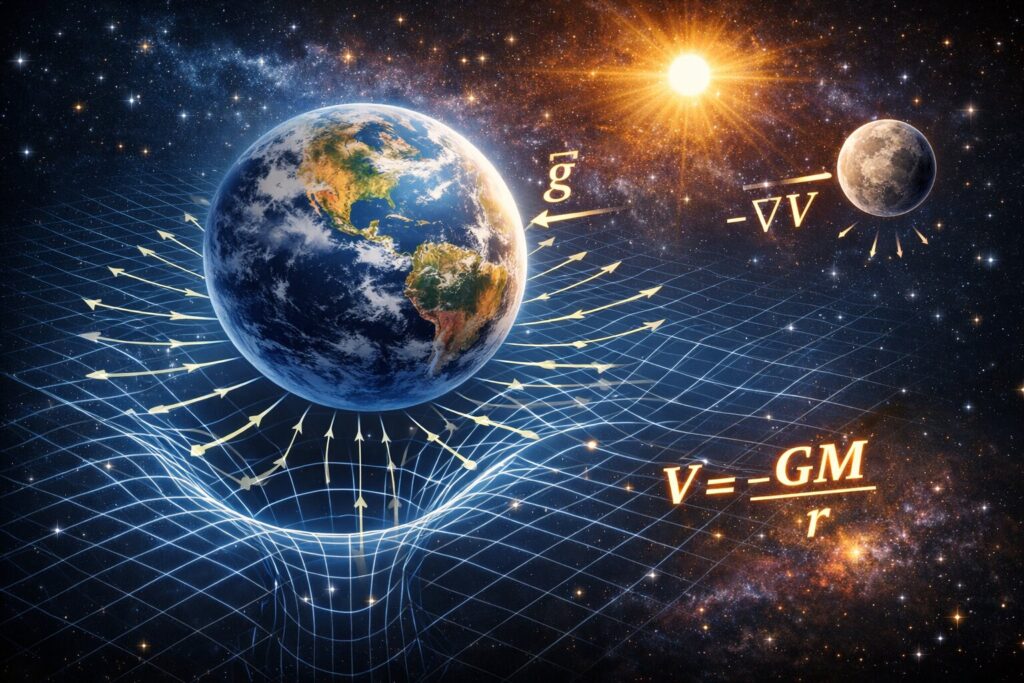
As the study of gravity and motion develops, it becomes useful to move beyond thinking of gravity purely as a force acting between two objects. While Newton’s Law of Universal Gravitation describes how masses attract one another, the concept of gravitational fields provides a more flexible and intuitive way to understand how gravity operates across space.
Instead of focusing only on interactions between pairs of objects, a gravitational field describes how a single mass influences the space around it. Any other object entering that region will experience a force due to the field. This shift in perspective is essential when analysing complex systems, where multiple bodies interact simultaneously.
The concept of a gravitational field
A gravitational field represents the influence that a mass exerts on its surroundings. At every point in space around a massive object, there exists a field that determines how another object would accelerate if placed there.
The strength of this field is defined as the force per unit mass experienced by a test object. In practical terms, this means that the gravitational field tells us how strongly gravity will act at a given location, independent of the object placed within it.
Within the framework of gravity and motion, this concept simplifies analysis. Instead of calculating forces between multiple objects repeatedly, we can describe how the field behaves and then determine how any object will move within it.
This approach is particularly useful in astronomy, where large bodies such as planets and stars create extensive gravitational fields that influence surrounding objects over great distances.
Field strength and variation with distance
Gravitational field strength is not constant. It changes depending on the distance from the mass generating the field. Closer to the source, the field is stronger, resulting in greater acceleration. As distance increases, the field weakens following the same inverse-square relationship seen in gravitational force.
Near the surface of the Earth, the field strength is approximately constant, which is why objects experience a uniform acceleration when falling. However, as altitude increases, this approximation becomes less accurate, and variations in the field must be considered.
Understanding how field strength changes with distance is essential in the study of gravity and motion, particularly when analysing satellite orbits or the motion of objects in space.
Gravitational potential and energy
While gravitational fields describe how forces act, gravitational potential provides a way to understand energy within a gravitational system. It represents the potential energy per unit mass at a given point in a gravitational field.
This concept allows us to analyse motion from an energy perspective rather than focusing solely on forces. An object moving within a gravitational field exchanges kinetic energy and potential energy as it changes position.
For example, as an object moves closer to a massive body, its gravitational potential energy decreases while its kinetic energy increases. This continuous exchange is a key feature of gravity and motion, governing how objects accelerate and move within gravitational systems.
By using potential, we can often simplify complex problems, especially when dealing with orbits and large-scale motion.
Equipotential surfaces and motion constraints
Equipotential surfaces are regions where the gravitational potential is constant. An object moving along one of these surfaces does not gain or lose gravitational potential energy, as its position relative to the field remains unchanged.
These surfaces are always perpendicular to the direction of the gravitational field. This relationship helps visualise how objects move within a field and how forces are distributed in space.
In the context of gravity and motion, equipotential surfaces provide insight into how energy is conserved and how motion is constrained by the geometry of the field.
They are particularly useful in understanding orbital paths and the behaviour of objects under gravitational influence.
From force-based to energy-based analysis
The introduction of gravitational fields and potential marks an important transition in physics. Rather than relying solely on force calculations, we gain the ability to analyse systems using energy principles.
This dual approach is powerful. Forces explain how motion changes at any given moment, while energy explains the overall behaviour of the system across time.
In many cases, especially in orbital mechanics, energy-based analysis offers a clearer and more efficient way to understand motion. It allows us to determine whether an object will remain bound to a system, escape it, or settle into a stable orbit.
This deeper understanding strengthens our ability to analyse gravity and motion across a wide range of scenarios.
The role of fields and potential in gravity and motion
Gravitational fields and potential provide a more complete picture of how gravity operates. They extend Newton’s original ideas, offering tools that make it easier to analyse complex systems and large-scale interactions.
By viewing gravity as a field that shapes space and motion as a response to that field, we move closer to a modern understanding of physics. This perspective not only simplifies calculations but also prepares the foundation for more advanced theories.
As we continue through this module, these concepts will become increasingly important, particularly when exploring orbital dynamics and energy systems within gravity and motion.
Motion Under Gravity
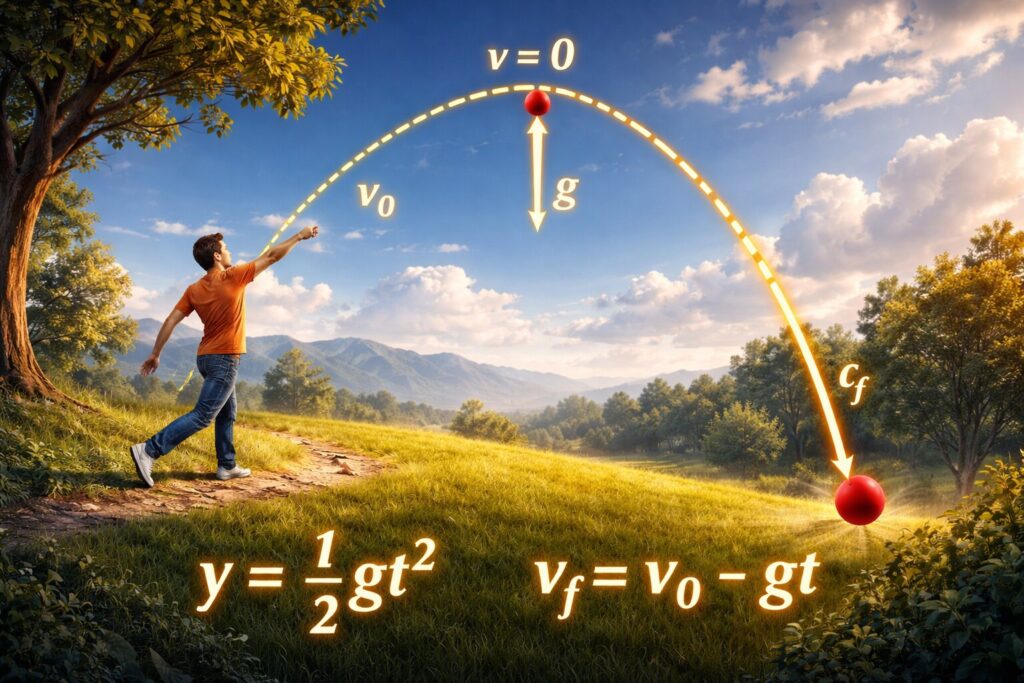
Motion under gravity represents one of the most direct and observable applications of physics, where the interaction between force and movement can be studied in both simple and complex systems. Within the broader framework of gravity and motion, this topic brings together earlier principles, showing how gravitational forces translate into measurable changes in velocity and trajectory.
Whether considering an object falling toward the Earth or a spacecraft moving through a planetary field, motion under gravity is governed by the same underlying rules. The difference lies in scale and conditions, not in the fundamental physics.
Free fall and constant acceleration
One of the simplest forms of motion under gravity is free fall. This occurs when an object moves under the influence of gravity alone, without significant resistance such as air drag.
Near the Earth’s surface, this motion can be approximated as having constant acceleration. All objects, regardless of their mass, experience the same rate of acceleration when falling, provided external forces are negligible. This principle is a key demonstration of how gravity and motion are linked in a predictable way.
The independence of mass in free fall may seem counterintuitive, but it reflects a deeper symmetry in gravitational physics. While heavier objects experience a greater gravitational force, they also possess greater inertia, resulting in the same acceleration as lighter objects.
This concept provides a clear and measurable example of how gravitational forces produce motion.
Projectile motion and curved trajectories
When an object is given an initial velocity, its motion under gravity becomes more complex. Instead of moving straight downward, it follows a curved path known as a projectile trajectory.
This motion can be understood by separating it into two components. Horizontally, the object continues at a constant velocity, assuming no resistance. Vertically, it accelerates downward due to gravity.
The combination of these two motions produces a curved path, typically described as parabolic. This behaviour illustrates how gravity and motion interact continuously, with gravity altering the direction of motion without necessarily affecting horizontal velocity.
Projectile motion is not limited to objects thrown on Earth. It forms the basis for understanding how objects move in gravitational fields more generally, including the early stages of orbital motion.
Variation of gravity with altitude
While constant acceleration is a useful approximation near the Earth’s surface, gravity does not remain uniform at all distances. As an object moves further from the Earth, the strength of the gravitational field decreases.
This variation becomes significant when analysing motion at higher altitudes or in space. Satellites, for example, experience weaker gravitational forces than objects on the surface, which affects their motion and orbital behaviour.
Within the study of gravity and motion, recognising this variation is essential. It allows for more accurate modelling of trajectories and explains why different systems require different assumptions.
Understanding how gravity changes with distance provides a bridge between simple motion near the Earth and more complex motion in space.
From falling objects to orbital paths
One of the most important insights in physics is that orbital motion is an extension of motion under gravity. An object in orbit is not escaping gravity. It is continuously falling toward the central body while moving forward at sufficient speed to avoid collision.
This idea connects simple free fall to large-scale motion in the universe. The same principles that govern a falling object also govern the motion of the Moon around the Earth or planets around the Sun.
In this sense, gravity and motion are part of a single continuous framework. The difference between falling and orbiting lies not in the force itself, but in the initial conditions of motion.
This perspective highlights the unity of physical laws, showing that the same concepts apply across vastly different scales.
The significance of motion under gravity
Motion under gravity provides a practical and conceptual foundation for understanding more advanced topics in physics. It demonstrates how forces produce acceleration, how trajectories are shaped and how motion evolves over time.
By studying these behaviours, we gain insight into both everyday phenomena and complex systems in astronomy and space science. The principles developed here will be essential as we move into topics such as circular motion, orbital mechanics and energy in gravitational systems.
Within the broader study of gravity and motion, this section serves as a bridge between theory and application, showing how abstract principles manifest in real-world motion.
Circular Motion and Centripetal Force
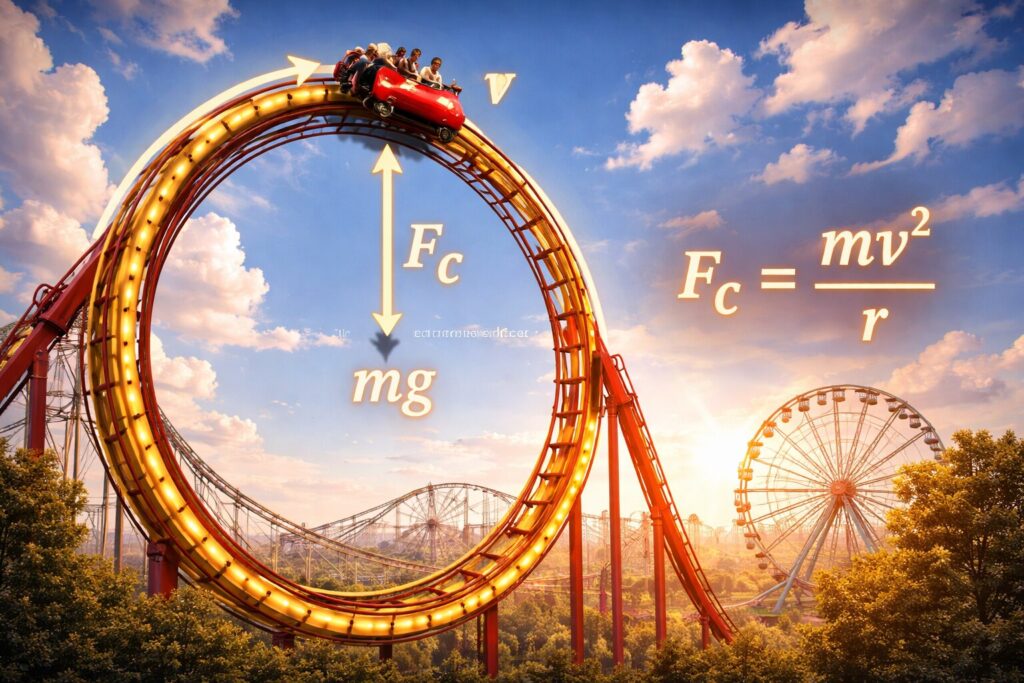
Circular motion introduces a crucial extension to the study of gravity and motion, revealing how objects can move along curved paths while still obeying the same fundamental laws of physics. Up to this point, motion has largely been considered in straight lines or simple trajectories. However, many systems in the universe, from planets to satellites, follow circular or near-circular paths under the influence of gravity.
Understanding circular motion requires a shift in perspective. Even when an object moves at a constant speed, its motion is still changing if its direction is continuously altered. This change in direction implies the presence of acceleration, and therefore a force, even when speed remains constant.
The nature of circular motion
In circular motion, an object travels along a curved path around a central point. Although its speed may remain constant, its velocity is constantly changing because velocity includes both magnitude and direction.
This continuous change in direction means that the object is always accelerating toward the centre of the circle. This acceleration is known as centripetal acceleration, and it is a defining feature of circular motion.
Within the broader context of gravity and motion, this concept is essential. It explains how objects can maintain stable paths without moving in straight lines, providing the foundation for understanding orbital behaviour.
Without a force acting toward the centre, the object would follow a straight-line path due to inertia, as described by Newton’s First Law.
Centripetal force and its role
The force responsible for maintaining circular motion is called centripetal force. This is not a new type of force but rather a role played by an existing force, such as gravity, tension or friction, depending on the system.
The magnitude of this force is given by:
Fc=rmv2
This equation shows that centripetal force depends on the mass of the object, its velocity and the radius of the circular path. As velocity increases or radius decreases, the required force grows significantly.
In the study of gravity and motion, gravity often provides the centripetal force needed to sustain circular orbits. This connection allows us to move from simple circular motion to a deeper understanding of how celestial bodies behave.
Gravity as the source of circular motion
In many natural systems, gravity acts as the centripetal force that keeps objects in orbit. For example, the gravitational attraction between the Earth and the Moon continuously pulls the Moon toward the Earth, preventing it from moving in a straight line.
At the same time, the Moon has forward motion, which keeps it from falling directly into the Earth. The result is a stable orbit, where gravity and motion work together to produce a continuous curved path.
This relationship is central to the study of gravity and motion. It shows that circular motion is not a separate phenomenon but a natural outcome of gravitational interaction combined with inertia.
The same principle applies to planets orbiting stars and satellites orbiting planets, demonstrating the universality of these concepts.
Uniform and non-uniform circular motion
Not all circular motion is identical. In uniform circular motion, the object moves at a constant speed, and only the direction of velocity changes. In non-uniform circular motion, both the speed and direction may change, introducing additional components of acceleration.
In gravitational systems, motion is often not perfectly circular. Orbits can be elliptical, meaning that both speed and distance from the central body vary over time. However, the principles of circular motion still apply locally, providing a useful approximation.
Understanding these distinctions is important when analysing real-world systems, where ideal conditions rarely exist. It allows us to apply the concepts of gravity and motion more accurately to complex scenarios.
Circular motion as a bridge to orbital dynamics
Circular motion and centripetal force form a critical bridge between basic mechanics and orbital dynamics. By understanding how forces produce curved motion, we can begin to analyse how objects move in gravitational fields over long periods.
This connection leads directly to more advanced topics, such as orbital velocity, escape velocity and the laws governing planetary motion. It also reinforces the idea that motion is always shaped by forces, even when that motion appears smooth and continuous.
Within the broader study of gravity and motion, circular motion is not just a special case. It is a key step toward understanding how the universe maintains its structure, from the smallest systems to the largest cosmic scales.
Orbital Mechanics
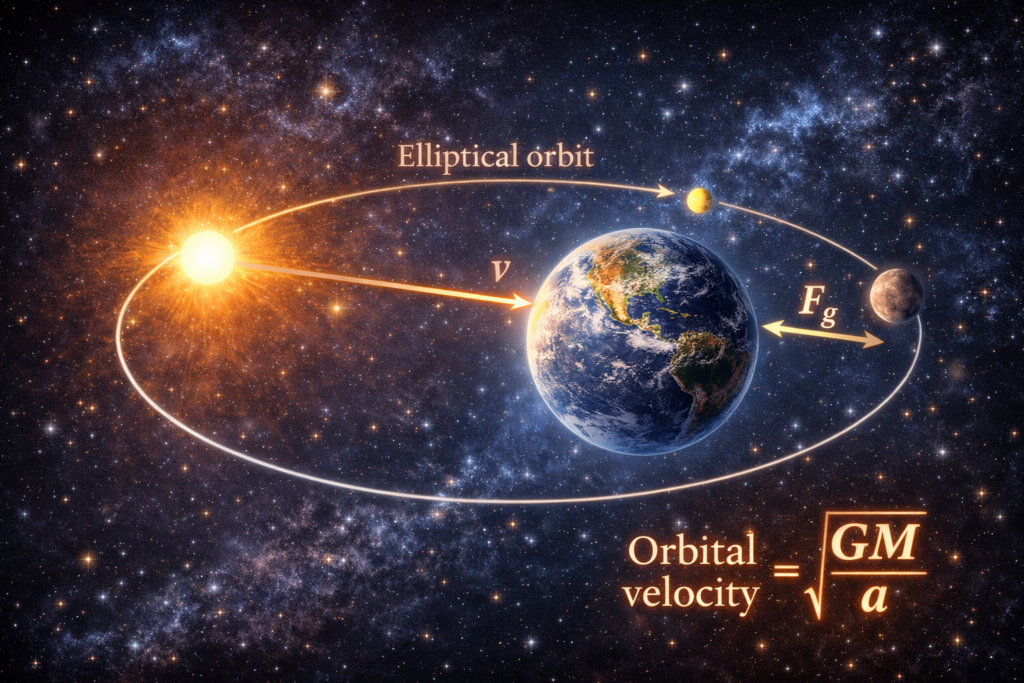
Orbital mechanics represents one of the most important applications of gravity and motion, bringing together the principles of force, acceleration and energy to explain how objects move through space under gravitational influence. From planets orbiting stars to satellites circling the Earth, orbital motion is a direct consequence of the interaction between inertia and gravity.
At first glance, orbits may appear stable and unchanging. However, they are the result of a continuous balance. An object in orbit is always moving forward due to its initial velocity, while gravity constantly pulls it inward. This interplay defines how motion evolves over time and is central to understanding gravity and motion on a cosmic scale.
Kepler’s laws and the structure of orbits
The foundations of orbital mechanics were established through the work of Johannes Kepler, who described how planets move around the Sun. His laws provide a geometric and observational framework that complements the physical explanations offered by Newton.
The first law states that orbits are elliptical, with the central mass located at one of the focal points. This means that motion is not perfectly circular, and the distance between objects changes over time.
The second law describes how objects sweep out equal areas in equal times. This implies that an orbiting body moves faster when it is closer to the central mass and slower when it is further away.
The third law relates the orbital period to the size of the orbit, showing that larger orbits take longer to complete. Together, these laws reveal how gravity and motion combine to produce predictable, repeating paths.
Orbital velocity and stable motion
For an object to remain in orbit, it must have the correct velocity. If it moves too slowly, gravity will pull it inward, causing it to fall toward the central body. If it moves too quickly, it may escape the gravitational influence entirely.
Orbital velocity is determined by the balance between gravitational force and the motion of the object. At the right speed, the object continuously falls toward the central mass while moving forward, resulting in a stable orbit.
This balance highlights a key idea in gravity and motion. Motion alone does not determine the path of an object, and neither does gravity on its own. It is the combination of both that creates orbital behaviour.
Understanding orbital velocity is essential for everything from launching satellites to predicting the movement of planets.
Escape velocity and gravitational limits
Not all motion within a gravitational system results in an orbit. If an object reaches a sufficiently high velocity, it can break free from the gravitational pull of a larger body. This threshold is known as escape velocity.
Escape velocity depends on the mass of the central object and the distance from it. A more massive body requires a higher escape velocity, while greater distance reduces the required speed.
This concept further illustrates the relationship between gravity and motion. It defines the boundary between objects that remain bound within a system and those that can travel beyond it.
In practical terms, escape velocity is a key consideration in space exploration, determining the energy required for spacecraft to leave planetary surfaces and enter deeper space.
Elliptical motion and changing energy states
In most real systems, orbits are not perfectly circular but elliptical. This means that both the speed and distance of an orbiting object change continuously.
As an object moves closer to the central mass, gravitational potential energy decreases while kinetic energy increases, causing the object to move faster. As it moves further away, the opposite occurs.
This continuous exchange of energy is a defining feature of gravity and motion in orbital systems. It ensures that motion remains dynamic, even within stable orbits.
Understanding these energy changes allows for deeper analysis of orbital behaviour, including how orbits can be altered or maintained over time.
Orbital mechanics in real-world systems
Orbital mechanics is not limited to theoretical models. It has direct applications in modern technology and space science. Satellites rely on precise orbital calculations to remain in position, whether for communication, navigation or observation.
Space missions use orbital mechanics to plan trajectories, taking advantage of gravitational forces to conserve energy and reach distant destinations. Even planetary motion within our solar system follows the same principles.
These applications demonstrate how gravity and motion are not abstract concepts but practical tools that shape how we explore and interact with space.
The role of orbital mechanics in gravity and motion
Orbital mechanics brings together the key ideas of gravity and motion into a unified system. It shows how forces, velocity and energy interact to produce stable and predictable paths.
By understanding these principles, it becomes possible to move beyond simple motion and analyse complex systems that operate over vast distances and timescales.
As the module progresses, orbital mechanics will serve as a foundation for exploring energy systems, multi-body interactions and more advanced models of gravitational behaviour.
Energy in Gravitational Systems
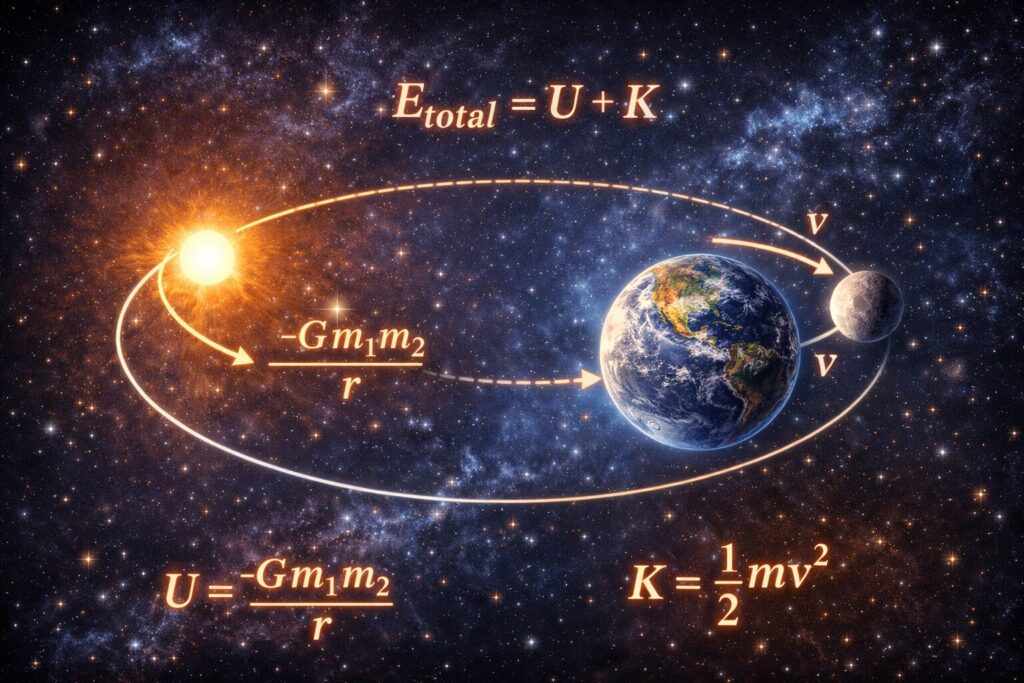
Energy provides a powerful lens through which gravity and motion can be understood at a deeper level. While forces describe how motion changes instant by instant, energy describes the overall state of a system and how motion evolves over time. In gravitational systems, this perspective allows us to analyse not just how objects move, but why they follow particular paths and whether those paths remain stable.
By shifting from a force-based approach to an energy-based one, complex problems in gravity and motion often become simpler and more intuitive. Instead of tracking every force interaction, we can examine how energy is transferred, conserved and transformed within the system.
Kinetic and potential energy in gravity
In any gravitational system, two main forms of energy are at play: kinetic energy and gravitational potential energy. Kinetic energy is associated with motion, while potential energy is associated with position within a gravitational field.
As an object moves under gravity, these two forms of energy are continuously exchanged. When the object moves closer to a massive body, its gravitational potential energy decreases while its kinetic energy increases, causing it to accelerate. When it moves away, kinetic energy decreases and potential energy increases.
This exchange is a fundamental feature of gravity and motion. It explains why objects speed up as they fall and slow down as they rise, and it underpins the behaviour of objects in orbit.
Understanding this balance allows us to predict how motion will change without needing to calculate forces at every moment.
Conservation of mechanical energy
One of the most important principles in physics is the conservation of energy. In an ideal gravitational system, where no external forces such as friction are present, the total mechanical energy remains constant.
This means that the sum of kinetic and potential energy does not change, even though each component may vary. As energy shifts between forms, the total remains the same.
Within the study of gravity and motion, this principle provides a powerful tool. It allows us to analyse entire systems at once, rather than focusing on individual forces or interactions.
For example, by knowing the total energy of an object, we can determine whether it will remain in orbit, fall toward the central body or escape the system entirely.
Bound and unbound systems
Energy also determines whether a system is bound or unbound. In a bound system, the total mechanical energy is negative, meaning the object does not have enough energy to escape the gravitational influence of the central body.
This is the case for planets orbiting stars or satellites orbiting planets. Their motion is constrained within a stable system, even though their position and speed may change continuously.
In an unbound system, the total energy is zero or positive. This allows the object to escape, moving away indefinitely rather than remaining in orbit.
This distinction is central to understanding gravity and motion at larger scales. It explains why some objects remain part of stable systems while others travel freely through space.
Energy and orbital behaviour
The shape and stability of an orbit are directly linked to the energy of the system. Circular orbits occur when energy is balanced in a way that keeps both speed and distance constant. Elliptical orbits arise when energy varies along the path, causing changes in speed and position.
As an object moves along an elliptical orbit, its energy shifts continuously between kinetic and potential forms. This creates the variation in speed observed in orbital motion, where objects move faster when closer to the central mass and slower when further away.
In this way, energy provides a unifying explanation for the patterns observed in gravity and motion. It connects the geometry of orbits with the underlying physics that drives them.
Energy as a unifying framework
The study of energy in gravitational systems brings together many of the concepts explored so far. It links forces, motion and position into a single framework that can be applied across a wide range of scenarios.
By focusing on energy, we gain a broader understanding of how systems behave over time. We can analyse stability, predict outcomes and identify transitions between different types of motion.
This approach is especially valuable in complex systems, where multiple forces and interactions are at play. It allows us to simplify analysis while still capturing the essential behaviour of the system.
Within the broader study of gravity and motion, energy serves as a unifying concept, tying together the principles that govern how objects move and interact throughout the universe.
Multi-Body Systems and Perturbations
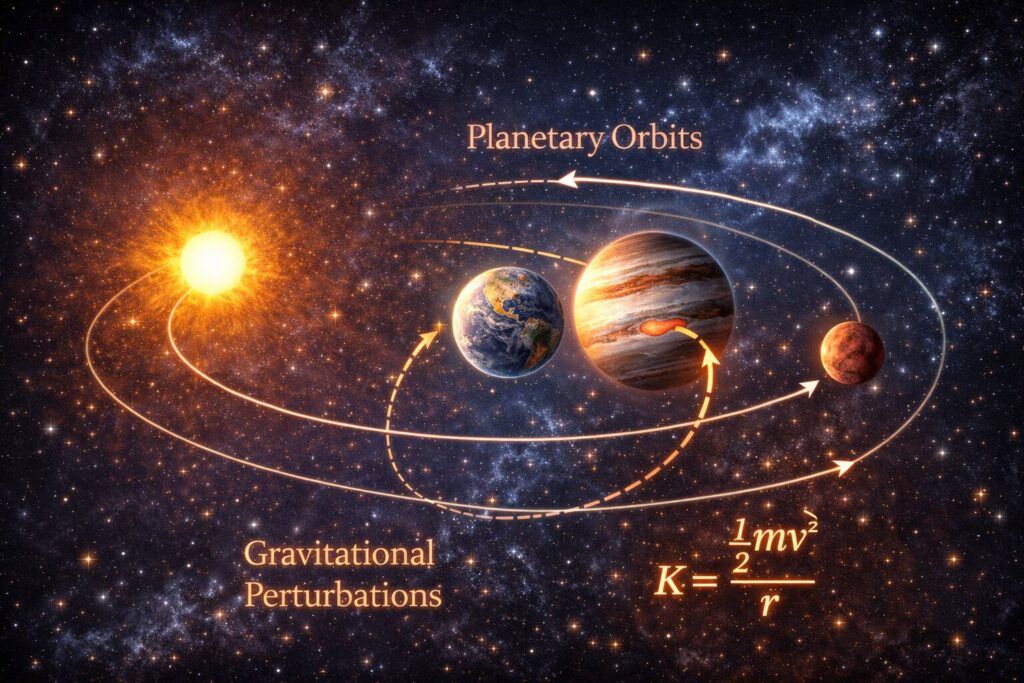
Up to this point, much of the study of gravity and motion has focused on simplified systems, typically involving two bodies interacting in isolation. While this approach provides clear insights and manageable equations, it does not fully reflect the complexity of the universe. In reality, most systems involve multiple interacting bodies, each exerting gravitational influence on the others.
When more than two objects are involved, motion becomes significantly more complex. The clean, predictable orbits seen in two-body systems give way to interactions that can shift, distort and evolve over time. This is where the study of multi-body systems and perturbations becomes essential in understanding gravity and motion at a more advanced level.
From two-body simplicity to multi-body complexity
In a two-body system, such as a planet orbiting a star, the motion can be described precisely using Newtonian mechanics. The paths are stable and predictable, often taking the form of conic sections such as ellipses.
However, when a third body is introduced, the system becomes far more difficult to solve. The additional gravitational influence alters the motion of the original bodies, preventing simple, closed-form solutions in most cases.
This transition highlights an important limitation in the classical study of gravity and motion. While the fundamental laws still apply, their combined effects become too complex to solve exactly, requiring approximation methods and numerical analysis.
Understanding this shift is key to appreciating why real-world systems behave differently from idealised models.
The nature of gravitational perturbations
Perturbations refer to small deviations in motion caused by additional forces or influences within a system. In multi-body systems, these deviations arise from the gravitational pull of other nearby objects.
Even a relatively small mass can produce noticeable effects over time. For example, the gravitational influence of the Moon affects the Earth’s motion, while other planets introduce subtle changes to each other’s orbits.
In the context of gravity and motion, perturbations are not errors or anomalies. They are natural consequences of multiple gravitational interactions occurring simultaneously.
Over short timescales, these effects may appear minor. Over longer periods, however, they can significantly alter trajectories, leading to shifts in orbital paths or changes in system stability.
Examples of multi-body interactions
Multi-body systems are common throughout the universe. Planetary systems, star clusters and galaxies all involve complex gravitational interactions between many objects.
One familiar example is the Earth-Moon-Sun system. While the Earth and Moon form a two-body system, the gravitational influence of the Sun introduces perturbations that affect the Moon’s orbit and contribute to phenomena such as tides.
In planetary systems, interactions between planets can lead to orbital resonances, where gravitational influences create repeating patterns in motion. These resonances can stabilise or destabilise orbits depending on the conditions.
These examples demonstrate how gravity and motion operate in interconnected systems, where no object exists in complete isolation.
Stability and chaos in multi-body systems
One of the most intriguing aspects of multi-body systems is the balance between stability and chaos. Some systems maintain long-term stability, with predictable patterns that persist over millions or even billions of years.
Others exhibit chaotic behaviour, where small changes in initial conditions lead to vastly different outcomes over time. This sensitivity makes long-term prediction extremely difficult in certain systems.
Within the study of gravity and motion, this introduces an important concept. Not all motion can be predicted precisely, especially in systems with many interacting bodies. Instead, we often rely on statistical methods and simulations to understand general behaviour.
This complexity adds depth to our understanding of the universe, showing that even simple laws can produce highly intricate outcomes.
Perturbations in practical applications
The effects of perturbations are not limited to theoretical systems. They play a crucial role in practical applications such as satellite navigation and space missions.
Satellites orbiting the Earth are influenced not only by Earth’s gravity but also by the Moon, the Sun and even variations in Earth’s shape and mass distribution. These factors must be accounted for to maintain accurate positioning and stable orbits.
Similarly, spacecraft trajectories often use gravitational interactions intentionally, taking advantage of perturbations to alter paths and conserve energy.
These applications highlight how an advanced understanding of gravity and motion is necessary for both scientific exploration and modern technology.
The role of multi-body systems in gravity and motion
Multi-body systems and perturbations represent a natural extension of the principles established earlier in the study of gravity and motion. They reveal the limitations of simplified models while demonstrating the richness and complexity of real-world systems.
By recognising how multiple gravitational influences interact, we gain a more complete understanding of motion across the universe. This prepares the foundation for exploring even more advanced topics, including relativistic effects and large-scale cosmic structures.
In this way, multi-body systems move the study of gravity and motion from idealised theory into the dynamic and interconnected reality of the cosmos.
Relativity and Gravity (Advanced Overview)
As the study of gravity and motion progresses, it becomes clear that Newton’s description of gravity, while remarkably accurate in many situations, is not complete. In extreme environments, such as near massive stars or at very high speeds, classical mechanics begins to break down. This led to the development of Einstein’s theory of relativity, which redefined our understanding of gravity at a fundamental level.
Rather than describing gravity as a force acting at a distance, relativity presents a different picture. Gravity emerges from the geometry of spacetime itself, where mass and energy determine how space and time are curved, and motion follows that curvature.
From force to spacetime curvature
In Newtonian physics, gravity is treated as a force pulling objects toward one another. This model works exceptionally well for most applications, including planetary motion and engineering systems. However, it assumes that space and time are fixed and independent.
Einstein’s theory of general relativity replaces this view with a unified concept known as spacetime. In this framework, space and time are not separate entities but part of a single, interconnected structure that can be warped by mass and energy.
Within this model of gravity and motion, objects do not move because they are being pulled by a force. Instead, they follow the natural paths, called geodesics, within curved spacetime. What we perceive as gravitational attraction is actually the result of this curvature guiding motion.
This shift in perspective represents one of the most profound changes in physics, transforming how gravity is understood at a fundamental level.
Geodesics and natural motion
A geodesic is the equivalent of a straight line in curved spacetime. In the absence of other forces, objects move along these paths, which are determined by the curvature created by nearby masses.
For example, the motion of a planet around a star can be understood as the planet following a geodesic within the curved spacetime generated by the star’s mass. This description aligns with observations while providing a deeper explanation than classical mechanics.
In the broader study of gravity and motion, this concept shows that motion is not simply a response to forces but a reflection of the structure of spacetime itself.
Gravitational time dilation
One of the most striking predictions of relativity is that time itself is affected by gravity. In stronger gravitational fields, time passes more slowly compared to regions with weaker gravity.
This effect, known as gravitational time dilation, has been confirmed through experiments and plays a practical role in modern technology. For example, satellite systems such as GPS must account for these differences to maintain accuracy.
Within the context of gravity and motion, time dilation highlights that motion cannot be fully understood without considering the nature of time itself. It adds a new dimension to how we analyse systems, especially those involving high precision or strong gravitational fields.
Extreme gravity and black holes
Relativity becomes particularly important in extreme environments, where gravitational effects are too strong for Newtonian physics to describe accurately. Black holes are one of the most dramatic examples.
Near a black hole, spacetime is curved so intensely that not even light can escape beyond a certain boundary, known as the event horizon. Motion in these regions follows paths that can appear highly distorted from an external perspective.
These phenomena push the study of gravity and motion into regimes where classical intuition no longer applies. They reveal the limits of earlier models and the necessity of a relativistic framework.
Relativity within the broader study of gravity and motion
Although general relativity provides a more complete description of gravity, it does not replace Newtonian mechanics in everyday applications. Instead, it extends and refines our understanding, becoming essential only under specific conditions.
For most practical purposes, Newton’s laws remain sufficient and far simpler to use. However, when dealing with high speeds, strong gravitational fields or precise measurements, relativity becomes indispensable.
In the broader study of gravity and motion, relativity represents the next level of understanding. It connects classical physics with modern theories, offering a more comprehensive view of how the universe operates.
A deeper perspective on gravity and motion
The introduction of relativity transforms gravity from a force into a property of spacetime itself. This shift not only deepens our understanding but also opens the door to new questions about the nature of the universe.
By incorporating relativity into the study of gravity and motion, we move beyond simple models and begin to explore the underlying structure that governs all motion.
This perspective completes the progression from classical mechanics to modern physics, providing a foundation for further exploration into cosmology, black holes and the evolution of the universe.
Real-World Applications of Gravity and Motion
The study of gravity and motion is not confined to theory or distant astronomical systems. It plays a central role in many technologies and systems that shape everyday life, from communication networks to space exploration. By applying the principles developed throughout this module, it becomes possible to understand and design systems that operate reliably under gravitational influence.
What makes gravity and motion particularly powerful is their universality. The same laws that describe planetary orbits also govern engineered systems on and around the Earth. This connection between theory and application is what allows physics to move from abstract understanding into practical use.
Satellite systems and orbital technology
One of the most direct applications of gravity and motion is found in satellite systems. Satellites rely on carefully calculated orbits to remain in stable paths around the Earth, allowing them to perform functions such as communication, weather monitoring and navigation.
To achieve this, engineers must balance gravitational attraction with orbital velocity. If a satellite moves too slowly, it will descend toward the Earth. If it moves too quickly, it may escape orbit. The precise control of motion under gravity ensures that satellites remain in predictable and useful positions.
Systems such as GPS depend on this stability. Even small deviations in motion can lead to significant errors, which is why an accurate understanding of gravity and motion is essential for maintaining these technologies.
Space missions and trajectory design
Space exploration relies heavily on the principles of gravity and motion. Every mission, whether launching a satellite or sending a probe to another planet, requires careful planning of trajectories.
Rather than relying solely on propulsion, spacecraft often use gravitational interactions to their advantage. Techniques such as gravitational assists allow spacecraft to gain speed and alter direction by passing near planets.
This approach reduces the amount of fuel required and makes long-distance missions more efficient. It also demonstrates how gravity and motion can be used not just as constraints, but as tools in engineering design.
Trajectory planning is therefore a direct application of the theoretical principles explored earlier in this module.
Engineering systems and structural considerations
Gravity and motion also influence the design of structures and mechanical systems on Earth. Buildings, bridges and transport systems must account for gravitational forces and the motion they produce.
For example, engineers must consider how loads are distributed and how structures respond to movement, whether from vehicles, wind or seismic activity. These considerations are rooted in the same principles that govern motion under gravity.
Even in smaller systems, such as elevators or moving machinery, the interaction between force and motion must be carefully controlled to ensure safety and efficiency.
This demonstrates that gravity and motion are not limited to large-scale systems but are fundamental to engineering at all levels.
Planetary science and astrophysics
In scientific research, gravity and motion provide the tools needed to understand the universe. By observing how objects move, scientists can infer the presence of unseen masses, such as dark matter, or determine the properties of distant systems.
Planetary motion reveals the structure of solar systems, while the movement of stars within galaxies provides insight into their composition and evolution.
These applications highlight how motion serves as a window into gravitational interactions. By studying how objects move, we gain knowledge about forces that may not be directly observable.
This approach has been central to many discoveries in modern astrophysics.
Navigation, transport and everyday systems
Even in everyday life, gravity and motion play an important role. Transportation systems, from cars to aircraft, must account for forces and motion to operate safely and efficiently.
Aviation, for example, involves balancing gravitational forces with lift and thrust to maintain controlled motion through the air. Similarly, road transport systems rely on an understanding of motion to manage speed, braking and stability.
Navigation systems, both terrestrial and satellite-based, depend on precise calculations of position and motion. These systems integrate the principles of gravity and motion to provide accurate and reliable guidance.
Although these applications may seem routine, they are grounded in the same physical laws that govern the motion of planets and stars.
The practical significance of gravity and motion
The real-world applications of gravity and motion demonstrate that these concepts are not abstract or distant. They are deeply embedded in the technologies and systems that define modern life.
From orbiting satellites to everyday transport, the principles explored in this module provide the foundation for understanding and innovation. They allow us to predict behaviour, design systems and explore environments beyond our immediate reach.
By connecting theory with application, gravity and motion become more than academic topics. They become essential tools for interacting with and understanding the world around us.
Summary and Concept Integration
The study of gravity and motion brings together a set of principles that explain how objects move and interact across all scales of the universe. From the earliest ideas of motion to the development of modern physics, these concepts have evolved into a unified framework that connects forces, energy and trajectories into a coherent system.
At the most fundamental level, motion describes change in position, while gravity provides one of the primary influences that shapes that change. Through Newton’s laws, we established that motion is not something that requires continuous cause, but rather something that persists unless altered by forces. Gravity then emerges as a key force that continuously modifies motion, producing acceleration and curved paths.
As the module progressed, this relationship deepened. Newton’s Law of Universal Gravitation extended the principles of gravity and motion beyond the Earth, showing that all masses interact through the same underlying law. The introduction of gravitational fields and potential shifted the perspective from direct forces to distributed influence and energy, allowing for more flexible analysis of complex systems.
When applied to real motion, these ideas revealed how objects behave under gravity, from simple free fall to curved projectile paths. Circular motion and centripetal force then provided the bridge to orbital dynamics, showing how continuous acceleration toward a central point leads to stable orbits rather than collapse.
Orbital mechanics brought these concepts together, demonstrating how velocity, distance and gravitational influence combine to produce predictable motion. The introduction of energy added another layer of understanding, showing how kinetic and potential energy interact to determine whether systems remain bound or become unbound.
As complexity increased, multi-body systems and perturbations highlighted the limitations of simplified models. They showed that while the laws of gravity and motion remain consistent, their combined effects can produce highly intricate and sometimes unpredictable behaviour.
Finally, relativity expanded the framework further, redefining gravity not as a force but as a property of spacetime itself. This shift provided a deeper understanding of how motion occurs in extreme environments, while still building upon the classical foundations established earlier.
Taken together, these concepts form a continuous progression. Each layer builds on the previous one, moving from simple observations to advanced theoretical models. Throughout this progression, gravity and motion remain inseparable, each shaping and defining the other.
By integrating these ideas, we arrive at a comprehensive understanding of how the universe operates. Motion is not random or isolated. It is governed by consistent principles that apply equally to falling objects, orbiting planets and the large-scale structure of the cosmos.
In this way, the study of gravity and motion provides both a practical framework for analysing physical systems and a deeper insight into the underlying order of the universe.