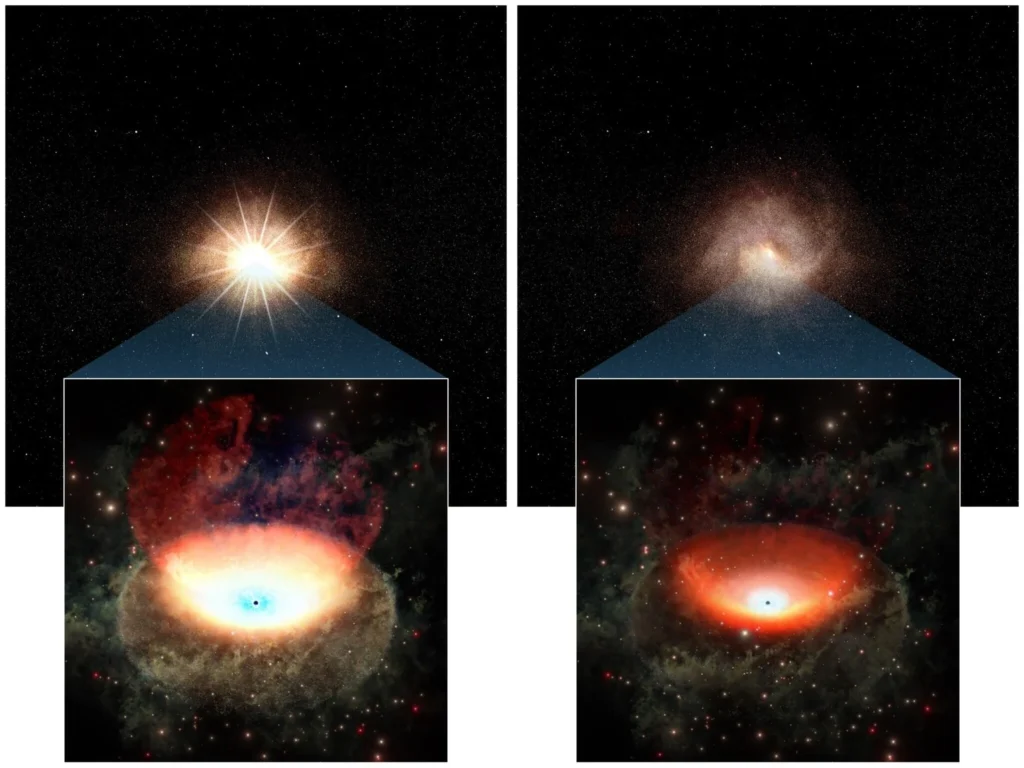
Astronomers have observed something extraordinary in a distant galaxy known as J0218-0036, located roughly 10 billion light-years away. Over just two decades, the galaxy dimmed to about one-twentieth of its original brightness, a change that typically takes millions of years in cosmic terms.
Such rapid dimming is highly unusual for galaxies, especially those powered by active galactic nuclei (AGN), which are normally stable over long periods. This unexpected behaviour has sparked new questions about how galaxies and their central black holes evolve.
What powers an active galactic nucleus?
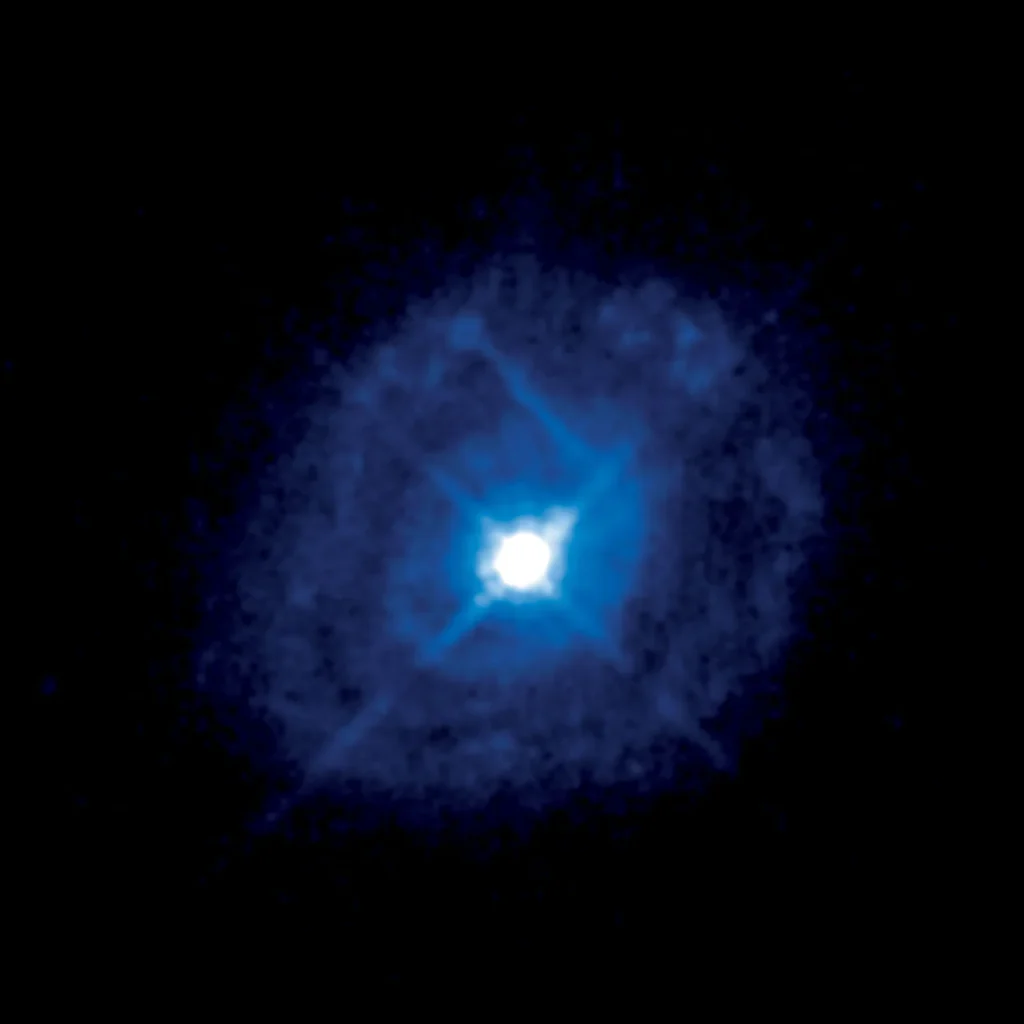
At the heart of most large galaxies lies a supermassive black hole. When surrounded by gas and dust, this black hole forms what astronomers call an active galactic nucleus.
As material spirals inward through an accretion disk, it heats up due to friction and emits enormous amounts of energy across the electromagnetic spectrum. This process is what makes AGN some of the brightest objects in the universe.
Under normal conditions, the brightness of an AGN only fluctuates slightly, depending on how much material is being consumed. Large-scale changes, however, are expected to occur over thousands to millions of years, not decades.
The surprising discovery
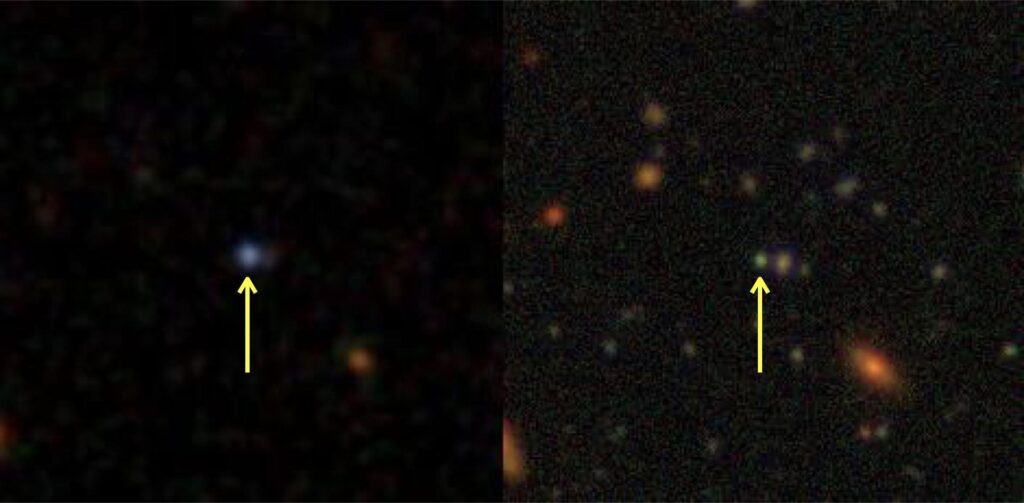
An international team of astronomers compared data from the Sloan Digital Sky Survey with more recent observations from the Subaru Telescope’s Hyper Suprime-Cam. What they found was remarkable.
The central AGN in J0218-0036 had dramatically faded between the early 2000s and 2023. This decline far exceeds the typical variability seen in similar objects, suggesting that something unusual is happening at the galaxy’s core.
By isolating the brightness of the AGN from the rest of the galaxy, researchers confirmed that the dimming was not due to the galaxy itself, but rather the activity of the supermassive black hole.
A black hole running out of fuel?
The leading explanation is surprisingly simple: the black hole may be running out of gas.
Observations show that the rate at which the black hole is consuming material dropped to about one-fiftieth of its previous level in just seven years. This sharp decline in “feeding” would naturally result in a dramatic reduction in emitted energy.
Alternative explanations, such as dust clouds blocking the light, are unlikely. Since AGN emit radiation across many wavelengths, dust would not be able to obscure all of it. This strongly suggests that the change is happening within the accretion disk itself.
Why this changes what we know about galaxies
For decades, astronomers believed that AGN brightness changed slowly over extremely long timescales. This discovery challenges that assumption.
If supermassive black holes can “switch off” this quickly, it could mean that galaxies evolve in more dynamic and unpredictable ways than previously thought. The relationship between black holes and their host galaxies may be far more complex, with periods of rapid activity and sudden dormancy.
What comes next for astronomers
Researchers are now looking to find more galaxies like J0218-0036 using wide-field surveys. By identifying additional cases of rapidly fading AGN, scientists hope to understand what causes these sudden changes.
Key questions remain:
- What disrupts the flow of gas into the accretion disk?
- Can these black holes “restart” their activity?
- How do these changes affect star formation in their galaxies?
Future observations across multiple wavelengths will be crucial in answering these questions.
A rare glimpse into cosmic change
The dimming of J0218-0036 offers a rare, real-time look at how a galaxy’s core can change dramatically over a short period.
For astronomers, this is more than just an unusual observation; it’s a clue that the universe may be far more dynamic than we once believed.