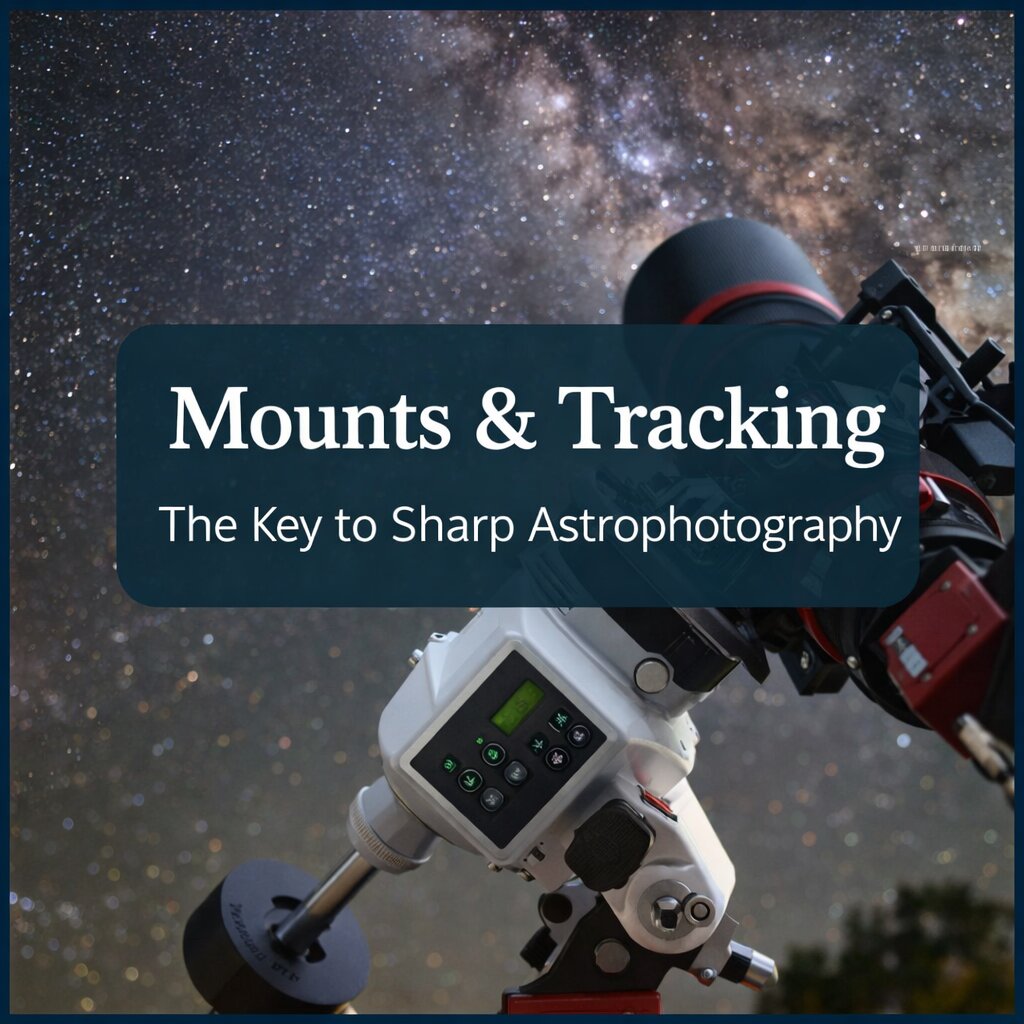

When it comes to capturing the night sky, your camera and telescope are only part of the equation. Mounts & tracking systems are the true backbone of astrophotography, allowing you to follow celestial objects smoothly as the Earth rotates. Without proper tracking, even the most advanced equipment will struggle to produce sharp, detailed images.
Whether you’re photographing the Moon, planets, or deep-sky objects like nebulae and galaxies, understanding mounts & tracking is essential. These systems ensure that your target remains centred and stable during long exposures, preventing motion blur and star trailing.
In this guide, we explore how mounts & tracking work, the different types available, and how to choose the right setup for your astrophotography journey.
Why mounts & tracking matter in astrophotography

The Earth rotates at approximately 15 degrees per hour, which means celestial objects appear to move across the sky constantly. For visual observation, this motion may not be obvious, but for long-exposure photography, it becomes a major challenge.
This is where mounts & tracking come into play. A good tracking system compensates for Earth’s rotation, keeping your subject perfectly aligned with your camera or telescope. This allows for longer exposure times, which are crucial for capturing faint objects in space.
Without effective mounts & tracking, your images will suffer from streaking stars and loss of detail. Even a few seconds of exposure can reveal movement, making tracking one of the most important aspects of astrophotography.
Types of mounts used in astronomy

There are several types of mounts used in astronomy, each suited to different needs and experience levels. Understanding these options is key to choosing the right mounts & tracking setup.
Alt-azimuth mounts are the most basic and are commonly used for beginners. They move up-down and left-right, making them easy to operate. However, they are not ideal for long-exposure astrophotography because they do not naturally compensate for Earth’s rotation.
Equatorial mounts, on the other hand, are specifically designed for tracking celestial motion. By aligning one axis with the Earth’s rotational axis, they allow for smooth and accurate tracking. These mounts are the preferred choice for serious astrophotography.
There are also computerised mounts, often referred to as GoTo mounts. These systems can automatically locate and track objects in the night sky, making mounts & tracking more accessible for beginners while still offering advanced capabilities.
Key features of effective tracking systems
Not all mounts & tracking systems are created equal. The quality of your tracking directly impacts the clarity and detail of your images, so it’s important to understand the features that matter most.
Here are some key features to look for:
- Accurate motorised tracking
- Stable and durable construction
- Payload capacity suited to your equipment
- Compatibility with guiding systems
- Ease of alignment and setup
- Software or GoTo functionality
These features ensure that your mounts & tracking system performs reliably, allowing you to focus on capturing the perfect shot.
Matching mounts & tracking to your goals
Choosing the right mounts & tracking setup depends on what you want to achieve in astrophotography. Beginners may start with simpler systems for lunar and planetary imaging, while more advanced users often require high-precision tracking for deep-sky photography.
If your goal is to capture wide-field images of the Milky Way, a portable tracking mount may be sufficient. These lightweight systems are ideal for travel and quick setups. However, for detailed images of galaxies and nebulae, a robust equatorial mount with advanced tracking capabilities is essential.
It’s also important to consider future upgrades. Investing in a system that can grow with your skills will save you time and money in the long run. Mounts & tracking should be seen as a long-term investment in your astrophotography journey.
Enhancing results with guiding and alignment
For those looking to take their imaging to the next level, guiding systems and precise alignment play a crucial role. Even the best mounts & tracking systems benefit from additional fine-tuning.
Polar alignment ensures that your mount is accurately aligned with the Earth’s axis, which is essential for precise tracking. Small errors in alignment can lead to drift over time, affecting image quality.
Autoguiding systems use a secondary camera to monitor a reference star and make real-time adjustments. This improves tracking accuracy and allows for longer exposures, especially when capturing faint deep-sky objects.
By combining good mounts & tracking with proper alignment and guiding, you can significantly enhance the quality of your astrophotography.
Building your astrophotography foundation
Mastering mounts & tracking is one of the most important steps in becoming a successful astrophotographer. While cameras and optics often get the most attention, it’s the mount that determines how well your system performs.
By understanding the different types of mounts, key features, and advanced techniques, you can make informed decisions that improve your results. Whether you’re just starting out or looking to upgrade your setup, investing in the right mounts & tracking system will set the foundation for everything you capture in the night sky.
With the right equipment and knowledge, the universe is yours to explore—one perfectly tracked image at a time.