NASA’s Artemis II mission continues to progress smoothly, with a key milestone now completed in orbit. The Orion spacecraft has successfully performed its perigee raise burn, refining its trajectory as the crew prepares for the next major phase of the mission.
This update marks another important step in humanity’s return to deep space exploration.
A successful launch into history
The Artemis II mission launched on 1 April 2026 aboard NASA’s Space Launch System (SLS), carrying four astronauts on a historic journey around the Moon. This is the first crewed mission beyond low Earth orbit since the Apollo era.
Commander Reid Wiseman, Pilot Victor Glover, Mission Specialist Christina Koch, and Canadian astronaut Jeremy Hansen are currently aboard the Orion spacecraft, named Integrity by the crew.
The mission is expected to last around 10 days, taking the crew on a free-return trajectory around the Moon before splashing down back on Earth.
Perigee raise burn completed
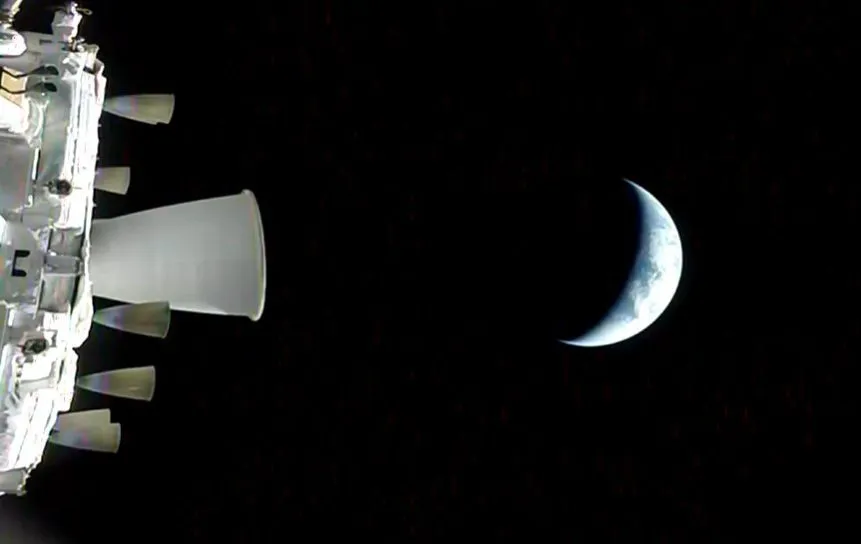
In the early hours of the mission, Orion completed its perigee raise burn, a crucial orbital adjustment. The spacecraft’s main engine fired for 43 seconds, raising the lowest point of its orbit and refining its path around Earth.
This manoeuvre placed Orion into a stable high Earth orbit, aligning it with the trajectory needed for its upcoming journey toward the Moon.
Following the burn, the crew returned to a scheduled rest period, while mission teams continue monitoring systems and performance.
Preparing for translunar injection
The next major milestone for Artemis II is the translunar injection burn. This engine firing will push Orion out of Earth orbit and onto a trajectory toward the Moon.
If approved by mission management, the burn is scheduled to last nearly six minutes and will significantly increase the spacecraft’s velocity, sending the crew into deep space for the first time in over 50 years.
Flight controllers will closely monitor navigation, propulsion, and guidance systems to ensure a precise outbound path.
Mission objectives and journey ahead
Artemis II is not a landing mission, but it plays a critical role in preparing for future lunar exploration. The crew will test life-support systems, navigation, and spacecraft performance in deep space conditions.
The Orion spacecraft is expected to reach the Moon around day six of the mission, performing a flyby before returning to Earth.
During the journey, astronauts will travel farther from Earth than any human crew since Apollo, gathering valuable data for upcoming missions.
Early mission highlights and challenges
The mission has already delivered historic milestones, including the first woman and first person of colour travelling toward the Moon, as well as the first Canadian astronaut on such a mission.
Like all space missions, Artemis II has also faced minor challenges. Early in the flight, the crew worked with ground control to resolve an issue with the spacecraft’s onboard toilet system, highlighting the realities of living in space.
These moments provide valuable insights into long-duration human spaceflight.
A step toward the future
Artemis II represents a major step in NASA’s long-term plans for lunar exploration and beyond. The mission is designed to pave the way for future crewed landings and eventually human missions to Mars.
By testing systems in real conditions, Artemis II ensures that future missions will be safer and more capable.
As Orion continues its journey, all eyes remain on the mission as humanity once again ventures deeper into space.