
Space exploration constantly pushes the boundaries of science, engineering, and material technology. One of the biggest challenges facing astronauts, satellites, spacecraft, and advanced electronics is radiation exposure. From cosmic radiation in deep space to electromagnetic interference between onboard systems, radiation can damage sensitive technology and pose serious health risks to humans working in the space industry.
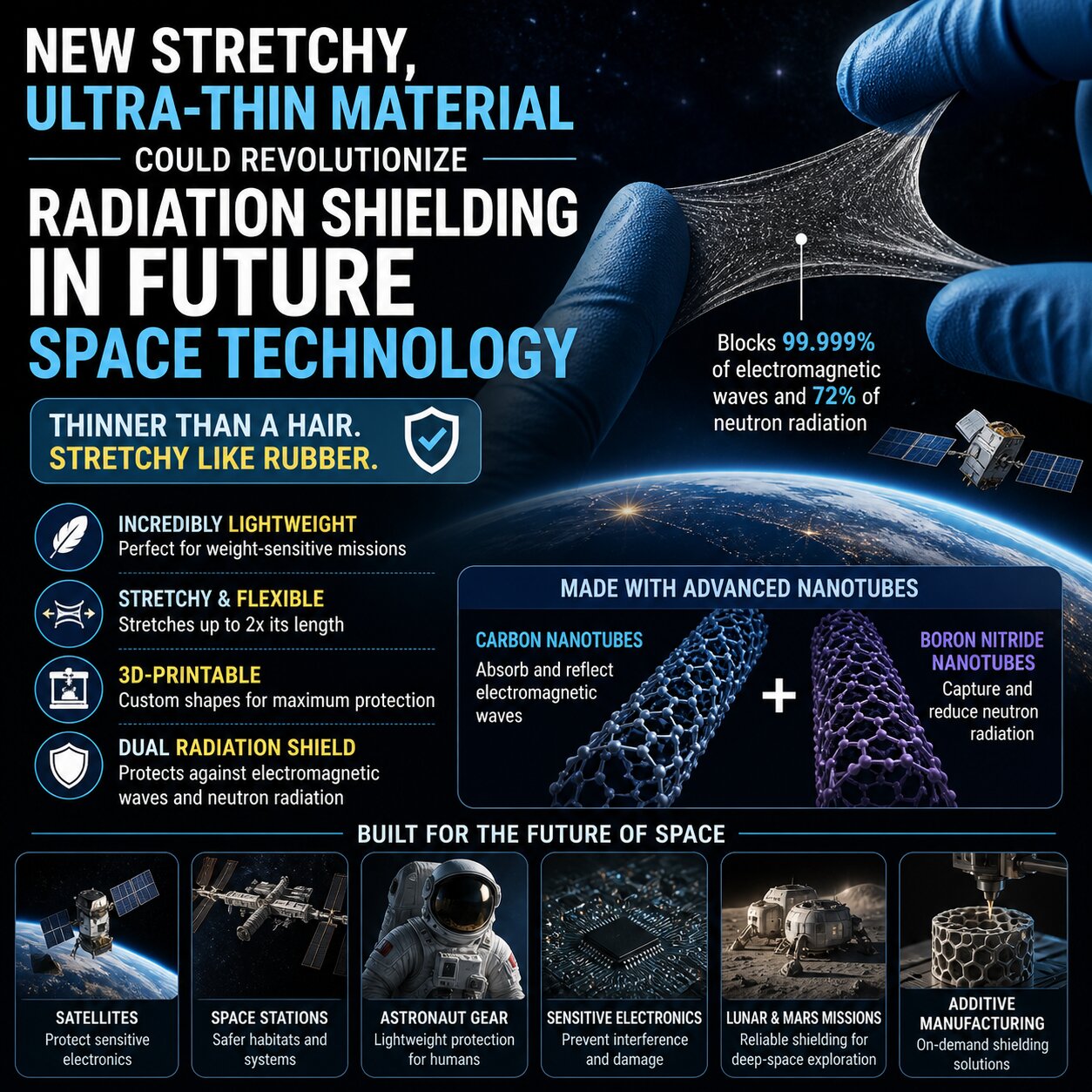
Now, researchers have developed a fascinating new material that could dramatically improve radiation protection for future space missions. According to a newly published study, the material is thinner than a human hair, stretches like rubber, and can even be 3D-printed into different shapes for enhanced shielding performance.
The breakthrough could eventually help protect astronauts, satellites, space stations, semiconductors, and future deep-space technologies while reducing the overall weight of spacecraft. In an industry where every gram matters during launch, lightweight protection systems are extremely valuable.
Why Radiation Is Such A Major Problem In Space
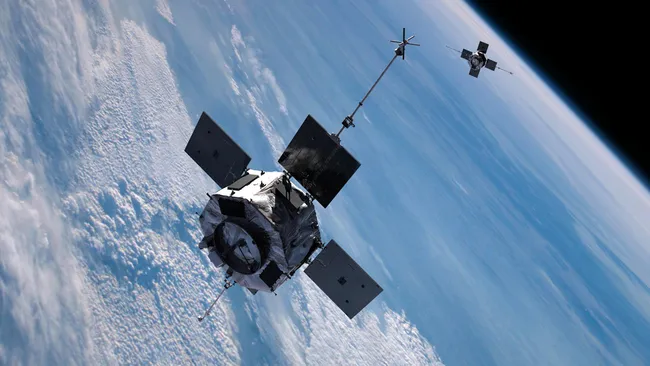
Radiation remains one of the most dangerous obstacles in human space exploration. Outside Earth’s protective atmosphere and magnetic field, astronauts are exposed to high-energy particles from the Sun and deep space that can damage cells, increase cancer risks, and interfere with electronics.
However, space radiation is not the only concern. Many technologies used in spaceflight also generate different forms of radiation themselves. Spacecraft systems, semiconductors, medical devices, power systems, and communication technologies can all emit electromagnetic radiation or neutron radiation that may interfere with nearby equipment.
This creates a complicated challenge for engineers designing future spacecraft and orbital infrastructure. Sensitive systems must be protected without adding excessive weight, bulk, or rigidity to the spacecraft itself.
Radiation shielding has traditionally relied on heavier materials, but launching heavy payloads into space significantly increases mission costs and complexity.
The New Material Is Thin, Stretchy And Extremely Lightweight
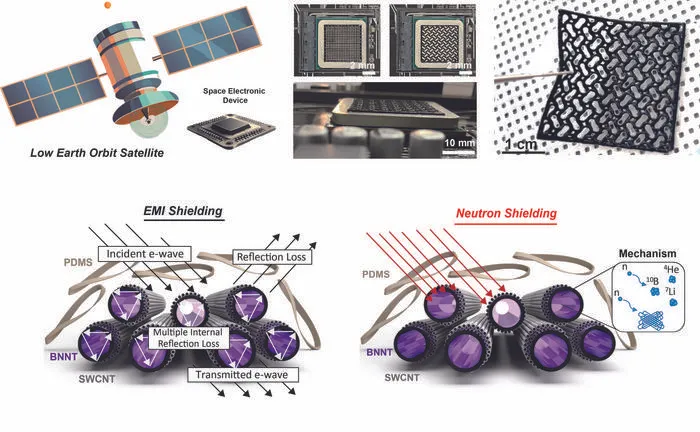
Researchers at the Korea Institute of Science and Technology developed the new material using a combination of carbon nanotubes and boron nitride nanotubes. Together, these materials create a flexible shielding system capable of blocking both electromagnetic waves and neutron radiation.
Carbon nanotubes help absorb and reflect electromagnetic waves while remaining highly conductive. Boron nitride nanotubes, meanwhile, are especially effective at capturing neutrons. When combined, the material reportedly blocks an incredible 99.999% of electromagnetic waves and around 72% of neutron radiation.
Lead author Joo Yong-ho described the technology as a completely new concept in shielding systems because it combines flexibility, lightweight design, and high radiation resistance in a material as thin as tape.
Perhaps even more impressive is the material’s flexibility. It can stretch to double its original length without losing functionality, opening possibilities for flexible wearable equipment, curved spacecraft components, or adaptable shielding structures.
3D Printing Could Unlock New Spacecraft Designs
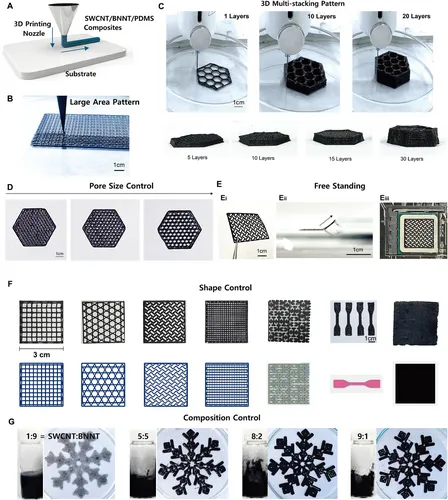
One of the most exciting aspects of this new material is its compatibility with 3D printing technology. Researchers experimented with different structural patterns and discovered that honeycomb-shaped designs improved radiation shielding performance by roughly 15%.
This flexibility could allow engineers to create highly customised shielding solutions tailored for different spacecraft systems, habitats, satellites, or astronaut equipment. Future missions may use advanced 3D printers to produce specialised protective structures directly during manufacturing or even potentially in space itself.
The ability to create lightweight, flexible, and highly efficient shielding materials could become increasingly important as humanity prepares for more ambitious missions to the Moon, Mars, and beyond.
Space agencies are already exploring self-healing materials, inflatable habitats, advanced composites, and modular spacecraft designs. Flexible radiation shielding could become another critical piece of next-generation space infrastructure.
Future Applications Could Go Beyond Space Exploration
While the study focuses heavily on space-related applications, the technology may also benefit industries here on Earth. Radiation shielding plays an important role in medical equipment, nuclear facilities, semiconductor manufacturing, and advanced electronics.
Lightweight flexible shielding could eventually improve safety equipment for technicians, engineers, healthcare workers, and industrial environments where radiation exposure remains a concern.
In the space sector specifically, the potential applications are enormous. Future versions of the material may help protect:
- Satellites
- Space stations
- Deep-space habitats
- Space suits
- Lunar infrastructure
- Mars mission equipment
- Sensitive onboard electronics
- Astronaut protective gear
As spacecraft become more advanced and missions travel farther from Earth, efficient radiation shielding technologies will become increasingly important for both human survival and system reliability.
A Glimpse Into The Future Of Space Materials
The development of this ultra-thin radiation shielding material highlights how rapidly space technology continues evolving. Modern space exploration is no longer driven only by rockets and engines. Advanced materials science is becoming one of the most important fields shaping the future of human expansion into space.
Flexible, lightweight shielding materials could eventually reduce launch costs, improve astronaut safety, and allow spacecraft to carry more scientific equipment instead of heavier protective systems. Combined with 3D printing and modular spacecraft construction, innovations like this may help pave the way for longer and more ambitious missions throughout the solar system.
While the technology is still in the research stage, it offers another exciting glimpse into how future spacecraft and space habitats may become smarter, lighter, safer, and more adaptable in the years ahead.