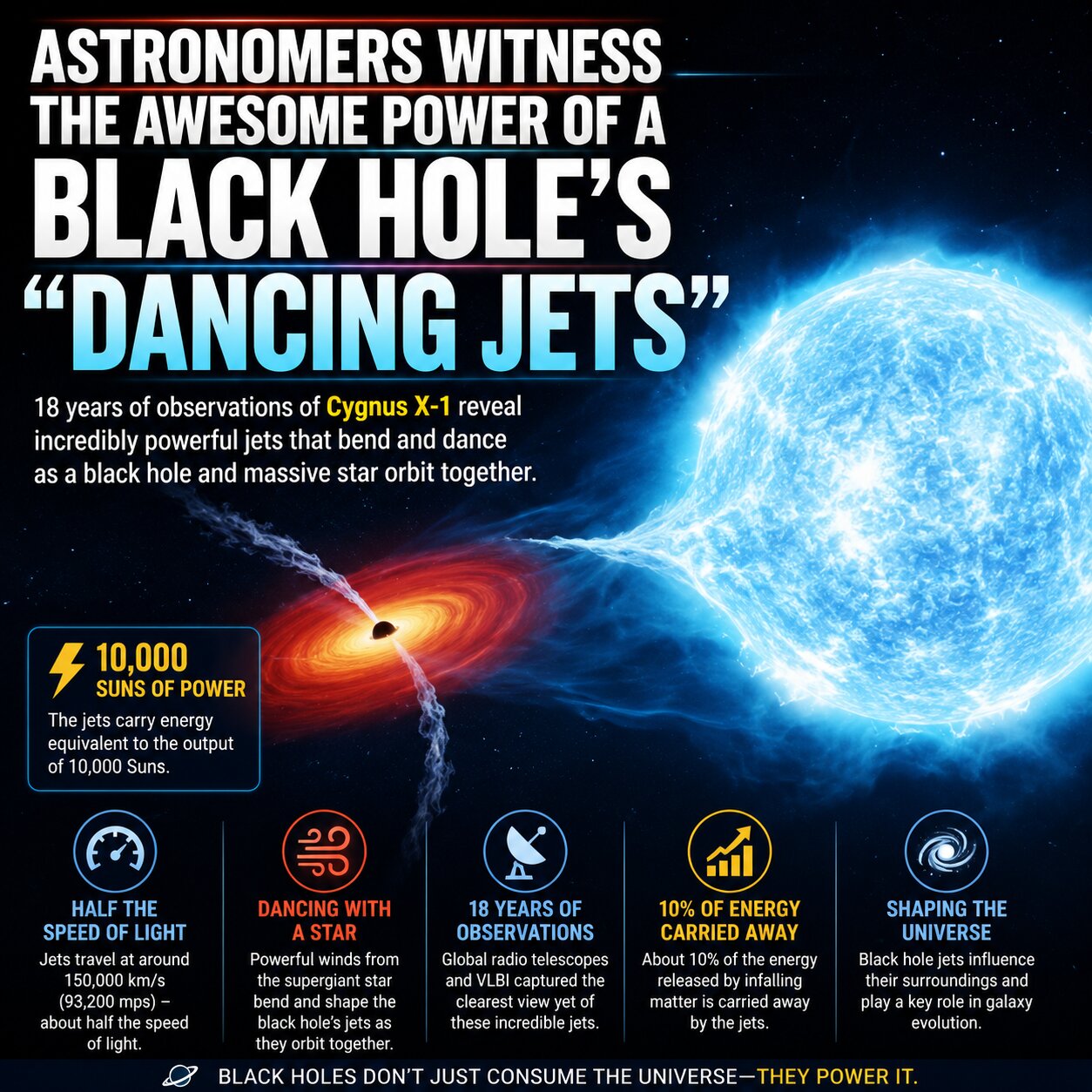

Astronomers have once again uncovered breathtaking new details about the violent and energetic nature of black holes. In a recent study focusing on the famous Cygnus X-1 system, researchers observed powerful “dancing jets” blasting away from a black hole at extraordinary speeds while being pushed and bent by stellar winds from a nearby supergiant companion star.
Cygnus X-1 holds an important place in astronomy because it was the first confirmed binary system containing a black hole and a massive star. Located thousands of light-years from Earth, the system has fascinated scientists for decades due to its extreme behaviour and immense energy output.
The latest observations used nearly 18 years of high-resolution radio imaging data to study how the black hole’s jets interact with the environment around them. These jets are streams of highly energetic particles launched from the regions surrounding the black hole, moving at speeds approaching half the speed of light.
Researchers discovered that the power carried within these jets is equivalent to the energy output of approximately 10,000 Suns, highlighting just how influential black holes can be on the structure and evolution of galaxies.
What Causes Black Hole Jets?
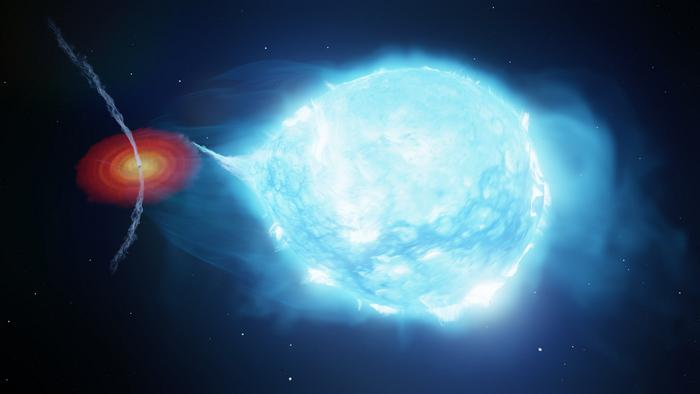
Black holes themselves do not directly emit light because their gravity is so powerful that not even light can escape once it crosses the event horizon. However, the regions surrounding black holes are often among the brightest and most energetic environments in the universe.
As gas and dust fall towards the black hole, they form a rapidly spinning accretion disc. Friction and magnetic forces within this disc heat the material to incredible temperatures while accelerating some particles away from the black hole’s poles in the form of narrow jets.
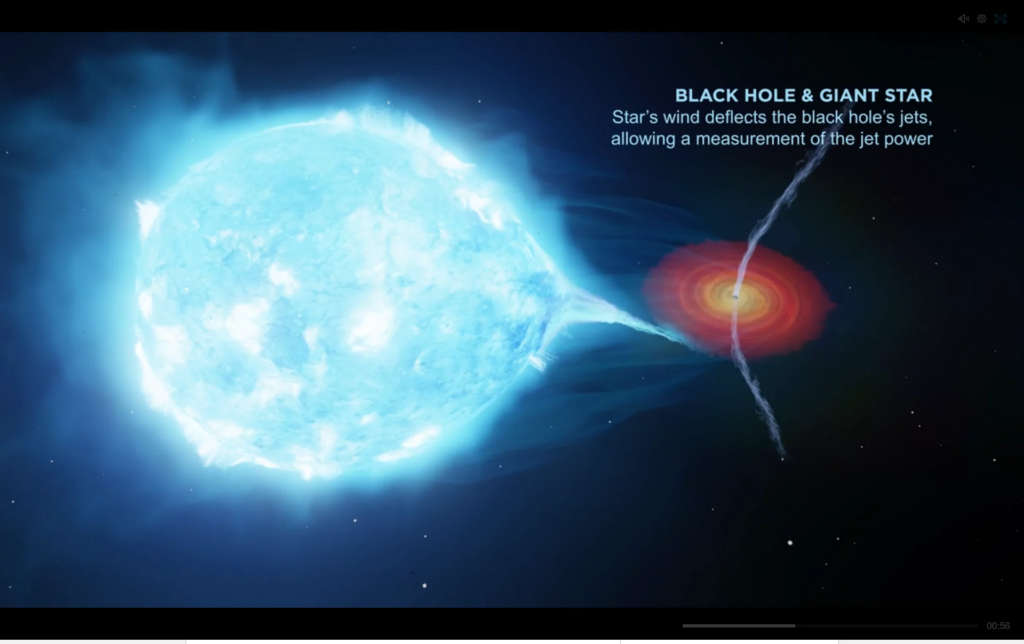
These jets can travel enormous distances across space and strongly influence nearby cosmic environments. In the case of Cygnus X-1, the jets are constantly being distorted by the powerful stellar wind flowing from the companion supergiant star, creating the appearance of “dancing” motion as the system orbits.
The research team used Very Long Baseline Interferometry, or VLBI, to combine data from radio telescope arrays across Earth. This technique effectively creates a planet-sized virtual telescope capable of observing fine details in distant cosmic systems.
Key Discoveries From the Research
The long-term study of Cygnus X-1 allowed scientists to make several major discoveries about black hole jet behaviour and energy transfer.
Important findings from the research include:
- The jets carry away roughly 10% of the energy released by infalling matter
- Jet speeds reach around 150,000 km/s
- The jets move at approximately half the speed of light
- Stellar winds from the companion star visibly bend the jets
- Black hole jets strongly influence surrounding space environments
- The observations help confirm long-standing astrophysical theories
One of the most important breakthroughs involved directly measuring the jet power through observation rather than relying mainly on theoretical modelling. Scientists have long assumed that black hole jets transfer large amounts of energy into surrounding space, but confirming these values observationally has remained difficult.
The study now provides an important calibration point for understanding how black holes of different sizes behave across the universe.
Why This Matters for Astronomy
Black hole jets are not simply fascinating visual phenomena. They play a major role in shaping galaxies, influencing star formation, and redistributing enormous amounts of energy throughout space.
By understanding how much energy black hole jets release and how they interact with surrounding matter, astronomers can improve large-scale models of galaxy evolution and cosmic structure formation.
The findings are especially important as new radio astronomy facilities continue to expand observational capabilities. Projects such as the Square Kilometre Array Observatory, currently under construction in South Africa and Australia, are expected to detect jets from millions of distant black holes in the future.
These new observations from Cygnus X-1 help provide a reliable reference point that scientists can use to estimate jet power in more distant systems. As future telescopes begin collecting even more detailed data, our understanding of black holes and their influence on the universe is likely to grow dramatically.
The study also reinforces how interconnected cosmic systems truly are. Even objects as destructive and mysterious as black holes remain deeply influenced by the stars, gas, and environments surrounding them.
Black Holes Continue to Surprise Us
The discovery of Cygnus X-1’s powerful “dancing jets” reminds us that black holes are far more than simple cosmic vacuum cleaners. They are dynamic engines capable of reshaping entire regions of space through immense energy and complex interactions.
As astronomers continue studying these extraordinary systems, each new discovery reveals more about how black holes help shape the structure and evolution of the universe itself. With next-generation observatories coming online in the near future, humanity may soon witness even more astonishing cosmic phenomena hidden deep within the darkness of space.