
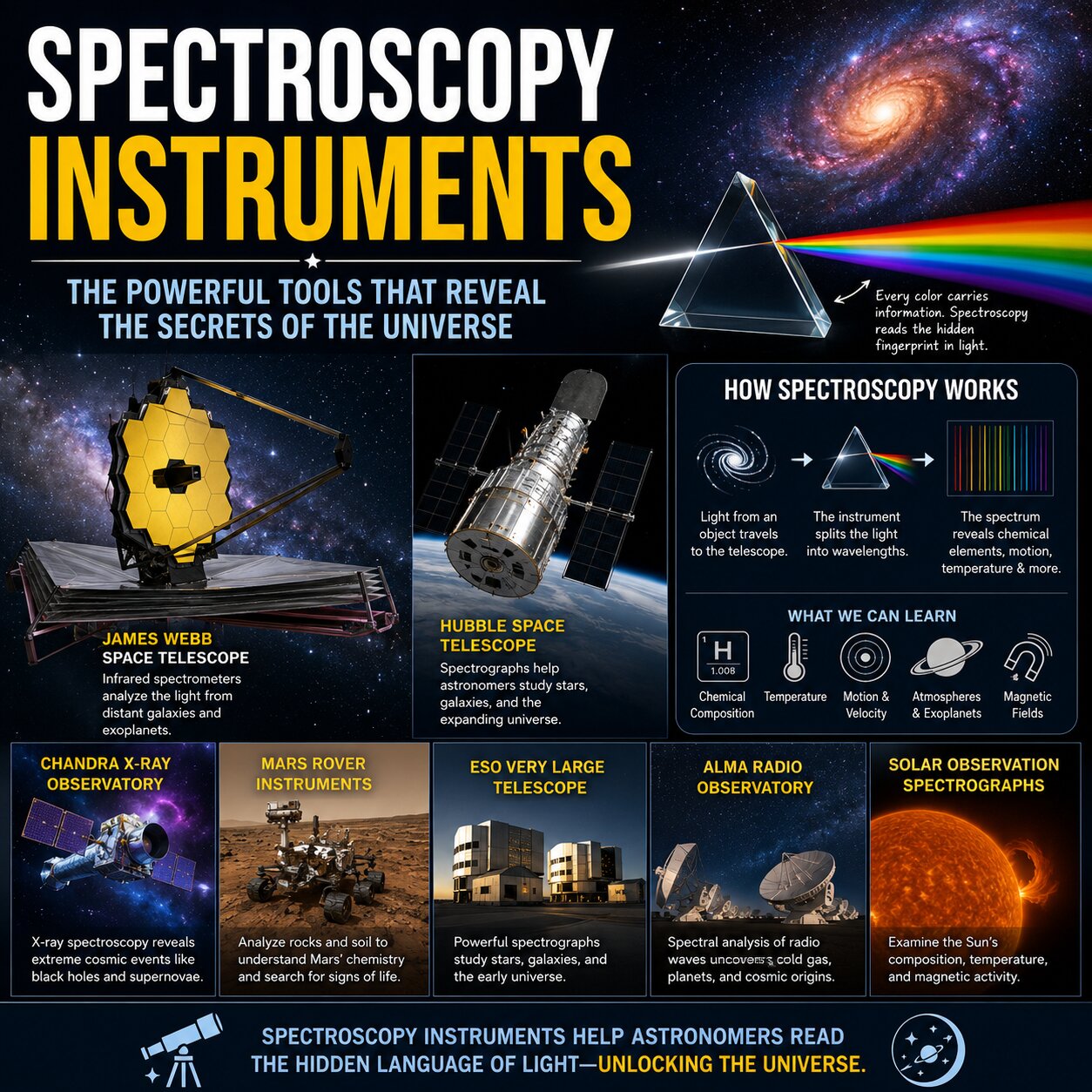

When astronomers want to understand what stars, planets, nebulae, or galaxies are made of, they often rely on spectroscopy instruments. These highly specialised scientific tools allow researchers to analyse light coming from distant objects in space and uncover information that would otherwise remain invisible to the human eye.
Spectroscopy instruments play a critical role in modern astronomy and space exploration. Instead of simply capturing images, they break light into detailed spectra, revealing the chemical composition, temperature, movement, magnetic activity, and even atmospheric conditions of celestial objects.
Many of the most famous observatories and space agencies, including NASA and the European Space Agency, use advanced spectroscopy instruments on telescopes, satellites, and planetary missions. Without them, scientists would know far less about the universe and how it functions.
For casual astronomy enthusiasts, spectroscopy may initially sound extremely technical. However, the basic concept is surprisingly easy to understand once light itself becomes the focus of the discussion.
How spectroscopy instruments work
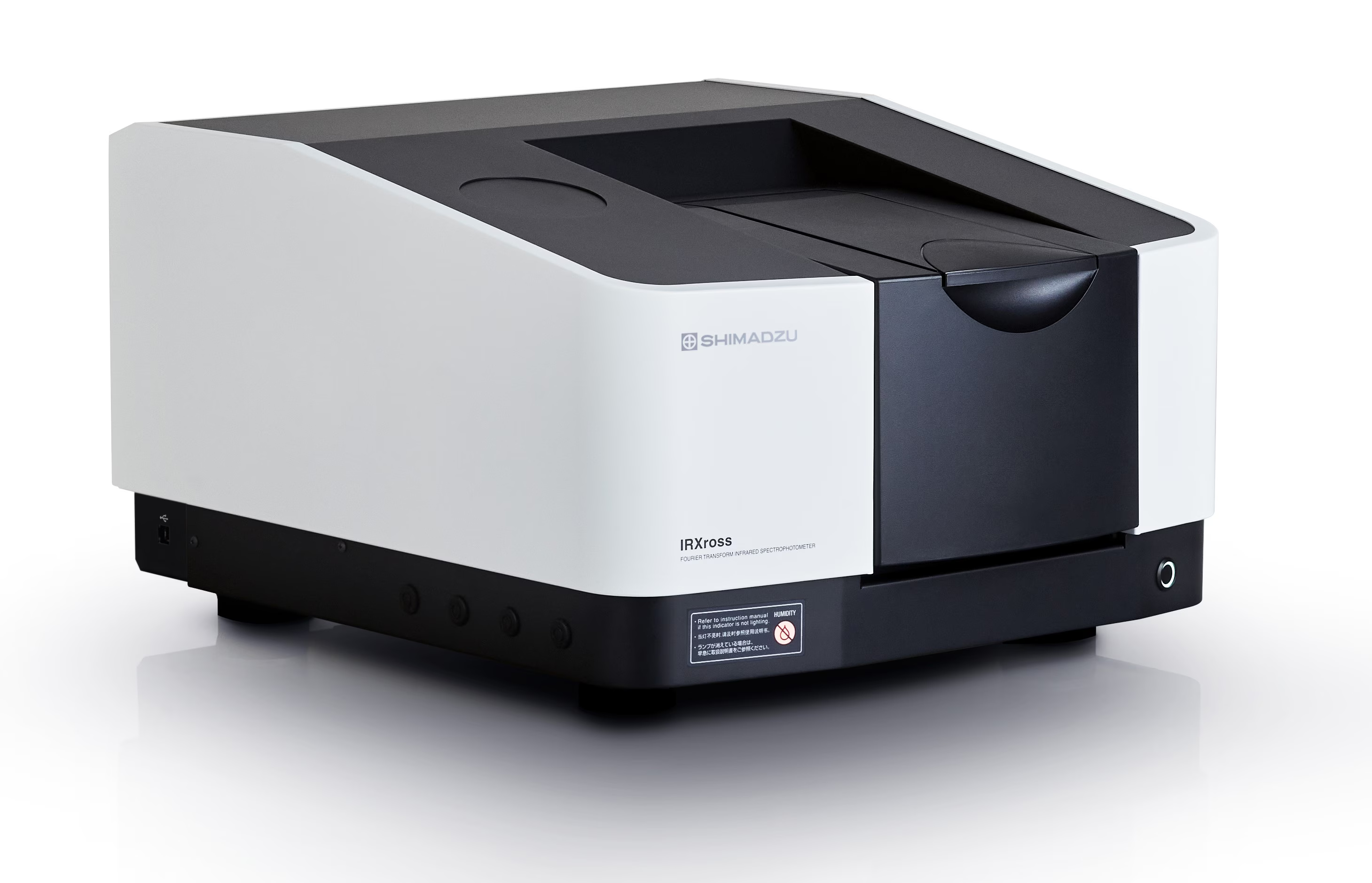
At their core, spectroscopy instruments analyse light by separating it into different wavelengths or colours. This process works similarly to how a prism splits white light into a rainbow. Each chemical element produces a unique pattern within light, almost like a cosmic fingerprint.
When astronomers observe distant stars or galaxies, spectroscopy instruments allow them to detect these fingerprints and determine which elements are present. Hydrogen, helium, oxygen, carbon, sodium, and many other elements can all be identified through their spectral signatures.
These instruments also help scientists measure motion in space. If an object moves toward or away from Earth, its light shifts slightly through what is known as the Doppler Effect. By studying these shifts, astronomers can calculate the speed of stars, galaxies, and even orbiting exoplanets.
Temperature can also be determined using spectroscopy. Hotter objects emit different light patterns compared to cooler ones, allowing researchers to estimate surface temperatures and atmospheric conditions across vast cosmic distances.
Famous spectroscopy instruments used in astronomy
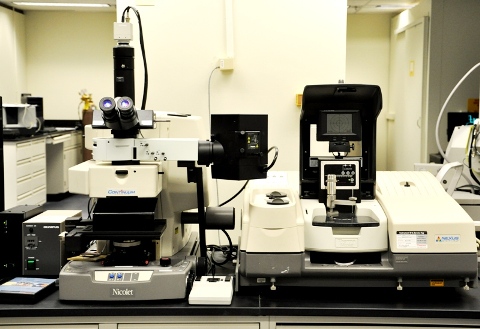
Some of the world’s most advanced observatories rely heavily on spectroscopy instruments to support scientific discoveries across the universe.
Well-known examples include:
- The James Webb Space Telescope spectrometers
- Hubble Space Telescope spectrographs
- NASA’s Chandra X-ray Observatory instruments
- Spectrometers aboard Mars rovers
- ESO Very Large Telescope spectroscopy systems
- ALMA radio observatory spectral analysers
- Solar observation spectrographs
- Planetary atmosphere analysis instruments
- Infrared spectroscopy systems for exoplanet research
The James Webb Space Telescope, for example, uses sophisticated infrared spectroscopy instruments to study the atmospheres of distant exoplanets and investigate the earliest galaxies formed after the Big Bang. These tools help scientists search for water vapour, methane, carbon dioxide, and other important compounds.
Mars missions also rely on spectroscopy instruments to analyse rocks, soil, and atmospheric chemistry. By studying reflected light and chemical signatures, scientists can better understand whether ancient Mars may once have supported life.
Why spectroscopy instruments are so important
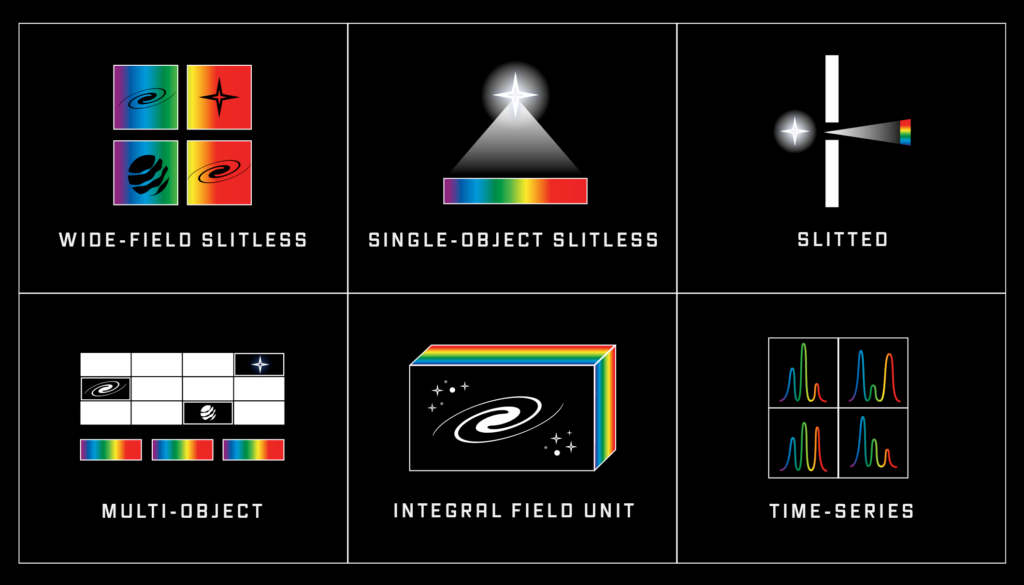
While photographs from telescopes are visually stunning, spectroscopy instruments provide much deeper scientific insight. Images show what an object looks like, but spectroscopy reveals what it actually is and how it behaves.
Without spectroscopy, astronomers would struggle to identify the composition of stars or determine how galaxies move throughout the universe. Many discoveries involving black holes, dark matter, stellar evolution, and planetary atmospheres depend heavily on spectroscopic analysis.
Spectroscopy instruments are also essential in the search for potentially habitable exoplanets. Scientists can examine how starlight changes as it passes through a planet’s atmosphere, allowing them to search for gases that may indicate biological activity or suitable environmental conditions.
As telescope technology continues advancing, spectroscopy instruments are becoming increasingly sensitive and capable of analysing fainter and more distant objects than ever before.
Reading The Hidden Language Of Light
Spectroscopy instruments remain some of the most powerful scientific tools ever developed for astronomy. By studying the hidden information contained within light, scientists can uncover the chemistry, motion, temperature, and history of objects located billions of light-years away.
For casual astronomy enthusiasts, understanding spectroscopy opens the door to appreciating how researchers truly explore the universe beyond beautiful images alone.

