
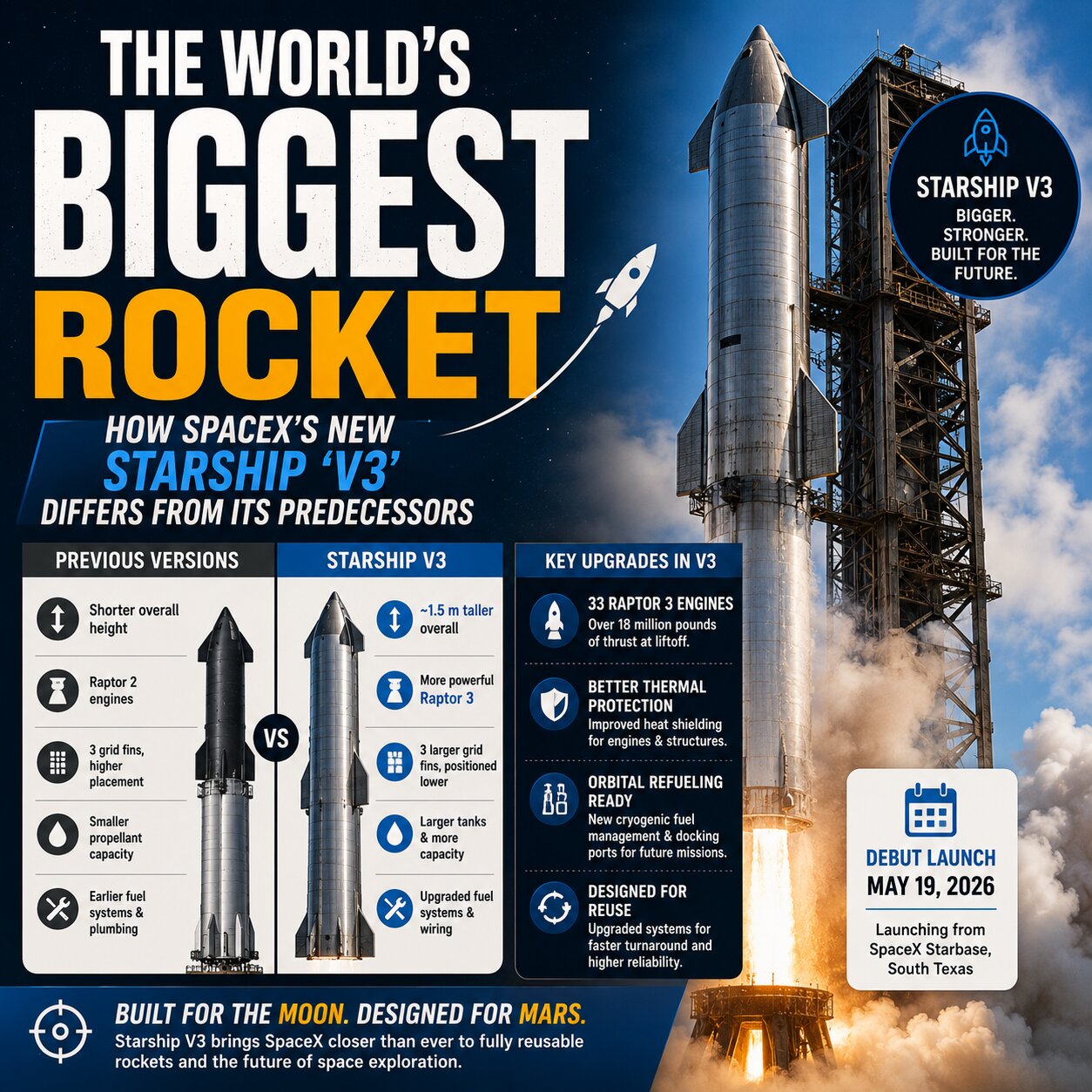

SpaceX is preparing for the next major evolution of its massive Starship rocket system with the upcoming debut of Starship V3. Following years of testing, explosive failures, engineering improvements, and rapid development, the company’s newest version of the world’s largest rocket represents a major leap forward for future space exploration.
The new Starship V3 is expected to launch on 19 May 2026 from SpaceX’s Starbase facility in South Texas. According to recent reports, the upgraded rocket is more powerful, more efficient, and more capable than its predecessors, bringing the company closer to achieving a fully reusable launch system capable of supporting lunar missions, Mars exploration, and rapid orbital operations.
While Starship has already completed multiple test flights since its first integrated launch in April 2023, Version 3 introduces extensive design changes to both the Super Heavy booster and the Ship upper stage. These upgrades aim to improve reliability, payload capability, and long-term reusability.
Starship V3 is larger and more powerful
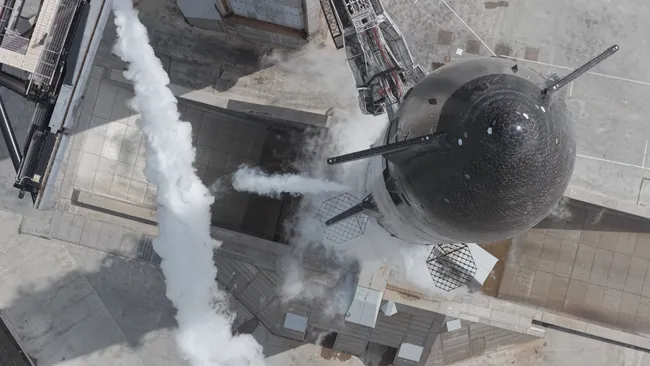
One of the first major differences with Starship V3 is its increased size and performance. The new rocket stands around 1.5 metres taller than previous versions and delivers significantly more thrust during launch.
Both the Super Heavy booster and Ship upper stage now use the upgraded Raptor 3 engines. These new engines are designed to be more powerful, streamlined, and reliable compared to the earlier Raptor 2 models. The Super Heavy stage alone uses 33 Raptor 3 engines capable of generating over 18 million pounds of thrust during liftoff.
SpaceX has also redesigned the fuel systems and engine support structures to improve ignition reliability and thermal protection. The fuel transfer tube inside the booster is now substantially larger, helping support faster and more efficient engine ignition sequences during both launch and landing operations.
These upgrades are important because SpaceX intends Starship to operate at extremely high launch frequencies in the future. Improving reliability and turnaround times remains critical to the company’s long-term plans.
Improved landing and reusability systems
Reusable rockets are central to SpaceX’s strategy, and Starship V3 includes several major changes designed to improve recovery operations. The Super Heavy booster now features larger grid fins positioned lower on the vehicle to reduce heat exposure during hot-stage separation procedures.
Hot staging occurs when the Ship upper stage ignites its engines before fully separating from the booster. This creates intense thermal stress, which forced engineers to redesign several systems for Version 3. SpaceX also modified the hot stage ring configuration to improve structural integration during flight.
The aft section of the booster has received additional thermal protection and tighter integration between fuel, computer, and power systems. These improvements aim to increase reliability during both ascent and landing burns.
Reusability remains one of the biggest challenges in modern rocketry. Every successful landing and reuse reduces launch costs while improving the viability of large-scale missions to the Moon and Mars.
The Ship upper stage receives major upgrades
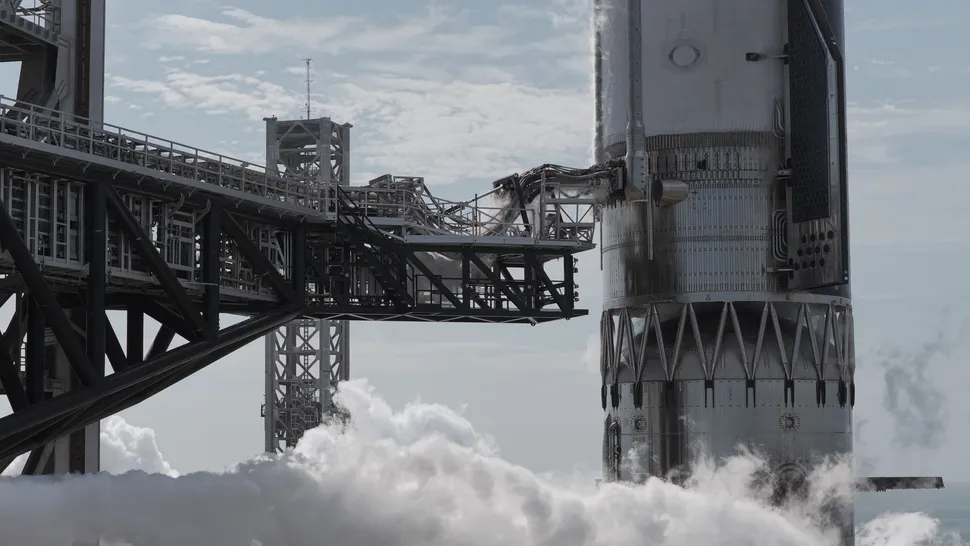
The Ship upper stage has also undergone significant redesign work. SpaceX introduced larger propellant tanks, improved plumbing systems, upgraded wiring layouts, and an enhanced reaction control system for better manoeuvrability in space.
Perhaps the most important addition is the new cryogenic fuel management system. SpaceX added dedicated hardware and docking ports to support future orbital refuelling missions, a critical requirement for deep-space operations.
Orbital refuelling will allow Starship spacecraft to transfer fuel between vehicles while in space. This capability is considered essential for long-duration lunar and Mars missions because Starship cannot carry enough fuel at launch to complete all mission phases without refuelling.
The system has not yet been fully demonstrated, making it one of the most important milestones SpaceX must achieve in the coming years.
Why Starship V3 matters for NASA’s Artemis programme
NASA is relying heavily on Starship for its future Artemis lunar missions. SpaceX is one of the companies contracted to provide a lunar landing system capable of transporting astronauts from lunar orbit to the Moon’s surface.
Before astronauts can fly aboard Starship, the company must demonstrate several major capabilities. These include orbital refuelling, uncrewed lunar landings, safe returns to orbit, and reliable docking operations with the Orion spacecraft.
NASA is currently targeting Artemis 3 for late 2027 and Artemis 4 for late 2028, although timelines remain flexible depending on spacecraft readiness.
Because of these deadlines, the first Starship V3 launch carries enormous importance. A successful mission would help validate several key technologies needed for future crewed lunar exploration.
Planned objectives for the first Starship V3 flight
The debut mission for Starship V3 includes a long list of test objectives designed to push the vehicle far beyond earlier versions.
- Deployment of 22 Starlink mass simulator payloads
- Heat tile performance testing during re-entry
- In-space relight testing of a Raptor 3 engine
- Re-entry manoeuvre stress testing
- Offshore splashdown landings for both stages
- Testing improved thermal protection systems
- Demonstrating upgraded flight hardware
SpaceX also plans to use onboard cameras to inspect the underside heat shield tiles during flight, helping engineers analyse damage or tile loss during atmospheric re-entry.
A giant step toward the future of space travel
Starship V3 represents one of the most ambitious rocket upgrades ever attempted in such a short development cycle. With more power, improved reusability systems, enhanced orbital refuelling capabilities, and deeper integration into NASA’s Artemis plans, the vehicle moves SpaceX closer to transforming how humanity travels beyond Earth.
The upcoming launch will likely become one of the most closely watched spaceflight events of 2026. If successful, Starship V3 could mark another major turning point in the push toward reusable heavy-lift rockets, lunar exploration, and eventually human missions to Mars.

